



Question: What happened here? why? What advice do you have for senior management? Northwest Industries was a growing company that manufac- tured recreational vehicles. One of
What happened here? why? What advice do you have for senior management?
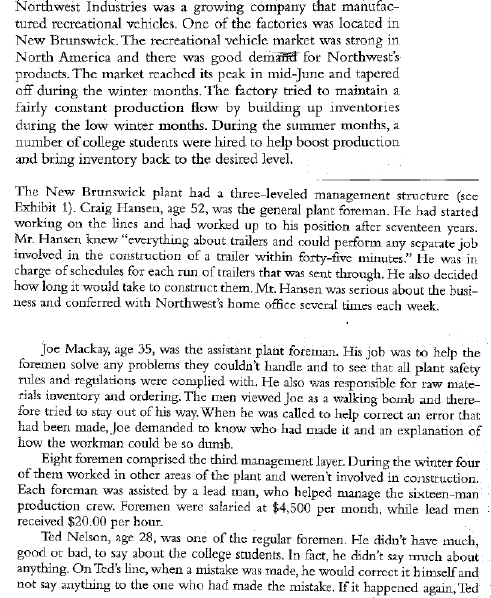
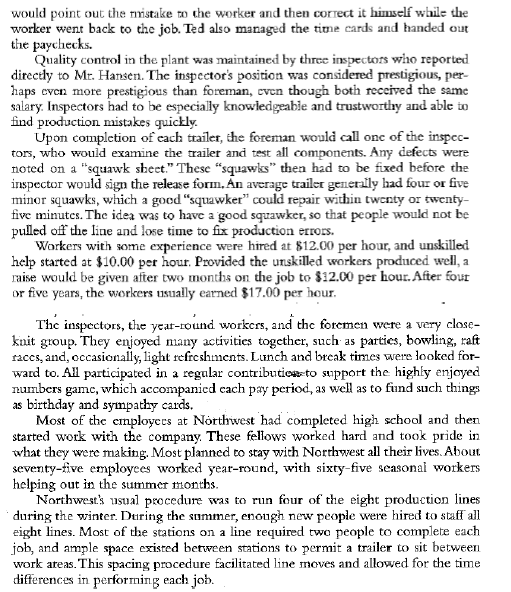
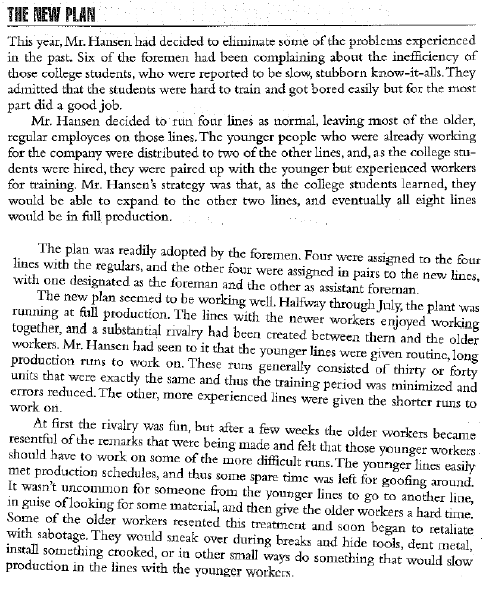
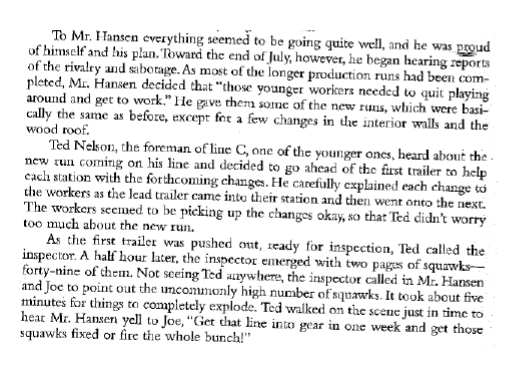
Northwest Industries was a growing company that manufac- tured recreational vehicles. One of the factories was located in New Brunswick. The recreational vehicle market was strong in North America and there was good demand for Northwest's products. The market reached its peak in mid-June and tapered off during the winter months. The factory tried to maintain a fairly constant production flow by building up inventories during the low winter months. During the summer months, a number of college studerlts were hired to help boost production and bring inventory back to the desired level. The New Brunswick plant had a three-leveled management structure (sce Exhibit 1). Craig Hansen, age 52, was the general plant foreman. He had started working on the lines and had worked up to his position after seventeen years. Mt. Hansen knew "everything about trailers and could perform any sepatute job involved in the construction of a trailer within forty-five mitutes." He was in charge of schedules for each run of trailers that was sent through. He also decided how long it would take to construct them. Mt. Hansen was serious about the busi- ness and conferred with Northwest's home office several times each week. Joe Mackay, age 35, was the assistant plait foretan. His job was to help the foremen solve any problems they couldn't handle and to see that all plant safety rules and regulations were complied with. He also was responsible for raw mate- rials inventory and ordering. The men viewed Joe as a walking bomb and there- fore tried to stay out of his way. When he was called to help correct an error that had been made, Joe demanded to know who had made it and an explanation of how the workman could be so dumb. Eight foremen comprised the third management layer. During the winter four of them worked in other areas of the plant and weren't involved in construction. Each forcman was assisted by a lead man, who helped manage the sixteen-man production crew. Foremen were salaried at $4,500 per month, while lead men received $20.00 per hour. Ted Nelson, age 28, was one of the regular foremen. He didn't have much, good or bad, to say about the college students. In fact, he didn't say much about anything. On Ted's linc, when a mistake was made, he would correct it himself and not say anything to the one who had made the mistake. If it happened again, Ted would point out the ministake to the worker and then correct it himself while the worker went back to the job. Ted also managed the time cards and handed out the paychecks. Quality control in the plant was maintained by three inspectors who reported directly to Mr. Hansen. The inspector's position was considered prestigious, per- haps even more prestigious than foreman, even though both received the same salary. Inspectors had to be especially knowledgeabie and trustworthy and able to find production mistakes quickly Upon completion of each trailer, the foreman would call one of the inspec- tors, who would examine the trailer and test all components. Any defects were noted on a "squawk sheet." These "squawks" then had to be fixed before the inspector would sign the release form. An average trailer generally had four or five minor squawks, which a good "squawker" could repair within twenty or twenty- five minutes. The idea was to have a good squawker, so that people would not be pulled off the line and lose time to fix production errors. Workers with some experience were hired at $12.00 per hour, and unskilled help started at $10.00 per hour. Provided the unskilled workers produced well, a raise would be given after two months on the job to $12.00 per hour. After four or five years, the workers usually earned $17.00 per hour. The inspectors, the year-round workers, and the foremen were a very close- knit group. They enjoyed many activities together, such as parties, bowling, raft races, and occasionally, light refreshments. Lunch and break times were looked for- ward to. All participated in a regular contributions to support the highly enjoyed numbers game, which accompanied cach pay period, as well as to fund such things as birthday and sympathy cards. Most of the employees at Northwest had completed high school and then started work with the company. These fellows worked hard and took pride in what they were making. Most planned to stay with Northwest all their lives. About seventy-five employees worked year-round, with sixty-five seasonal workers helping out in the summer months. Northwest's usual procedure was to run four of the eight production lines during the winter. During the summer, enough new people were hired to staff all eight lines. Most of the stations on a line required two people to complete each job, and ample space existed between stations to permit a trailer to sit between work ateas. This spacing procedure facilitated line moves and allowed for the time differences in performing each job. THE NEW PLAN This year, Mr. Hausen had decided to eliminate some of the problems experienced in the past. Six of the foremen had been complaining about the inefficiency of those college students, who were reported to be slow, stubborn know-it-alls. They admitted that the students were hard to train and got bored casily but for the most part did a good job. Mr. Hansen decided to ruien four lines as normal, leaving most of the older, regular employces on those lines. The younger people who were already working for the company were distributed to two of the other lines, and, as the college stu- dents were hired, they were paired up with the younger but experienced workers for training. Mr. Hansen's strategy was that, as the college students learned, they would be able to expand to the other two lines, and eventually all eight lines would be in full production. The plan was readily adopted by the foremen. Four were assigned to the four lines with the regulars, and the other four were assigned in pairs to the new lines, with one designated as the foreman and the other as assistant foreman The new plan seemed to be working well. Halfway through July, the plant was running at full production. The lines with the newer workers enjoyed working together, and a substantial rivalry had been created between thern and the older workers. Mr. Hansen had seen to it that the younger lines were given routine, long production runs to work on. These runs generally consisted of thirty or forty units that were exactly the same and thus the training period was minimized and errors reduced. The other, more experienced lines were given the shorter runs to work on. At first the rivalry was fun, but after a few weeks the older workers became resentful of the remarks that were being made and felt that those younger workers should have to work on some of the more difficult rurs. The younger lities easily met production schedules, and thus some spare time was left for goofing around. It wasn't uncommon for someone from the younger lines to go to another line, in guise of looking for some material, and then give the older workers a hard time. Some of the older workers resented this treatment and soon began to retaliate with sabotage. They would sneak over during breaks and hide tools, dent metal, install something crooked, or in other small ways do something that would slow production in the lines with the younger workers. To Mr. Hansen everything seemed to be going quite well , and he was proud of himself and his plan. "Toward the end of July, however, he began hearing reports of the rivalry and sabotage. As most of the longer production runs had been com- pleted, Mr. Hansen decided that those younger workers needed to quit playing around and get to work." He gave them some of the new runs, which were basi- cally the same as before, except for a few changes in the interior walls and the wood roof. Ted Nelson, the foreman of line C, one of the younger ones, heard about the new run coming on his line and decided to go ahead of the first trailer to help cach station with the forthcoming changes. He carefully explained each change to the workers as the lead trailer came into their station and then went on to the next. The workers seemed to be picking up the changes okay, so that Ted didn't worry too much about the new run. As the first trailer was pushed out, ready for inspection, Ted called the inspector. A half hour later, the inspector emerged with two pages of squawks-- forty-nine of them. Not seeing Ted anywhere, the inspector called in M. Hansen and Joe to point out the uncommonly high number of squawks. It took about five minutes for things to completely explode. Ted walked on the scene just in time to heat Mr. Hansen yell to Joe, "Get that line into gear in one week and get those squawks fixed or fire the whole bunchStep by Step Solution
There are 3 Steps involved in it
1 Expert Approved Answer
Step: 1 Unlock

Question Has Been Solved by an Expert!
Get step-by-step solutions from verified subject matter experts
Step: 2 Unlock
Step: 3 Unlock