







Question: What happens if we insert keys 8 , 3 1 , 1 9 , 1 7 , 2 1 , 4 1 , 1 2
What happens if we insert keys into a hash table where colliam
keys are stored in linked lists as we did during the lecture this is called "chaining" with the
hash function
kmod
Let #
Represent xinU as binary number of length
bin
Pick subset of indices in :
binbindots,bin::
#::
Concatenate bits bin
bindots,bin
and interpret number
::
Show that distributes keys evenly.
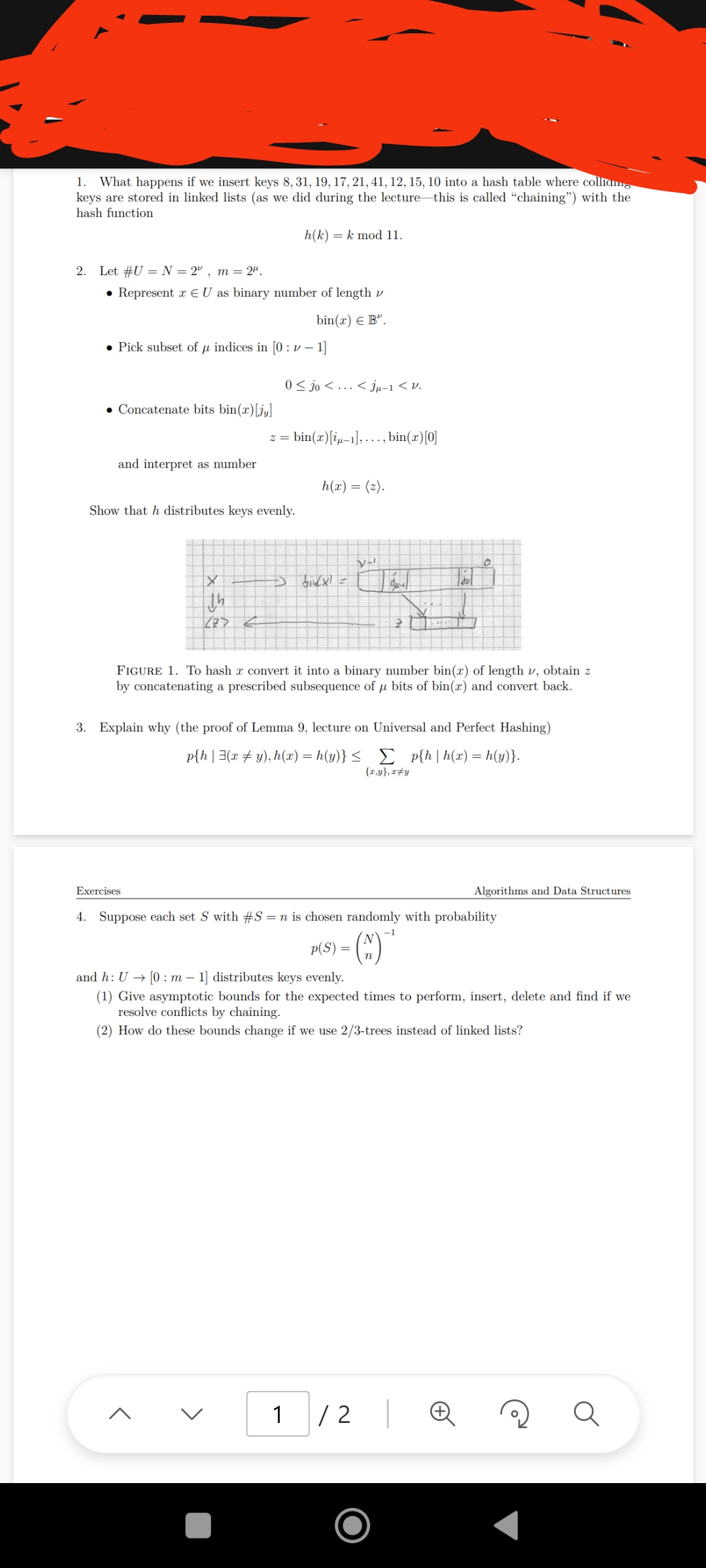
Figure hash convert into a binary number bin length
obtain
concatenating a prescribed subsequence bits bin and convert back.
Explain why proof Lemma lecture Universal and Perfect Hashing
Suppose each set with # chosen randomly with probability
and :: distributes keys evenly.
Give asymptotic bounds for the expected times perform, insert, delete and find
resolve conflicts chaining.
How these bounds change usetrees instead linked lists? please solve second task
Step by Step Solution
There are 3 Steps involved in it
1 Expert Approved Answer
Step: 1 Unlock

Question Has Been Solved by an Expert!
Get step-by-step solutions from verified subject matter experts
Step: 2 Unlock
Step: 3 Unlock
 Study Help