







Question: What information does the payback period provide? A project's payback period (PB) indicates the number of years required for a project to recover its initial
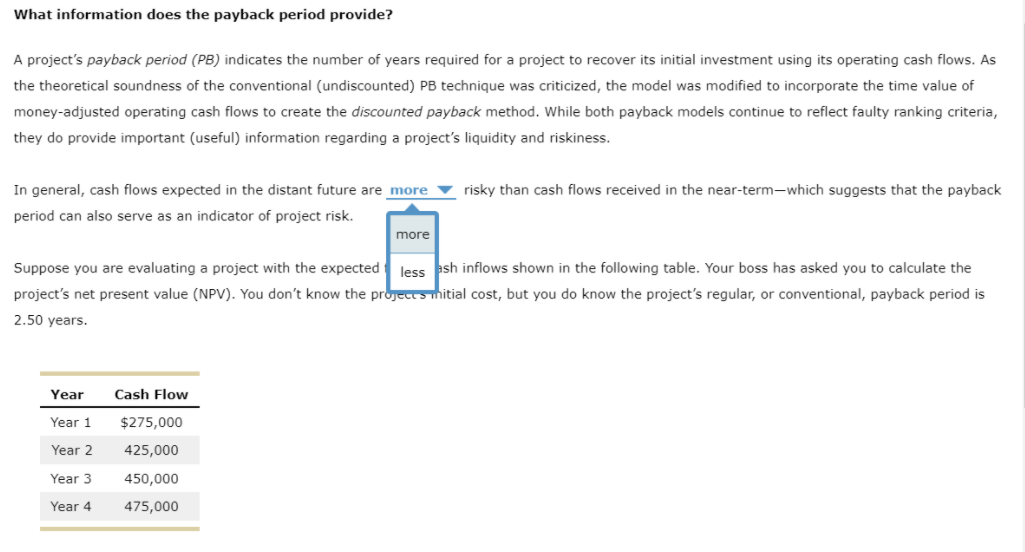
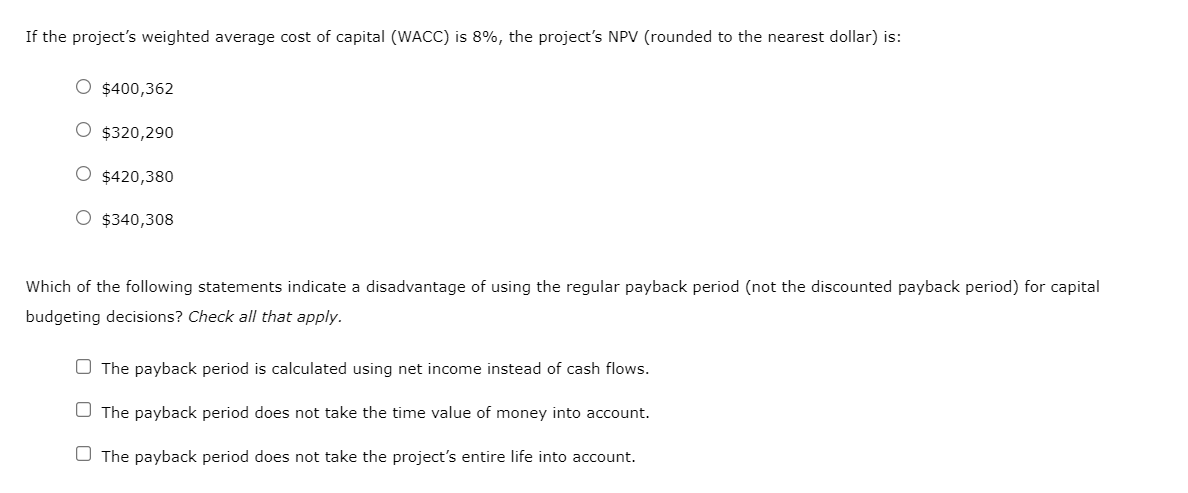
What information does the payback period provide? A project's payback period (PB) indicates the number of years required for a project to recover its initial investment using its operating cash flows. As the theoretical soundness of the conventional (undiscounted) PB technique was criticized, the model was modified to incorporate the time value of money-adjusted operating cash flows to create the discounted payback method. While both payback models continue to reflect faulty ranking criteria, they do provide important (useful information regarding a project's liquidity and riskiness. In general, cash flows expected in the distant future are more risky than cash flows received in the near-term-which suggests that the payback period can also serve as an indicator of project risk. more Suppose you are evaluating a project with the expected less sh inflows shown in the following table. Your boss has asked you to calculate the project's net present value (NPV). You don't know the projects thitial cost, but you do know the project's regular, or conventional, payback period is 2.50 years. Year Cash Flow Year 1 $275,000 425,000 Year 2 Year 3 450,000 475,000 Year 4 If the project's weighted average cost of capital (WACC) is 8%, the project's NPV (rounded to the nearest dollar) is: O $400,362 O $320,290 O $420,380 O $340,308 Which of the following statements indicate a disadvantage of using the regular payback period (not the discounted payback period) for capital budgeting decisions? Check all that apply. The payback period is calculated using net income instead of cash flows. The payback period does not take the time value of money into account. The payback period does not take the project's entire life into account
Step by Step Solution
There are 3 Steps involved in it

Get step-by-step solutions from verified subject matter experts
 Study Help