



Question: what is the answer of this Problem 1 (2nd generation Bol crises model: IME 2019-20, the 4th final exam) 1. What is a currency crisis?
what is the answer of this
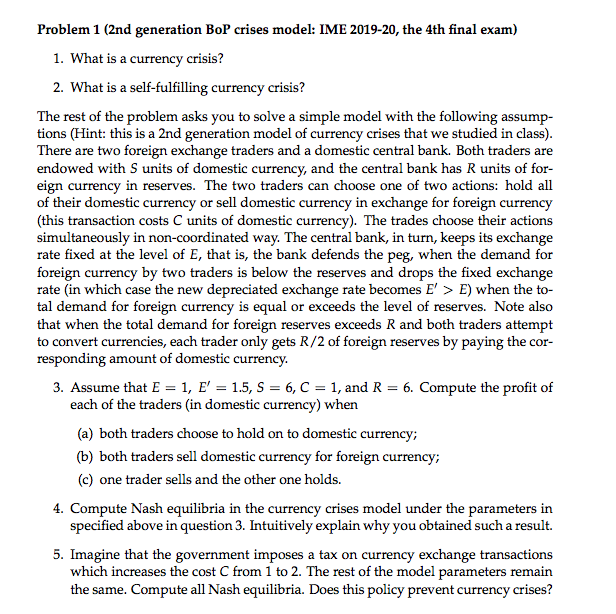
Problem 1 (2nd generation Bol crises model: IME 2019-20, the 4th final exam) 1. What is a currency crisis? 2. What is a self-fulfilling currency crisis? The rest of the problem asks you to solve a simple model with the following assump- tions (Hint: this is a 2nd generation model of currency crises that we studied in class). There are two foreign exchange traders and a domestic central bank. Both traders are endowed with S units of domestic currency, and the central bank has R units of for- eignacurrency in reserves. The two traders can choose one of two actions: hold all of their domestic currency or sell domestic currency in exchange for foreign currency (this transaction costs C units of domestic currency). The trades choose their actions simultaneously in non-coordinated way. The central bank, in turn, keeps its exchange rate fixed at the level of E, that is, the bank defends the peg, when the demand for foreign currency by two traders is below the reserves and drops the fixed exchange rate (in which case the new depreciated exchange rate becomes E' > [) when the to- tal demand for foreign currency is equal or exceeds the level of reserves. Note also that when the total demand for foreign reserves exceeds R and both traders attempt to convert currencies, each trader only gets R/2 of foreign reserves by paying the cor- responding amount of domestic currency. 3. Assume that E = 1, E' = 1.5, S = 6, C = 1, and R = 6. Compute the profit of each of the traders (in domestic currency) when (a) both traders choose to hold on to domestic currency; (b) both traders sell domestic currency for foreign currency; (c) one trader sells and the other one holds. 4. Compute Nash equilibria in the currency crises model under the parameters in specified above in question 3. Intuitively explain why you obtained such a result. 5. Imagine that the government imposes a tax on currency exchange transactions which increases the cost C from 1 to 2. The rest of the model parameters remain the same. Compute all Nash equilibria. Does this policy prevent currency crises
Step by Step Solution
There are 3 Steps involved in it

Get step-by-step solutions from verified subject matter experts