







Question: what is the code (Mathematica, Python, MATlab) for the following problem using the Greedy Method of the change-point algorithm, related information below question, the code
what is the code (Mathematica, Python, MATlab) for the following problem using the Greedy Method of the change-point algorithm, related information below question, the code should be able to locate the position of the change-point from using BIC probability in a graph

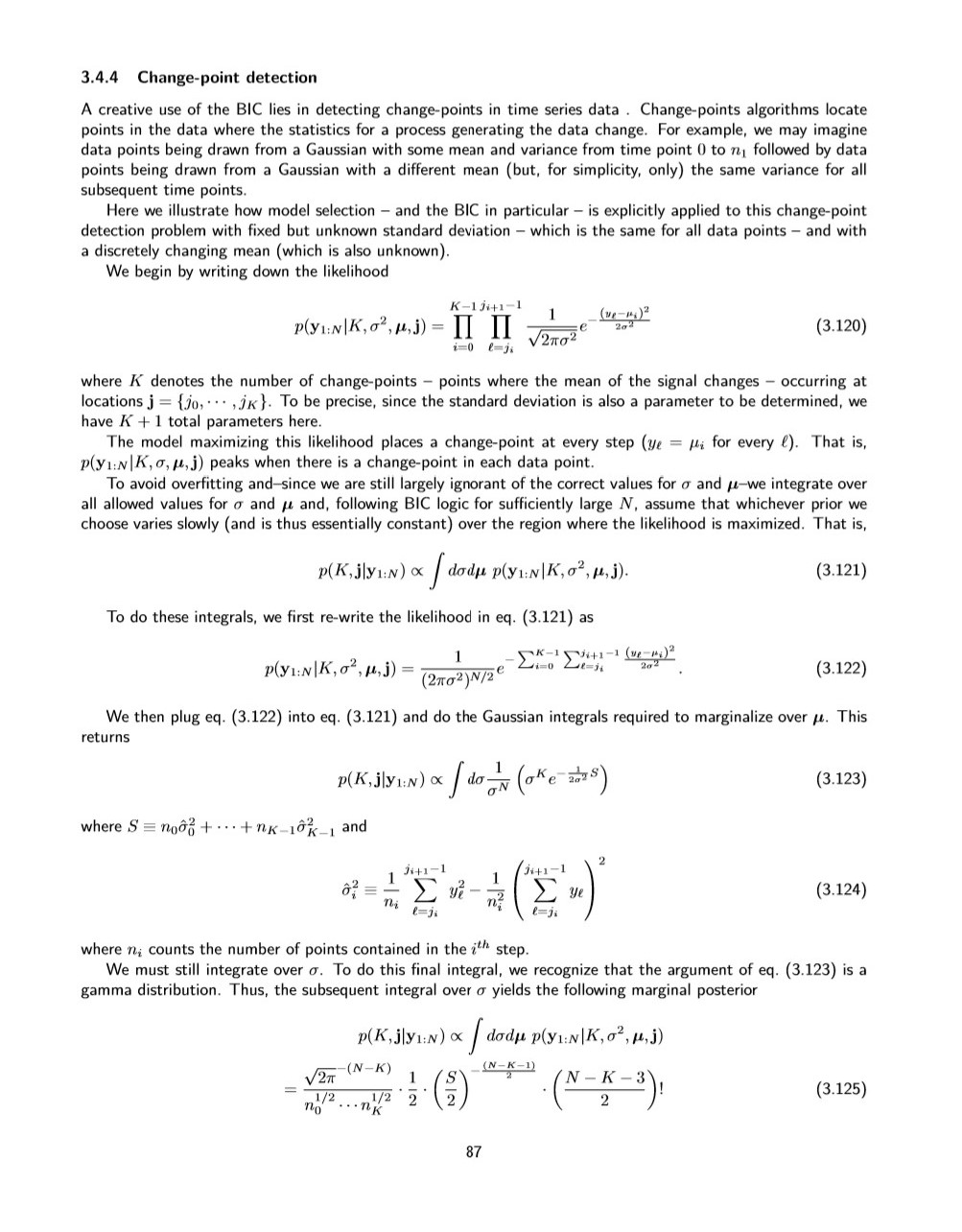
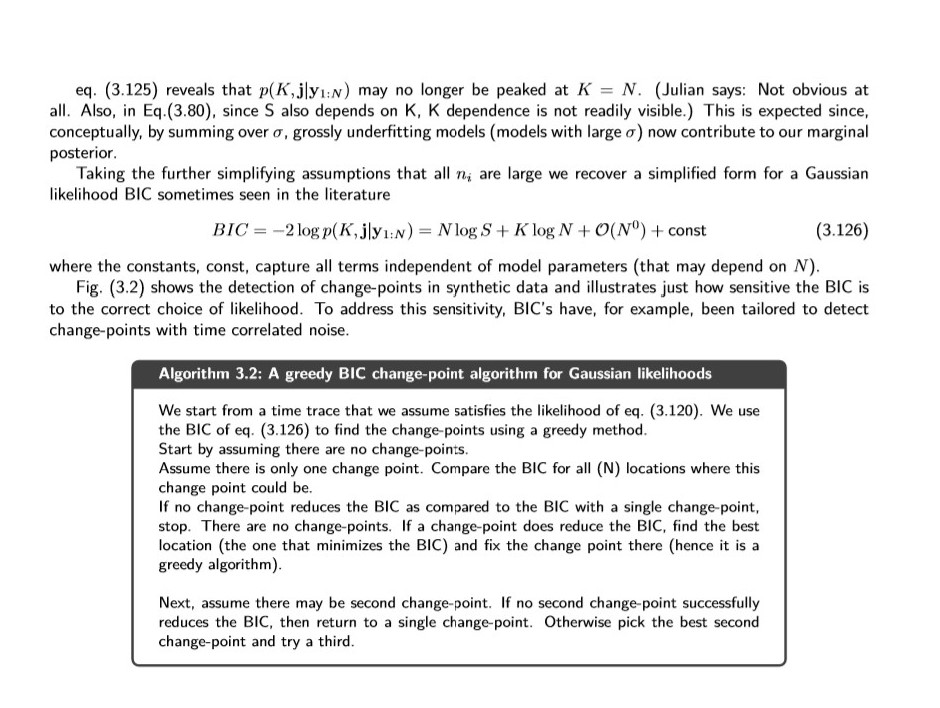
Problem 1: Change-point algorithm Implement the BIC-based change-point method for the simple case of a Gaussian likelihood with identical standard deviation assumed for all data points. In other words, begin by generating synthetic data assuming discrete steps in your data where you have pre-specified by hand the means of those steps in the signal, \"1: K, and 0. Then, implement the change-point method in order to learn the means, #1: K, and locations, j, of your steps. Compare your parameter estimates from your method to the theoretical values you used to generate your data. 3.4.4 Change-point detection A creative use of the BIC lies in detecting change-points in time series data . Change-points algorithms locate points in the data where the statistics for a process generating the data change. For example, we may imagine data points being drawn from a Gaussian with some mean and variance from time point 0 to n, followed by data points being drawn from a Gaussian with a different mean (but, for simplicity, only) the same variance for all subsequent time points. Here we illustrate how model selection - and the BIC in particular - is explicitly applied to this change-point detection problem with fixed but unknown standard deviation - which is the same for all data points - and with a discretely changing mean (which is also unknown). We begin by writing down the likelihood K-1ji+1-1 P()IN[K,2, M,j) = II II (we -14)2 V2702 (3.120) where K denotes the number of change-points - points where the mean of the signal changes - occurring at locations j = {jo, . .. ,jk ). To be precise, since the standard deviation is also a parameter to be determined, we have K + 1 total parameters here. The model maximizing this likelihood places a change-point at every step (ye = /; for every (). That is, p(y1:NK,
Step by Step Solution
There are 3 Steps involved in it

Get step-by-step solutions from verified subject matter experts
 Study Help