







Question: What is the distinction between exogenous variables and endogenous variables? O Exogenous variables are left out of the model, while endogenous variables are included in

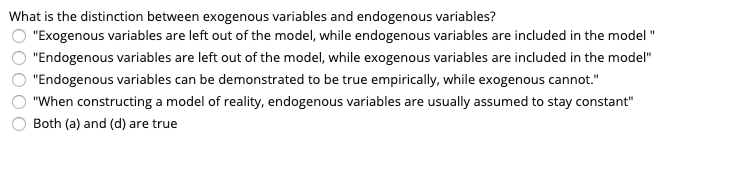


What is the distinction between exogenous variables and endogenous variables? O "Exogenous variables are left out of the model, while endogenous variables are included in the model" O "Endogenous variables are left out of the model, while exogenous variables are included in the model" "Endogenous variables can be demonstrated to be true empirically, while exogenous cannot." O "When constructing a model of reality, endogenous variables are usually assumed to stay constant" O Both (a) and (d) are trueWhich of the following describes the use of Keynesian macroeconomic policy to resolve an inflationary gap problem in the economy? O "Unemployment, resulting from the short-run product markets equilibrium being below Long-run Aggregate Supply (LRAS), causes wages to decline, which increases short-run Aggregate Supply (AS), until long-run equilibrium is attained at full employment level of income and a lower price level." "Government spending is increased, increasing Aggregate Demand (AD) to a level sufficient to attain long-run equilibrium at full employment level of income and a higher price level." "In attempting to produce beyond the economy's natural level of GDP, producers bid up wages and prices of other resources, causing the short-run Aggregate Supply (AS) to decrease to the point where long-run equilibrium is restored." O Taxes are increased reducing Aggregate Demand (AD) to a level consistent with full employment.Which of the following describes the way in which the self-correcting mechanism of the economy resolves the problem of a recessionary gap? "The recessionary gap is cured by an increase in government purchases of goods and services, which implies a shift to the right of the AD curve until full employment equilibrium is reestablished." "The unemployment associated with a recessionary gap causes wages to fall, increasing Aggregate Supply and thus shifting the AS curve to the right until a full employment equilibrium is reestablished. " "The unemployment associated with a recessionary gap causes a decrease in Aggregate Supply, shifting the AS curve to the left until full employment equilibrium is restored." Both (a) and (b) are correct. None of the above
Step by Step Solution
There are 3 Steps involved in it

Get step-by-step solutions from verified subject matter experts
 Study Help