







Question: Please show how one would solve the following using R studio codes.... Please show how one would solve the following using R studio codes. Please
Please show how one would solve the following using R studio codes....
Please show how one would solve the following using R studio codes. Please be as thorough as possible when providing the codes.
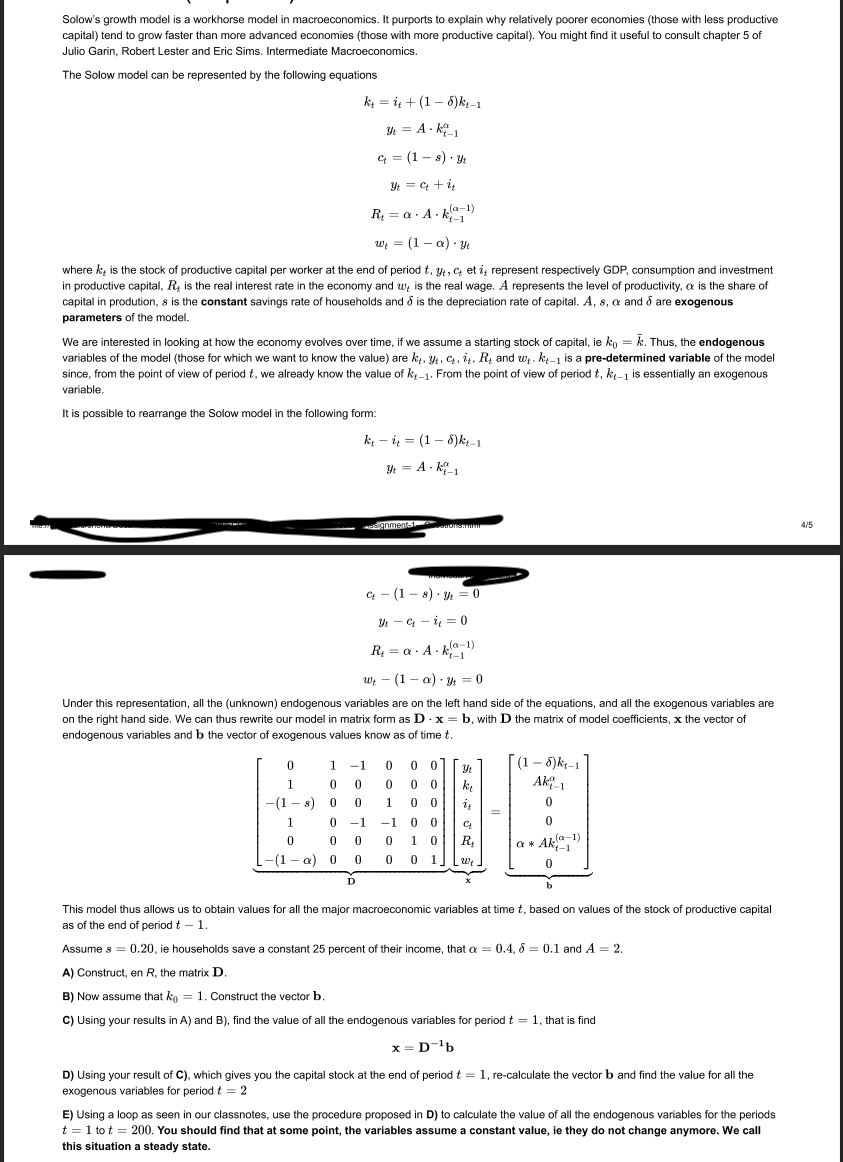
Solow's growth model is a workhorse model in macroeconomics. It purports to explain why relatively poorer economies (those with less productive capital) tend to grow faster than more advanced economies (those with more productive capital). You might find it useful to consult chapter 5 of Julio Garin, Robert Lester and Eric Sims. Intermediate Macroeconomics. The Solow model can be represented by the following equations k = i + (1 )k1 - Y = A ke-1 & = (1 s) Yt Y = c + i R = . A.k(+1) w = (1-) t where k is the stock of productive capital per worker at the end of period t, yt, et i, represent respectively GDP, consumption and investment in productive capital, R is the real interest rate in the economy and w, is the real wage. A represents the level of productivity, a is the share of capital in prodution, & is the constant savings rate of households and is the depreciation rate of capital. A, s, a and are exogenous parameters of the model. We are interested in looking at how the economy evolves over time, if we assume a starting stock of capital, ie k = . Thus, the endogenous variables of the model (those for which we want to know the value) are k, y,,, R and w. k-1 is a pre-determined variable of the model since, from the point of view of period t, we already know the value of k-1. From the point of view of period t, k-1 is essentially an exogenous variable. It is possible to rearrange the Solow model in the following form: k = (1-8)k-1 Y = A-k-1 signment 1 -(1-8) 0 R =-A-(-1) -1 w-(1-a) y = 0 Under this representation, all the (unknown) endogenous variables are on the left hand side of the equations, and all the exogenous variables are on the right hand side. We can thus rewrite our model in matrix form as D x = b, with D the matrix of model coefficients, x the vector of endogenous variables and b the vector of exogenous values know as of time t. 0 1 -1 0 0 0 Yt 1 0 0 0 0 0 kt (1-5)k-1 Ake-1 -(1-8) 0 0 1 0 0 i 0 = 1 0 0 -1 0 0 -1 0 0 0 a) 00 0 1 0 001 R a* Ak (a-1) Wt 0 D b This model thus allows us to obtain values for all the major macroeconomic variables at time t, based on values of the stock of productive capital as of the end of period t - 1. == Assume 8 = 0.20, ie households save a constant 25 percent of their income, that a = 0.4, 5 = 0.1 and A = 2. A) Construct, en R, the matrix D. B) Now assume that ko = 1. Construct the vector b. C) Using your results in A) and B), find the value of all the endogenous variables for period t = 1, that is find x = D-b D) Using your result of C), which gives you the capital stock at the end of period t = 1, re-calculate the vector b and find the value for all the exogenous variables for period t = 2 E) Using a loop as seen in our classnotes, use the procedure proposed in D) to calculate the value of all the endogenous variables for the periods t = 1 to t = 200. You should find that at some point, the variables assume a constant value, ie they do not change anymore. We call this situation a steady state. 4/5
Step by Step Solution
There are 3 Steps involved in it

Get step-by-step solutions from verified subject matter experts
 Study Help