Question: What is the main problem regarding this case study? Case Focus: Tai Din Fung and Sons Pte Ltd Headquartered in Singapore, Tai Din Fung and
What is the main problem regarding this case study?
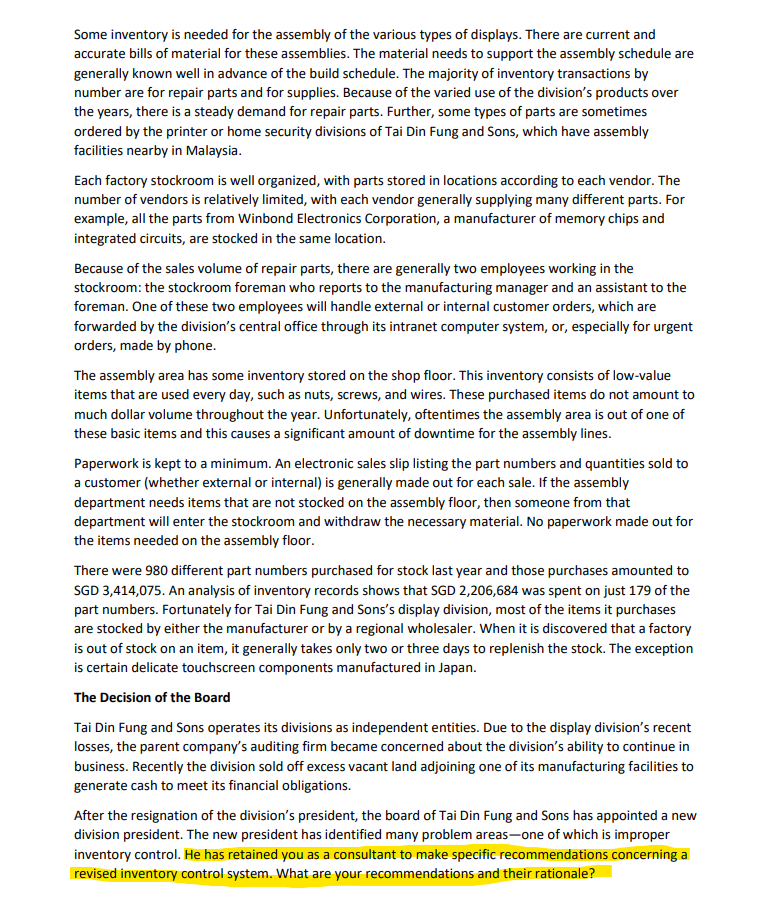
Case Focus: Tai Din Fung and Sons Pte Ltd Headquartered in Singapore, Tai Din Fung and Sons Pte Ltd is an industrial and real estate conglomerate with operations across South-East Asia and further holdings in the Middle East and Europe. One of the company's divisions specializes in the assembly of display screens used in retail and industrial terminals. The division also sells repair parts for its screens, both current production models and those no longer being produced. Manufacturing is located in two facilities in Malaysia, with parts being sourced, currently, from China, Japan, and Taiwan, as well as Malaysia. The display division sells to external customers that have included Apple, Lenovo, NCR, and Siemens, and also to some other divisions of Tai Din Fung and Sons. However, it is now a small player in a global market. In recent years the display division has been in financial difficulty, facing fierce competition while struggling to find its place in the booming touchscreen market. The division has lost money for three of the last four years, with the last year's loss being SGD 170,174 on sales of SGD 10,238,664. Inventory levels have been steadily increasing to their present levels of SGD 1,264,340. Besides manufacturing labour, the division employs 44 people. The management team consists of: division president, VP of sales, VP of manufacturing, VP of finance, and VP of purchasing. Each production facility is led by a team of three: a manufacturing manager, controller (finance), and purchasing manager; each of these team members reports to their respective VPs. In each facility, an assembly foreman, stockroom foreman, and quality engineer report to the manufacturing manager. Division President [VP of Manufacturing VP of Purchasing VP of Finance VP of Sales Manufacturing Manager Purchasing Manager Controller Assembly Foreman Stockroom Foreman Quality Engineer Current Inventory Control System The division's two in-house production facilities operate in similar ways. The current inventory control system is surprisingly unsophisticated. It consists of orders for stock replenishment being made by the stockroom foreman, the purchasing manager, or the manufacturing manager whenever one of them observes that the inventory is low. An order for replenishment of inventory is also placed whenever someone (either a customer or an employee in the assembly area) wants an item and it is not in stock. Some inventory is needed for the assembly of the various types of displays. There are current and accurate bills of material for these assemblies. The material needs to support the assembly schedule are generally known well in advance of the build schedule. The majority of inventory transactions by number are for repair parts and for supplies. Because of the varied use of the division's products over the years, there is a steady demand for repair parts. Further, some types of parts are sometimes ordered by the printer or home security divisions of Tai Din Fung and Sons, which have assembly facilities nearby in Malaysia. Each factory stockroom is well organized, with parts stored in locations according to each vendor. The number of vendors is relatively limited, with each vendor generally supplying many different parts. For example, all the parts from Winbond Electronics Corporation, a manufacturer of memory chips and integrated circuits, are stocked in the same location. Because of the sales volume of repair parts, there are generally two employees working in the stockroom: the stockroom foreman who reports to the manufacturing manager and an assistant to the foreman. One of these two employees will handle external or internal customer orders, which are forwarded by the division's central office through its intranet computer system, or, especially for urgent orders, made by phone. The assembly area has some inventory stored on the shop floor. This inventory consists of low-value items that are used every day, such as nuts, screws, and wires. These purchased items do not amount to much dollar volume throughout the year. Unfortunately, oftentimes the assembly area is out of one of these basic items and this causes a significant amount of downtime for the assembly lines. Paperwork is kept to a minimum. An electronic sales slip listing the part numbers and quantities sold to a customer (whether external or internal) is generally made out for each sale. If the assembly department needs items that are not stocked on the assembly floor, then someone from that department will enter the stockroom and withdraw the necessary material. No paperwork made out for the items needed on the assembly floor. There were 980 different part numbers purchased for stock last year and those purchases amounted to SGD 3,414,075. An analysis of inventory records shows that SGD 2,206,684 was spent on just 179 of the part numbers. Fortunately for Tai Din Fung and Sons's display division, most of the items it purchases are stocked by either the manufacturer or by a regional wholesaler. When it is discovered that a factory is out of stock on an item, it generally takes only two or three days to replenish the stock. The exception is certain delicate touchscreen components manufactured in Japan. The Decision of the Board Tai Din Fung and Sons operates its divisions as independent entities. Due to the display division's recent losses, the parent company's auditing firm became concerned about the division's ability to continue in business. Recently the division sold off excess vacant land adjoining one of its manufacturing facilities to generate cash to meet its financial obligations. After the resignation of the division's president, the board of Tai Din Fung and Sons has appointed a new division president. The new president has identified many problem areas one of which is improper inventory control. He has retained you as a consultant to make specific recommendations concerning a revised inventory control system. What are your recommendations and their rationale









 Study Help