







Question: what is this subject Part 3: Evaluating the Selection System You have now created a selection system for the job of a teller. The final
what is this subject
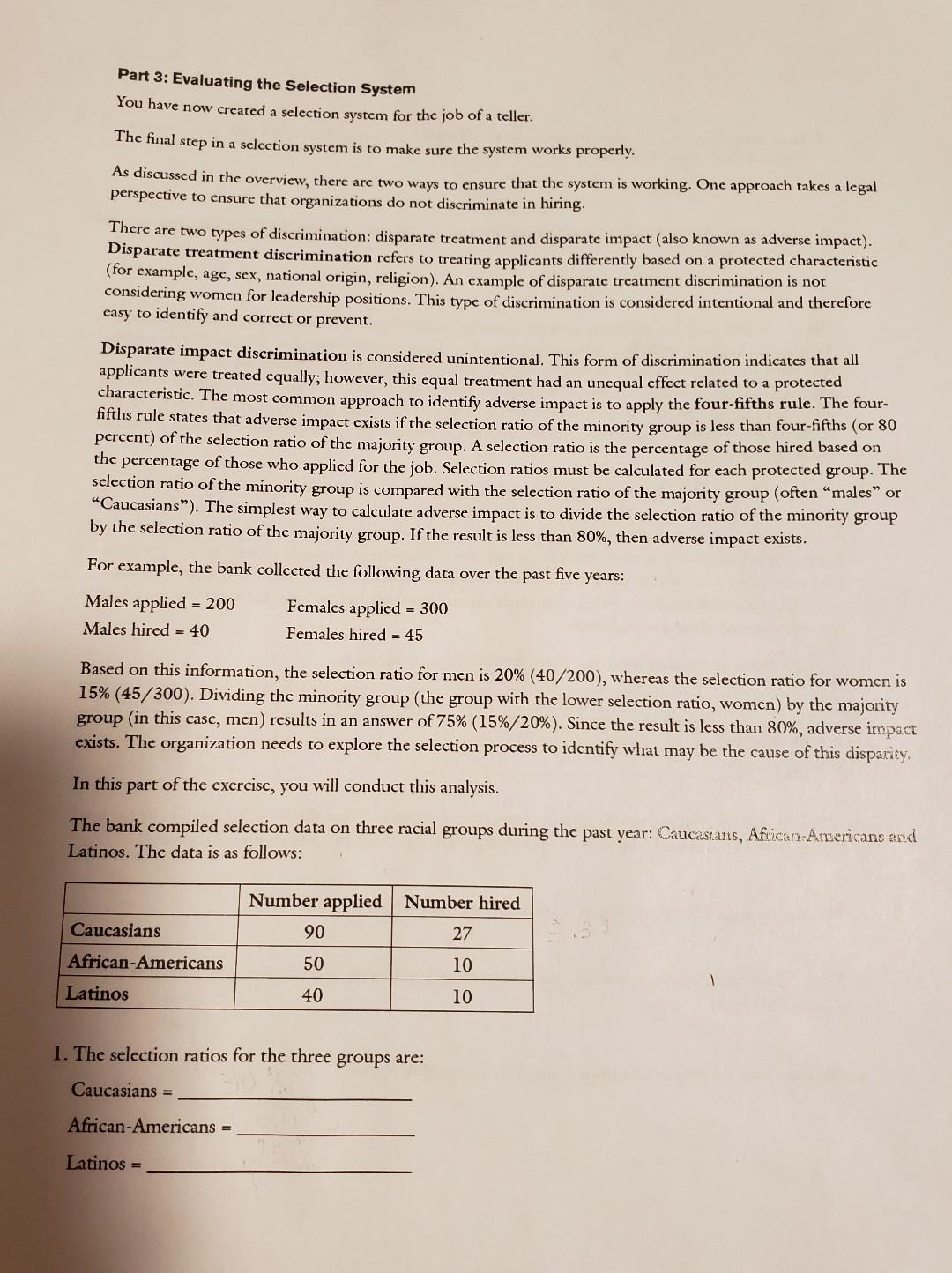
Part 3: Evaluating the Selection System You have now created a selection system for the job of a teller. The final step in a selection system is to make sure the system works properly. As discussed in the overview, there are two ways to ensure that the system is working. One approach takes a legal perspective to ensure that organizations do not discriminate in hiring. There are two types of discrimination: disparate treatment and disparate impact (also known as adverse impact). Disparate treatment discrimination refers to treating applicants differently based on a protected characteristic (for example, age, sex, national origin, religion). An example of disparate treatment discrimination is not considering women for leadership positions. This type of discrimination is considered intentional and therefore easy to identify and correct or prevent. Disparate impact discrimination is considered unintentional. This form of discrimination indicates that all applicants were treated equally; however, this equal treatment had an unequal effect related to a protected characteristic. The most common approach to identify adverse impact is to apply the four-fifths rule. The four- fifths rule states that adverse impact exists if the selection ratio of the minority group is less than four-fifths (or 80 percent) of the selection ratio of the majority group. A selection ratio is the percentage of those hired based on the percentage of those who applied for the job. Selection ratios must be calculated for each protected group. The selection ratio of the minority group is compared with the selection ratio of the majority group (often males or Caucasians). The simplest way to calculate adverse impact is to divide the selection ratio of the minority group by the selection ratio of the majority group. If the result is less than 80%, then adverse impact exists. For example, the bank collected the following data over the past five years: Males applied = 200 Females applied = 300 Males hired = 40 Females hired = 45 Based on this information, the selection ratio for men is 20% (40/200), whereas the selection ratio for women is 15% (45/300). Dividing the minority group (the group with the lower selection ratio, women) by the majority group (in this case, men) results in an answer of 75% (15%/20%). Since the result is less than 80%, adverse impact exists. The organization needs to explore the selection process to identify what may be the cause of this disparity. In this part of the exercise, you will conduct this analysis. The bank compiled selection data on three racial groups during the past year: Caucasians, African-Americans and Latinos. The data is as follows: Number hired Number applied 90 Caucasians 27 African-Americans 50 10 Latinos 40 10 1. The selection ratios for the three groups are: Caucasians = African-Americans = Latinos =Step by Step Solution
There are 3 Steps involved in it
1 Expert Approved Answer
Step: 1 Unlock

Question Has Been Solved by an Expert!
Get step-by-step solutions from verified subject matter experts
Step: 2 Unlock
Step: 3 Unlock
 Study Help