







Question: What need(s) do you plan to satisfy for this customer? 4-2. Step Two: Market Analysis How large is the total addressable market (TAM) for your
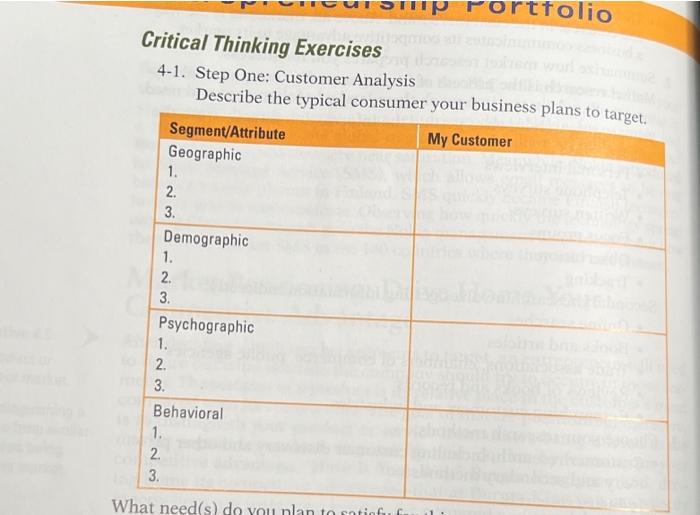
What need(s) do you plan to satisfy for this customer?
4-2. Step Two: Market Analysis
How large is the total addressable market (TAM) for your prod.
uct or service? How did you arrive at this figure?
How large is your served available market (SAM)? How do you
know?
Which segment of this market do you intend to target? Why?
large is the segment?
Describe your segmentation method. Why did you choose this
method?
4-3. Research can give you a great deal of information, but you wil
have to use your math skills to make it more useful. For example,
imagine you are interested in opening a dog-care service and you
have gathered the following facts:
In 2010, the U.S. Census Bureau estimated that there were 2.55
people per household.
According to your city's public records, the population of your
community is 80,000.
The U.S. Pet Ownership & Demographics Sourcebook* estimals
that the number of dog-owning households in a community
equals 0.361 multiplied by the total number of households.
The Sourcebook also estimates that the number of dogs in
a community equals 0.578 multiplied by the total number of
households- or 1.6 multiplied by the number of dog-owning
households.
Calculate:
a. The number of dog-owning households in your community.
b. The number of dogs in your community. Round your answers
off to the nearest whole number.
4-4. Analyze and describe what you would expect the target market to
be for a single-seat hybrid automobile that gets 120 miles per gal-
on according to the demographic, psychographic, and behavioral
segments. Consider such factors as gender, age, marital status,
occupation, household size, household income, interests, and
beliefs about global warming, gasoline prices, and the like. How
might you determine this?
45. Choose five people from your market segment to research with
a survey. Write 10 questions in a scaled format and ask the sur-
vey participants to frame their responses on a scale of 1 to 5 or
design your own range. Also ask five open-ended questions to
test your customer and product hypotheses (questions that can-
not be answered with a yes or no or scaled response). Was one
type of question more valuable to your research goals than the
other? Why or why not? Which question yielded the most useful
responses?
Key Concept Questions
4.6. Which four factors should market research include, and why?
4-7. Write a positioning statement for your business, or one that you
can envision, using the format provided.
4.8. Assess where you think your product or service is in the product
life cycle. Where is it, and why did you reach this conclusion?
Remember that while your company may be in its infancy, the
product/service or industry may be in maturity or decline.
4-9. Read and interpret the chart in Figure 4-2.
a. Which single provider has the largest market share? What is the
percentage?
b. What share do the two largest suppliers enjoy together?
c. How much bigger is IBM's share than Apple's?
d. If there are approximately 100 other smaller makers of personal
computers, about how much market share would each have on
average?
Critical Thinking Exercises 4-1. Step One: Customer Analysis Describe the typical consumer your business plans to tarcat
Step by Step Solution
There are 3 Steps involved in it

Get step-by-step solutions from verified subject matter experts
 Study Help