







Question: What statistical information shows whether the program was effective (or not)? Review the factors that limit the internal validity of a study (history, maturation, testing,
- What statistical information shows whether the program was effective (or not)?
- Review the factors that limit the internal validity of a study (history, maturation, testing, instrumentation, statistical regression, selection bias, and attrition).
- Select and explain which factors might limit the ability to draw conclusions regarding cause-and-effect relationships.
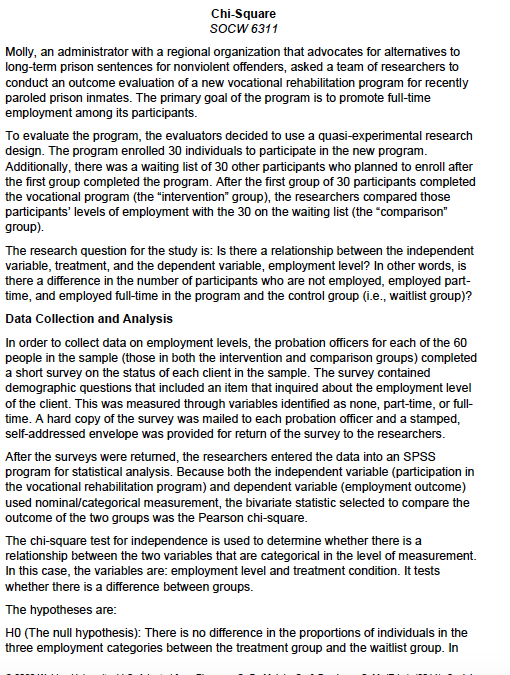
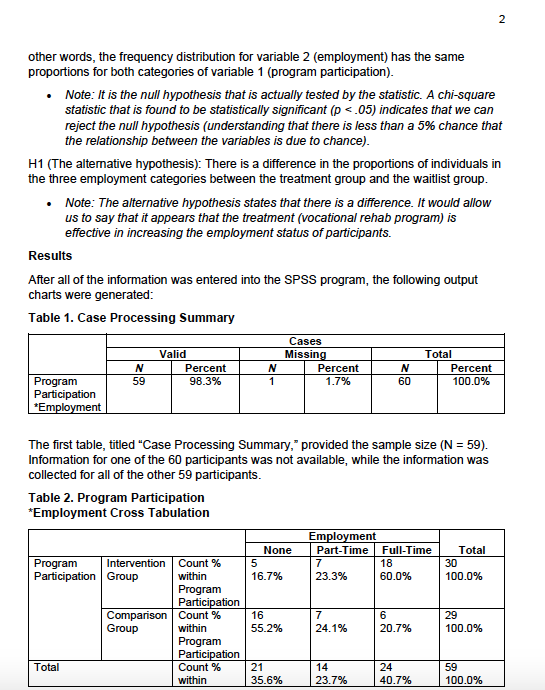
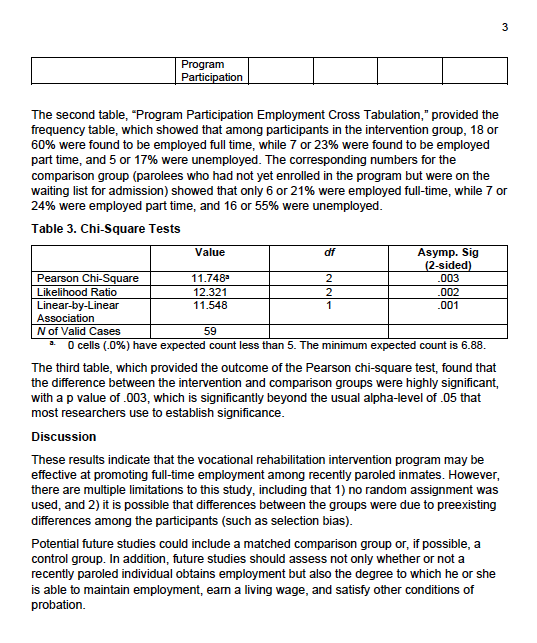
Chi-Square SOCW 6311 Molly, an administrator with a regional organization that advocates for alternatives to long-term prison sentences for nonviolent offenders, asked a team of researchers to conduct an outcome evaluation of a new vocational rehabilitation program for recently paroled prison inmates. The primary goal of the program is to promote full-time employment among its participants. To evaluate the program, the evaluators decided to use a quasi-experimental research design. The program enrolled 30 individuals to participate in the new program. Additionally, there was a waiting list of 30 other participants who planned to enroll after the first group completed the program. After the first group of 30 participants completed the vocational program (the "intervention" group), the researchers compared those participants' levels of employment with the 30 on the waiting list (the "comparison" group). The research question for the study is: Is there a relationship between the independent variable, treatment, and the dependent variable, employment level? In other words, is there a difference in the number of participants who are not employed, employed part- time, and employed full-time in the program and the control group (i.e., waitlist group)? Data Collection and Analysis In order to collect data on employment levels, the probation officers for each of the 60 people in the sample (those in both the intervention and comparison groups) completed a short survey on the status of each client in the sample. The survey contained demographic questions that included an item that inquired about the employment level of the client. This was measured through variables identified as none, part-time, or full- time. A hard copy of the survey was mailed to each probation officer and a stamped, self-addressed envelope was provided for return of the survey to the researchers. After the surveys were returned, the researchers entered the data into an SPSS program for statistical analysis. Because both the independent variable (participation in the vocational rehabilitation program) and dependent variable (employment outcome) used nominal/categorical measurement, the bivariate statistic selected to compare the outcome of the two groups was the Pearson chi-square. The chi-square test for independence is used to determine whether there is a relationship between the two variables that are categorical in the level of measurement. In this case, the variables are: employment level and treatment condition. It tests whether there is a difference between groups. The hypotheses are: HO (The null hypothesis): There is no difference in the proportions of individuals in the three employment categories between the treatment group and the waitlist group. In2 other words, the frequency distribution for variable 2 (employment) has the same proportions for both categories of variable 1 (program participation) . Note: It is the null hypothesis that is actually tested by the statistic. A chi-square statistic that is found to be statistically significant (p
Step by Step Solution
There are 3 Steps involved in it

Get step-by-step solutions from verified subject matter experts
 Study Help