







Question: WHAT TO PROGRAM: Write a C program input one character at a time and output the results to standard output. Roughly, your program should mostly
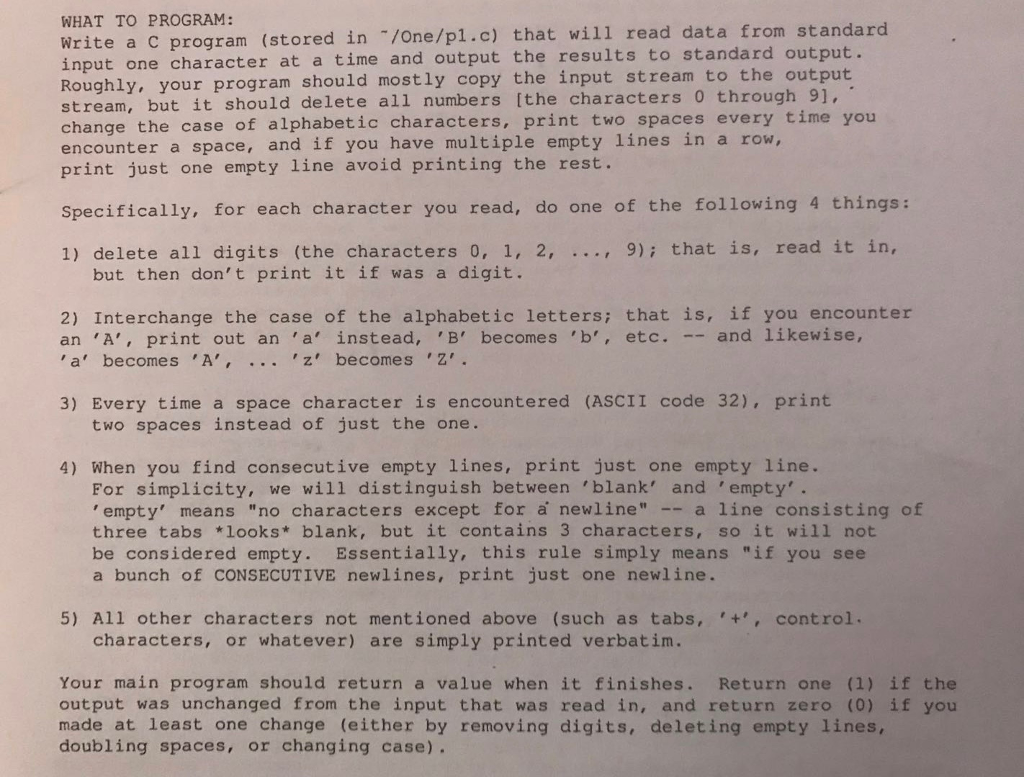
WHAT TO PROGRAM: Write a C program input one character at a time and output the results to standard output. Roughly, your program should mostly copy the input stream to the output stream, but it should delete all numbers [the characters 0 through 9], change the case of alphabetic characters, print two spaces every time you encounter a space, and if you have multiple empty lines in a row, print just one empty line avoid printing the rest. (stored in "/One/pl.c) that will read data from standard Specifically, for each character you read, do one of the following 4 things: 1) delete all digits (the characters 0, 1, 2, ., 9); that is, read it in but then don't print it if was a digit. 2) Interchange the case of the alphabetic letters; that is, if you encounter an 'A', print out an 'a' instead, 'B' becomes 'b', etc. and likewise, 'a' becomes'A', 'z' becomes 'z' 3) Every time a space character is encountered (ASCII code 32), print two spaces instead of just the one. 4) When you find consecutive empty lines, print just one empty line. For simplicity, we will distinguish between 'blank' and 'empty' 'empty' means "no characters except for a newline" a line consisting of three tabs looks* blank, but it contains 3 characters, so it will not be considered empty. Essentially, this rule simply means "if you se a bunch of CONSECUTIVE newlines, print just one newline. 5) All other characters not mentioned above (such as tabs, control characters, or whatever) are simply printed verbatim. Your main program should return a value when it finishes. Return one (1) if the output was unchanged from the input that was read in, and return zero (0) if you made at least one change (either by removing digits, deleting empty lines, doubling spaces, or changing case)
Step by Step Solution
There are 3 Steps involved in it

Get step-by-step solutions from verified subject matter experts
 Study Help