Question: What types of tests can be performed using the data that may at least indirectly address the primary research question and why? Your decisions should
- What types of tests can be performed using the data that may at least indirectly address the primary research question and why? Your decisions should be based on the types of data available.
- What do you think the primary conclusions of the white paper will be based on the data provided? Perform a set of analysis and use your analysis results to support your conclusions.
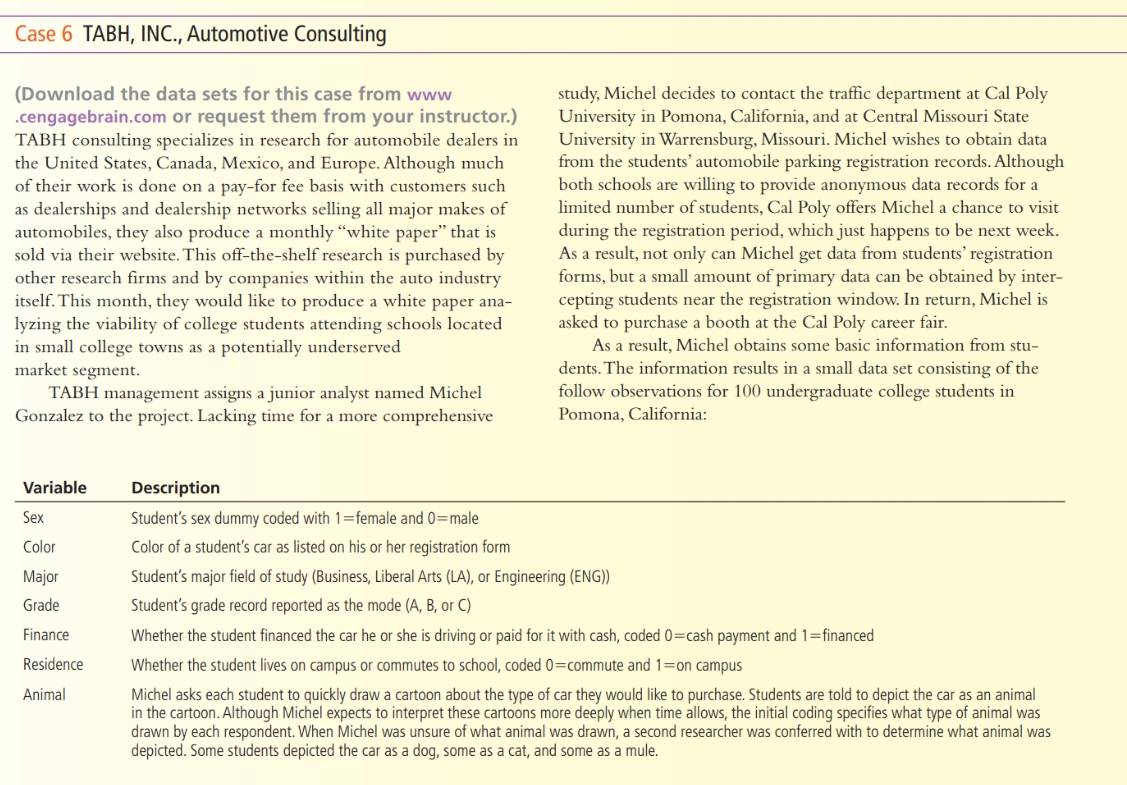
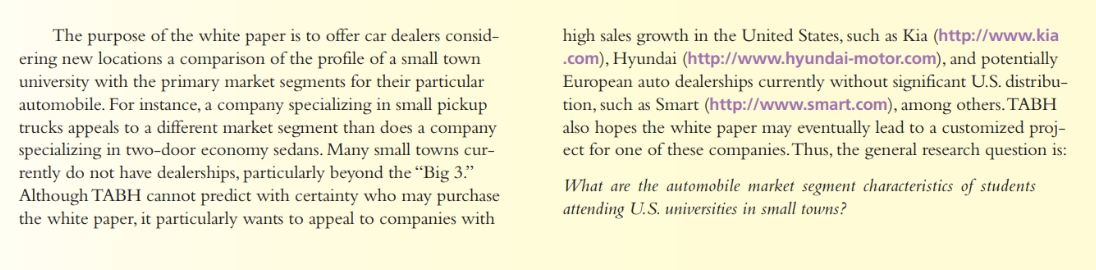
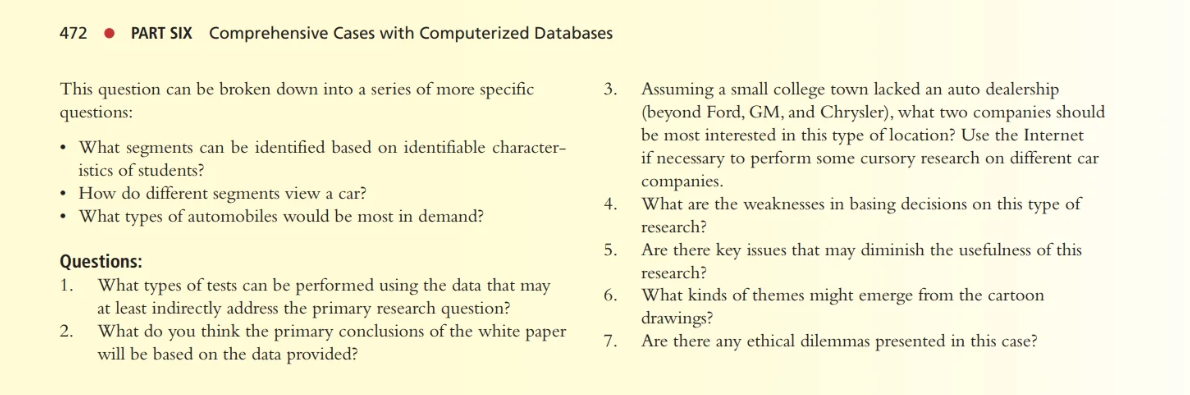
Case 6 TABH, INC., Automotive Consulting (Download the data sets for this case from www .cengagebrain.com or request them from your instructor.) TABH consulting specializes in research for automobile dealers in the United States, Canada, Mexico, and Europe. Although much of their work is done on a pay-for fee basis with customers such as dealerships and dealership networks selling all major makes of automobiles, they also produce a monthly "white paper" that is sold via their website. This off-the-shelf research is purchased by other research firms and by companies within the auto industry itself. This month, they would like to produce a white paper ana- lyzing the viability of college students attending schools located in small college towns as a potentially underserved market segment. TABH management assigns a junior analyst named Michel Gonzalez to the project. Lacking time for a more comprehensive Variable Sex Color Major Grade Finance Residence Animal study, Michel decides to contact the traffic department at Cal Poly University in Pomona, California, and at Central Missouri State University in Warrensburg, Missouri. Michel wishes to obtain data from the students' automobile parking registration records. Although both schools are willing to provide anonymous data records for a limited number of students, Cal Poly offers Michel a chance to visit during the registration period, which just happens to be next week. As a result, not only can Michel get data from students' registration forms, but a small amount of primary data can be obtained by inter- cepting students near the registration window. In return, Michel is asked to purchase a booth at the Cal Poly career fair. As a result, Michel obtains some basic information from stu- dents. The information results in a small data set consisting of the follow observations for 100 undergraduate college students in Pomona, California: Description Student's sex dummy coded with 1-female and 0=male Color of a student's car as listed on his or her registration form Student's major field of study (Business, Liberal Arts (LA), or Engineering (ENG)) Student's grade record reported as the mode (A, B, or C) Whether the student financed the car he or she is driving or paid for it with cash, coded 0=cash payment and 1= financed Whether the student lives on campus or commutes to school, coded 0=commute and 1=on campus Michel asks each student to quickly draw a cartoon about the type of car they would like to purchase. Students are told to depict the car as an animal in the cartoon. Although Michel expects to interpret these cartoons more deeply when time allows, the initial coding specifies what type of animal was drawn by each respondent. When Michel was unsure of what animal was drawn, a second researcher was conferred with to determine what animal was depicted. Some students depicted the car as a dog, some as a cat, and some as a mule. The purpose of the white paper is to offer car dealers consid- ering new locations a comparison of the profile of a small town university with the primary market segments for their particular automobile. For instance, a company specializing in small pickup trucks appeals to a different market segment than does a company specializing in two-door economy sedans. Many small towns cur- rently do not have dealerships, particularly beyond the "Big 3." Although TABH cannot predict with certainty who may purchase the white paper, it particularly wants to appeal to companies with high sales growth in the United States, such as Kia (http://www.kia .com), Hyundai (http://www.hyundai-motor.com), and potentially European auto dealerships currently without significant U.S. distribu- tion, such as Smart (http://www.smart.com), among others. TABH also hopes the white paper may eventually lead to a customized proj- ect for one of these companies. Thus, the general research question is: What are the automobile market segment characteristics of students attending U.S. universities in small towns? 472 PART SIX Comprehensive Cases with Computerized Databases This question can be broken down into a series of more specific questions: What segments can be identified based on identifiable character- istics of students? How do different segments view a car? What types of automobiles would be most in demand? Questions: What types of tests can be performed using the data that may at least indirectly address the primary research question? What do you think the primary conclusions of the white paper will be based on the data provided? 1. 2. 3. Assuming a small college town lacked an auto dealership (beyond Ford, GM, and Chrysler), what two companies should be most interested in this type of location? Use the Internet if necessary to perform some cursory research on different car companies. 4. 5. 6. 7. What are the weaknesses in basing decisions on this type of research? Are there key issues that may diminish the usefulness of this research? What kinds of themes might emerge from the cartoon drawings? Are there any ethical dilemmas presented in this case









 Study Help