







Question: what would be the function ? Convert the interpolated resistances from Part 3 to temperature in degrees Celsius using the thermistor equation (1) and the
 what would be the function ?
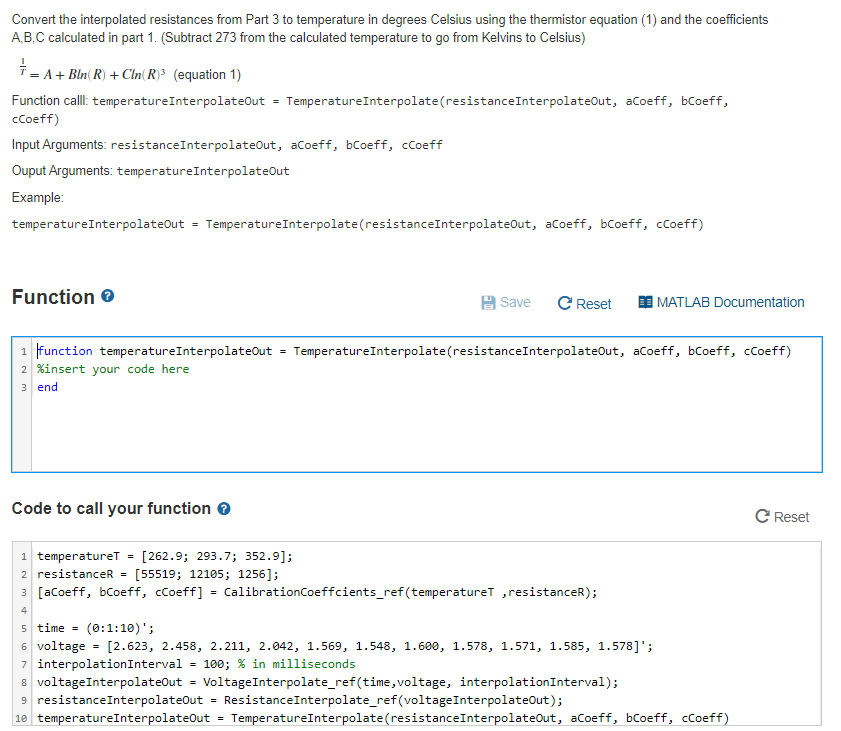
Convert the interpolated resistances from Part 3 to temperature in degrees Celsius using the thermistor equation (1) and the coefficients A,B,C calculated in part 1. (Subtract 273 from the calculated temperature to go from Kelvins to Celsius) A+ Bln(R) + Cin(R) (equation 1) Function call: temperatureInterpolateOut - TemperatureInterpolate (resistance InterpolateOut, acoeff, bcoeff, cCoeff) Input Arguments: resistance InterpolateOut, acoeff, bcoeff, cCoeff Ouput Arguments: temperature InterpolateOut Example: temperature InterpolateOut - Temperature Interpolate(resistanceInterpolateOut, acoeff, bcoeff, cCoeff) Function Save Reset D MATLAB Documentation 1 |function temperature InterpolateOut - Temperature Interpolate(resistanceInterpolateOut, acoeff, bcoeff, cCoeff) 2 %insert your code here 3 end Code to call your function Reset 1 temperaturet = [262.9; 293.7; 352.9]; 2 resistanceR = [55519; 12105; 1256]; 3 [aCoeff, bCoeff, cCoeff] Calibrationcoeffcients_ref (temperaturel , resistanceR); 4 5 time = (0:1:10)'; 6 voltage = [2.623, 2.458, 2.211, 2.042, 1.569, 1.548, 1.600, 1.578, 1.571, 1.585, 1.578]'; 7 interpolation Interval 100; % in milliseconds 8 voltage InterpolateOut = Voltage Interpolate_ref(time, voltage, interpolation Interval); 9 resistance InterpolateOut ResistanceInterpolate_ref(voltage InterpolateOut); 10 temperatureInterpolateOut Temperature Interpolate(resistanceInterpolateOut, acoeff, bcoeff, cCoeff)
Step by Step Solution
There are 3 Steps involved in it

Get step-by-step solutions from verified subject matter experts
 Study Help