







Question: When a solute is dissolved in a solvent the the following thermodynamic factors need to be considered: - The energy required to separate the solute
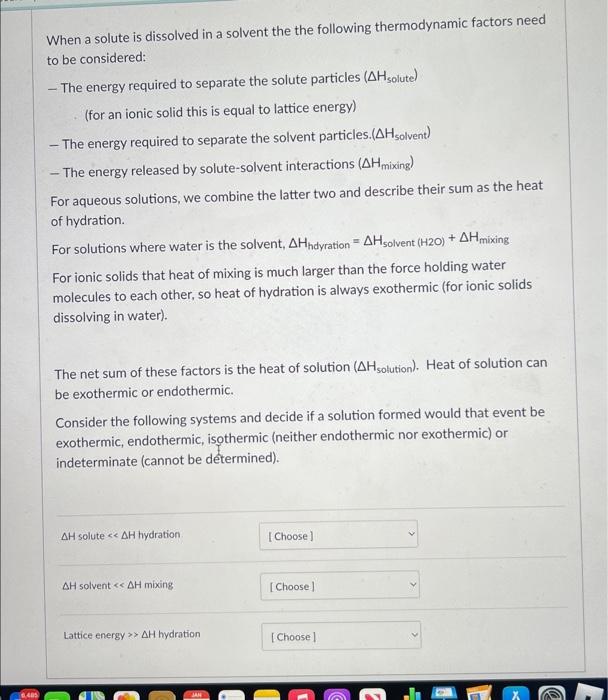
When a solute is dissolved in a solvent the the following thermodynamic factors need to be considered: - The energy required to separate the solute particles (Hsolute) (for an ionic solid this is equal to lattice energy) - The energy required to separate the solvent particles. (Hsolvent) - The energy released by solute-solvent interactions ( Hmixing ) For aqueous solutions, we combine the latter two and describe their sum as the heat of hydration. For solutions where water is the solvent, Hhdyration=Hsolvent(H2O)+Hmixing For ionic solids that heat of mixing is much larger than the force holding water molecules to each other, so heat of hydration is always exothermic (for ionic solids dissolving in water). The net sum of these factors is the heat of solution ( Hsolution ). Heat of solution can be exothermic or endothermic. Consider the following systems and decide if a solution formed would that event be exothermic, endothermic, isothermic (neither endothermic nor exothermic) or indeterminate (cannot be dtermined). H solute H hydration H solvent H mixing Lattice energy > hydration
Step by Step Solution
There are 3 Steps involved in it

Get step-by-step solutions from verified subject matter experts
 Study Help