







Question: when analyzing a particular stock's performance compared to the performance of a related benchmark segment of the stock market (x), the slape is a relative
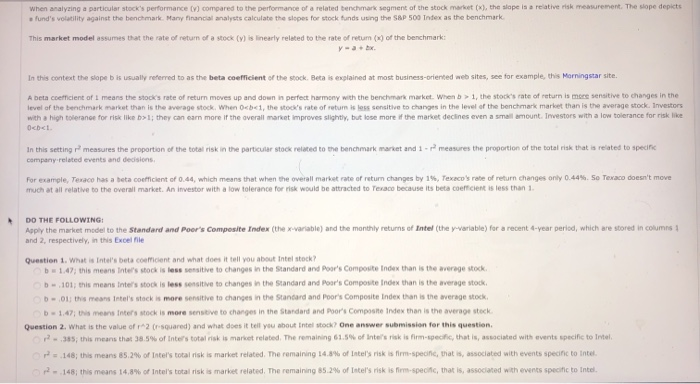
when analyzing a particular stock's performance compared to the performance of a related benchmark segment of the stock market (x), the slape is a relative risk measurement. The slope depicts fund's volatility against the benchmark. Many financial analysts calculate the slopes for stock funds using the SAP 500 Index as the benchmark This market model assumes that the rate of return of a stock (y) is linearly related to the rate of retum () of the benchmark: In this context the slope is usually referred to as the beta coefficient of the stock. Betais explained at most business-oriented websites, see for example, this Morningstar site. A beta coercent of means the stocks rate of return moves up and down in perfect harmony with the benchmark market. When the stock's rate of return is more sensitive to changes in the level of the benchmark market than is the average stock. When c541, the stock's rate of return is less sensitive to changes in the level of the benchmark market than is the average stock. Investors with a high tolerance for risk like > 1; they can earn more if the overall market improves slightly, but lose more the market declines even a small amount. Investors with a low tolerance for risk like measures the proportion of the total risk that is related to spedic In this setting measures the proportion of the total risk in the particular stock related to the benchmark market and 1 - company related events and decisions For example, Texaco has a beta coefficient of 0.44, which means that when the overall market rate of return changes by 19, Texaco's rate of return changes only 0.44% So Texaco doesn't move much at all relative to the overall market. An investor with a low tolerance for risk would be attracted to exace because its beta coercient is less than 1 DO THE FOLLOWING: Apply the market model to the Standard and Poor's Composite Index (the x variable) and the monthly returns of Intel (the variable) for a recent 4-year period, which are stored in columns 1 and 2, respectively in this Excelle Question 1. What is Intel's beta comicient and what does it tell you about Intel stock? b = 1.42; this means inter's stock is less sensitive to changes in the Standard and Poor's Composite Index than is the average stock 101; this means inter's stock is less sensitive to changes in the Standard and Poor's Composite Index than is the average stock b on this means intel's stock is more sensitive to changes in the Standard and Poor's Composite Index than is the average stock 1.47; I means inter's stock is more sensitive to changes in the Standard and Poor's Composite Index than is the average stock Question 2. What is the value of 2 (squared) and what does it tell you about Intel Sock One answer submission for this question. 385; this means that 38.5% of Inter's total risk is market related. The remaining 61.5 of Intel's risk is firm-specific, that is associated with events specific to Intel p=148; this means 85.296 of Intel's total risk is market related. The remaining 14.8% of Intel's risk is firm-specife, that is associated with events specific to Intel 148; this means 14,8% of Intel's total risk is market related. The remaining 85.2% of Intel's risk is special that is associated with events specific to Intel when analyzing a particular stock's performance compared to the performance of a related benchmark segment of the stock market (x), the slape is a relative risk measurement. The slope depicts fund's volatility against the benchmark. Many financial analysts calculate the slopes for stock funds using the SAP 500 Index as the benchmark This market model assumes that the rate of return of a stock (y) is linearly related to the rate of retum () of the benchmark: In this context the slope is usually referred to as the beta coefficient of the stock. Betais explained at most business-oriented websites, see for example, this Morningstar site. A beta coercent of means the stocks rate of return moves up and down in perfect harmony with the benchmark market. When the stock's rate of return is more sensitive to changes in the level of the benchmark market than is the average stock. When c541, the stock's rate of return is less sensitive to changes in the level of the benchmark market than is the average stock. Investors with a high tolerance for risk like > 1; they can earn more if the overall market improves slightly, but lose more the market declines even a small amount. Investors with a low tolerance for risk like measures the proportion of the total risk that is related to spedic In this setting measures the proportion of the total risk in the particular stock related to the benchmark market and 1 - company related events and decisions For example, Texaco has a beta coefficient of 0.44, which means that when the overall market rate of return changes by 19, Texaco's rate of return changes only 0.44% So Texaco doesn't move much at all relative to the overall market. An investor with a low tolerance for risk would be attracted to exace because its beta coercient is less than 1 DO THE FOLLOWING: Apply the market model to the Standard and Poor's Composite Index (the x variable) and the monthly returns of Intel (the variable) for a recent 4-year period, which are stored in columns 1 and 2, respectively in this Excelle Question 1. What is Intel's beta comicient and what does it tell you about Intel stock? b = 1.42; this means inter's stock is less sensitive to changes in the Standard and Poor's Composite Index than is the average stock 101; this means inter's stock is less sensitive to changes in the Standard and Poor's Composite Index than is the average stock b on this means intel's stock is more sensitive to changes in the Standard and Poor's Composite Index than is the average stock 1.47; I means inter's stock is more sensitive to changes in the Standard and Poor's Composite Index than is the average stock Question 2. What is the value of 2 (squared) and what does it tell you about Intel Sock One answer submission for this question. 385; this means that 38.5% of Inter's total risk is market related. The remaining 61.5 of Intel's risk is firm-specific, that is associated with events specific to Intel p=148; this means 85.296 of Intel's total risk is market related. The remaining 14.8% of Intel's risk is firm-specife, that is associated with events specific to Intel 148; this means 14,8% of Intel's total risk is market related. The remaining 85.2% of Intel's risk is special that is associated with events specific to Intel
Step by Step Solution
There are 3 Steps involved in it

Get step-by-step solutions from verified subject matter experts
 Study Help