



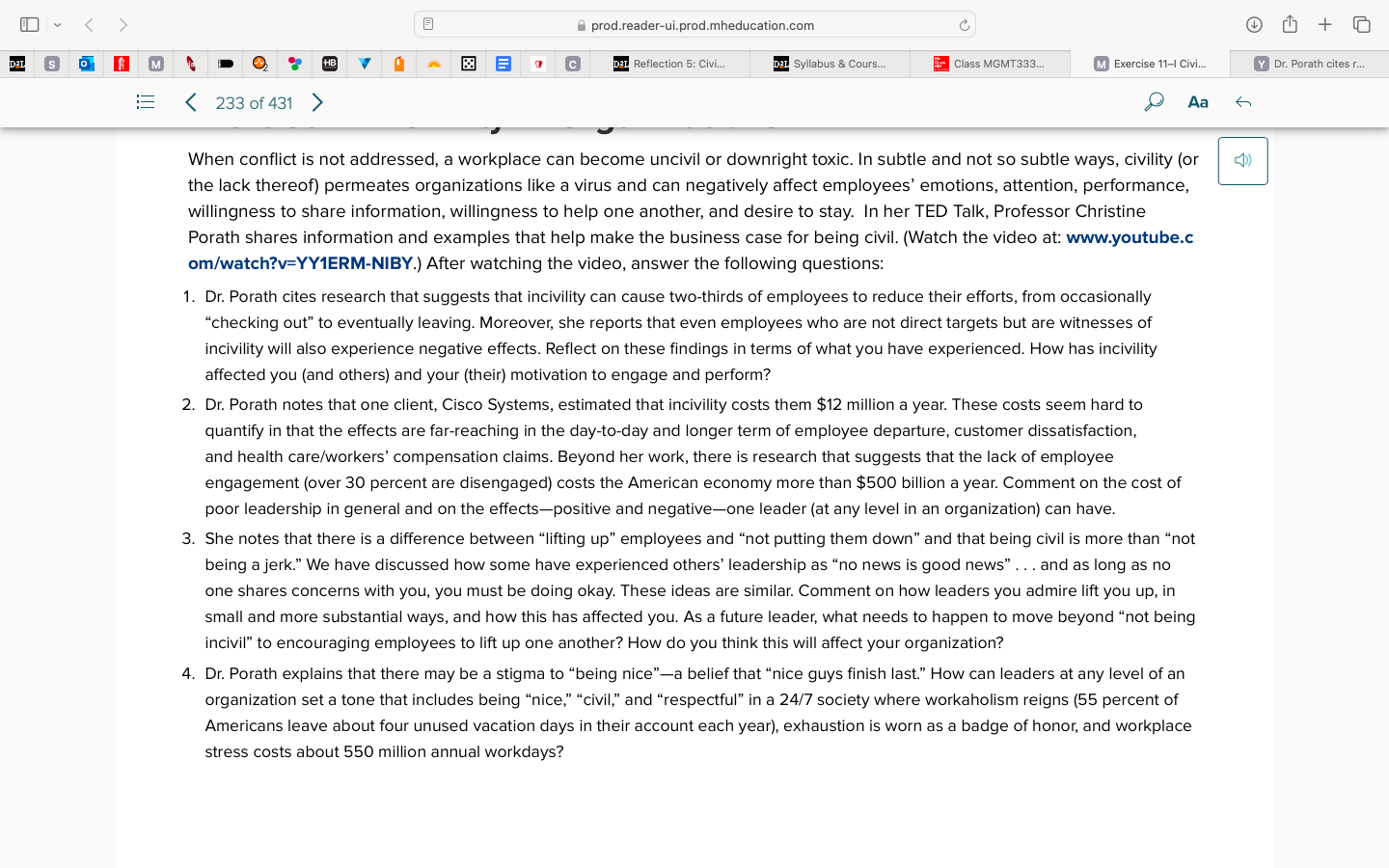
Question: When conflict is not addressed, a workplace can become uncivil or downright toxic. In subtle and not so subtle ways, civility ( or the lack
When conflict is not addressed, a workplace can become uncivil or downright toxic. In subtle and not so subtle ways, civility or
the lack thereof permeates organizations like a virus and can negatively affect employees' emotions, attention, performance,
willingness to share information, willingness to help one another, and desire to stay. In her TED Talk, Professor Christine
Porath shares information and examples that help make the business case for being civil. Watch the video at: wwwyoutube.c
omwatchvYYERMNIBY. After watching the video, answer the following questions:
Dr Porath cites research that suggests that incivility can cause twothirds of employees to reduce their efforts, from occasionally
"checking out" to eventually leaving. Moreover, she reports that even employees who are not direct targets but are witnesses of
incivility will also experience negative effects. Reflect on these findings in terms of what you have experienced. How has incivility
affected you and others and your their motivation to engage and perform?
Dr Porath notes that one client, Cisco Systems, estimated that incivility costs them $ million a year. These costs seem hard to
quantify in that the effects are farreaching in the daytoday and longer term of employee departure, customer dissatisfaction,
and health careworkers compensation claims. Beyond her work, there is research that suggests that the lack of employee
engagement over percent are disengaged costs the American economy more than $ billion a year. Comment on the cost of
poor leadership in general and on the effectspositive and negativeone leader at any level in an organization can have.
She notes that there is a difference between "lifting up employees and "not putting them down" and that being civil is more than "not
being a jerk." We have discussed how some have experienced others' leadership as no news is good news" and as long as no
one shares concerns with you, you must be doing okay. These ideas are similar. Comment on how leaders you admire lift you up in
small and more substantial ways, and how this has affected you. As a future leader, what needs to happen to move beyond "not being
incivil" to encouraging employees to lift up one another? How do you think this will affect your organization?
Dr Porath explains that there may be a stigma to "being nice"a belief that "nice guys finish last." How can leaders at any level of an
organization set a tone that includes being "nice," "civil," and "respectful" in a society where workaholism reigns percent of
Americans leave about four unused vacation days in their account each year exhaustion is worn as a badge of honor, and workplace
stress costs about million annual workdays?
Step by Step Solution
There are 3 Steps involved in it
1 Expert Approved Answer
Step: 1 Unlock

Question Has Been Solved by an Expert!
Get step-by-step solutions from verified subject matter experts
Step: 2 Unlock
Step: 3 Unlock