Question: When it comes to drilling companies, those settlements often include gag orders. That means the people involved can't talk about their experiences, or, more than
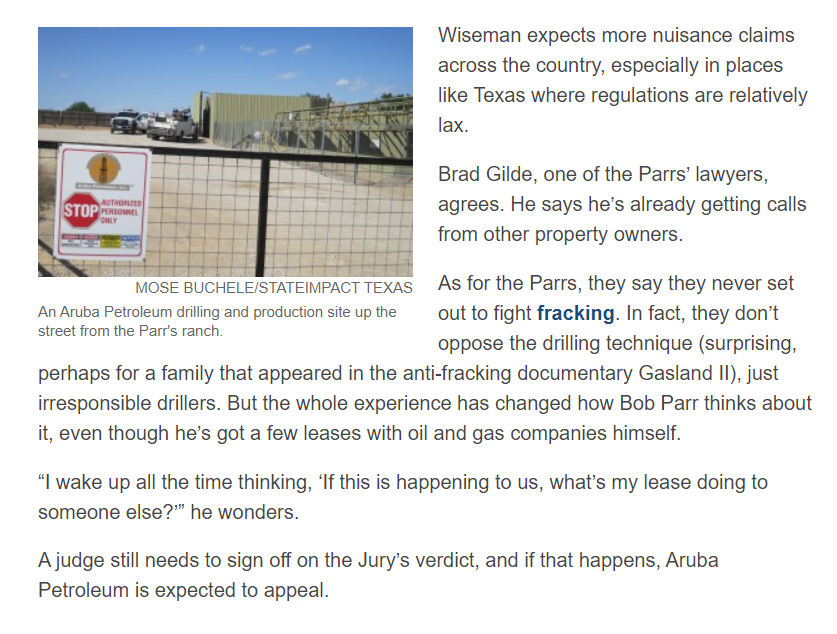

When it comes to drilling companies, those settlements often include gag orders. That means the people involved can't talk about their experiences, or, more than likely, show evidence to others of medical distress, like the photos the Parrs provided us with for this story. But in the case of Aruba Petroleum, the drilling company apparently decided to draw a line. As it turns out, that was not necessarily a very good decision, McGarity says. In a statement released after the verdict, the company expressed disappointment, saying, in part, that it's in compliance with Texas air quality rules. But that's another reason this case is getting attention: it doesn't necessarily matter whether the company is in compliance. The Parrs filed what's called a nuisance claim, the same kind of suit that's sometimes brought against unruly neighbors even if they haven't been charged with a crime. The Parrs had to show not that the company was breaking the law (though they say it was), but that it was behaving unreasonably as a neighbor. These types of claims are increasing in parts of the country where oil and gas drilling occurs near peoples' homes, says Hannah Wiseman, an Assistant Professor of Law at Florida State University. Because they allow this very broad argument that property use has been interfered with, and I think they fill in what some people see as gaps in the regulatory regime," Wiseman says. Wiseman expects more nuisance claims across the country, especially in places like Texas where regulations are relatively lax. AUTHORIZED STOP PERSONNEL Brad Gilde, one of the Parrs' lawyers, agrees. He says he's already getting calls from other property owners. ONEY MOSE BUCHELE/STATEIMPACT TEXAS As for the Parrs, they say they never set An Aruba Petroleum drilling and production site up the out to fight fracking. In fact, they don't street from the Parr's ranch. oppose the drilling technique (surprising, perhaps for a family that appeared in the anti-fracking documentary Gasland II), just irresponsible drillers. But the whole experience has changed how Bob Parr thinks about it, even though he's got a few leases with oil and gas companies himself. I wake up all the time thinking, 'If this is happening to us, what's my lease doing to someone else?!" he wonders. Ajudge still needs to sign off on the Jury's verdict, and if that happens, Aruba Petroleum is expected to appeal. The company's defense was that they were in compliance with the state regulatory standards. The plaintiffs claim that the state regulatory law is not the final word on liability. There is still wrongful conduct that falls under the general heading of tort law," in this case, nuisance. Do you agree with the plaintiffs or the company? Why? State regulatory standards are enforced by the government. But redress for civil wrongs (torts) may be pursued by private parties through lawsuits. Is one system preferable to the other? Is the combination of both better? Why or why not









 Study Help