







Question: When objects of different masses are compared without a scale, to be perceived the difference in mass must be large enough. For example, when held
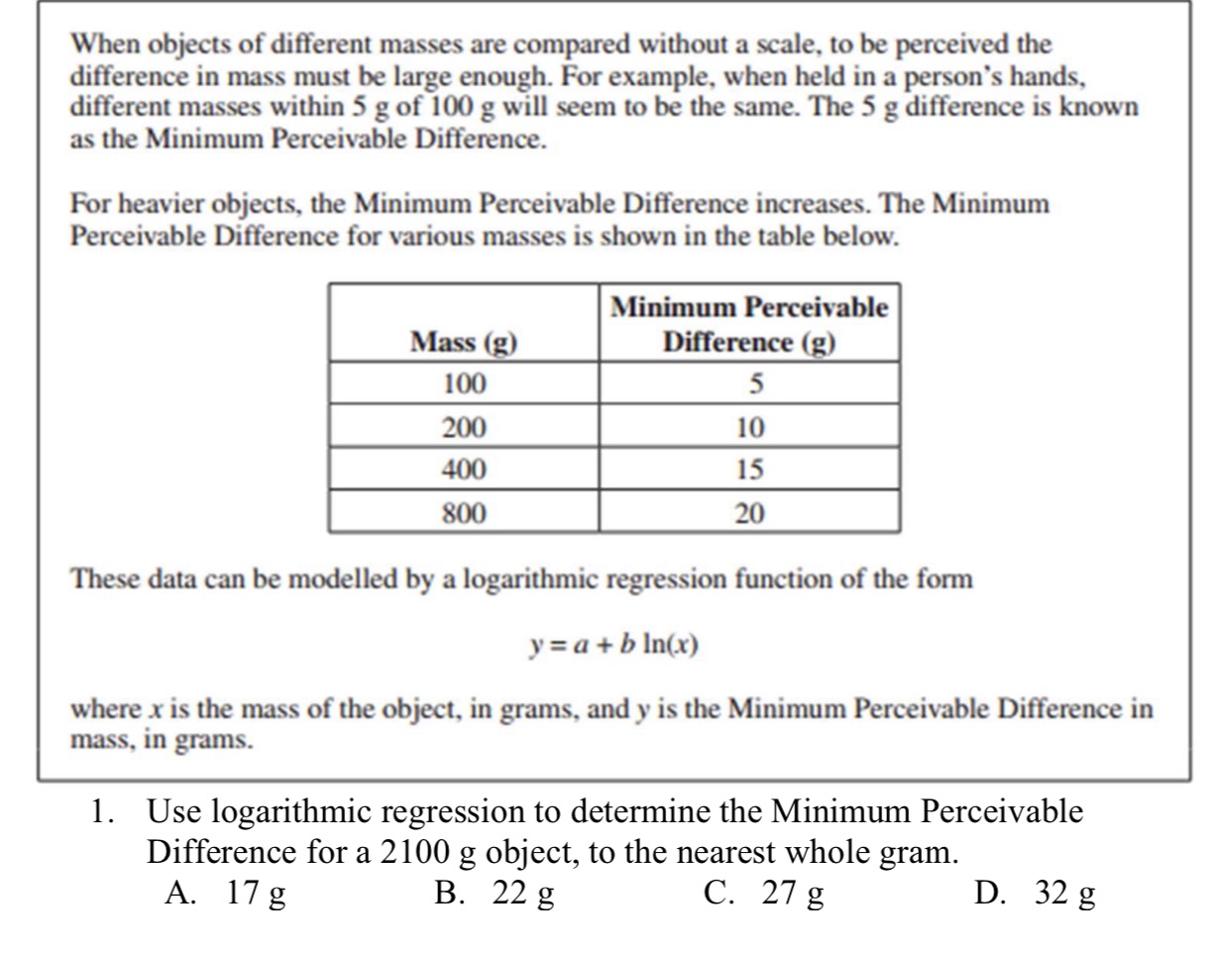
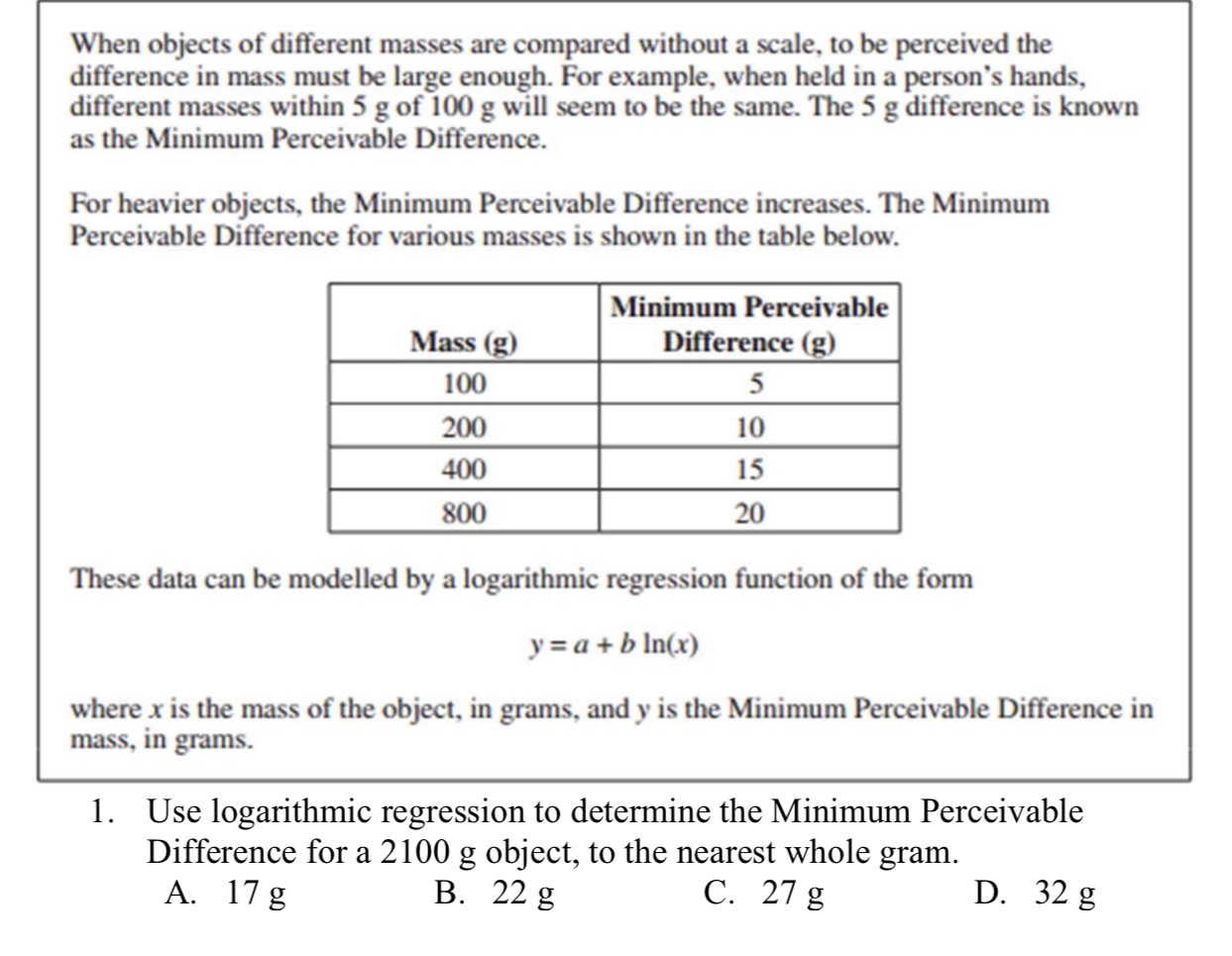
When objects of different masses are compared without a scale, to be perceived the difference in mass must be large enough. For example, when held in a person's hands, different masses within 5 g of 100 g will seem to be the same. The 5 g difference is known as the Minimum Perceivable Difference. For heavier objects, the Minimum Perceivable Difference increases. The Minimum Perceivable Difference for various masses is shown in the table below. Minimum Perceivable Mass (g) Difference (g) 100 5 200 10 400 15 800 20 These data can be modelled by a logarithmic regression function of the form y = a + b In(x) where x is the mass of the object, in grams, and y is the Minimum Perceivable Difference in mass, in grams. 1. Use logarithmic regression to determine the Minimum Perceivable Difference for a 2100 g object, to the nearest whole gram. A. 17g B. 22 g C. 27 g D. 32 g
Step by Step Solution
There are 3 Steps involved in it

Get step-by-step solutions from verified subject matter experts
 Study Help