







Question: When one does an integral over a flat disk of charge, the result is that the electric field above the center of the disk is:
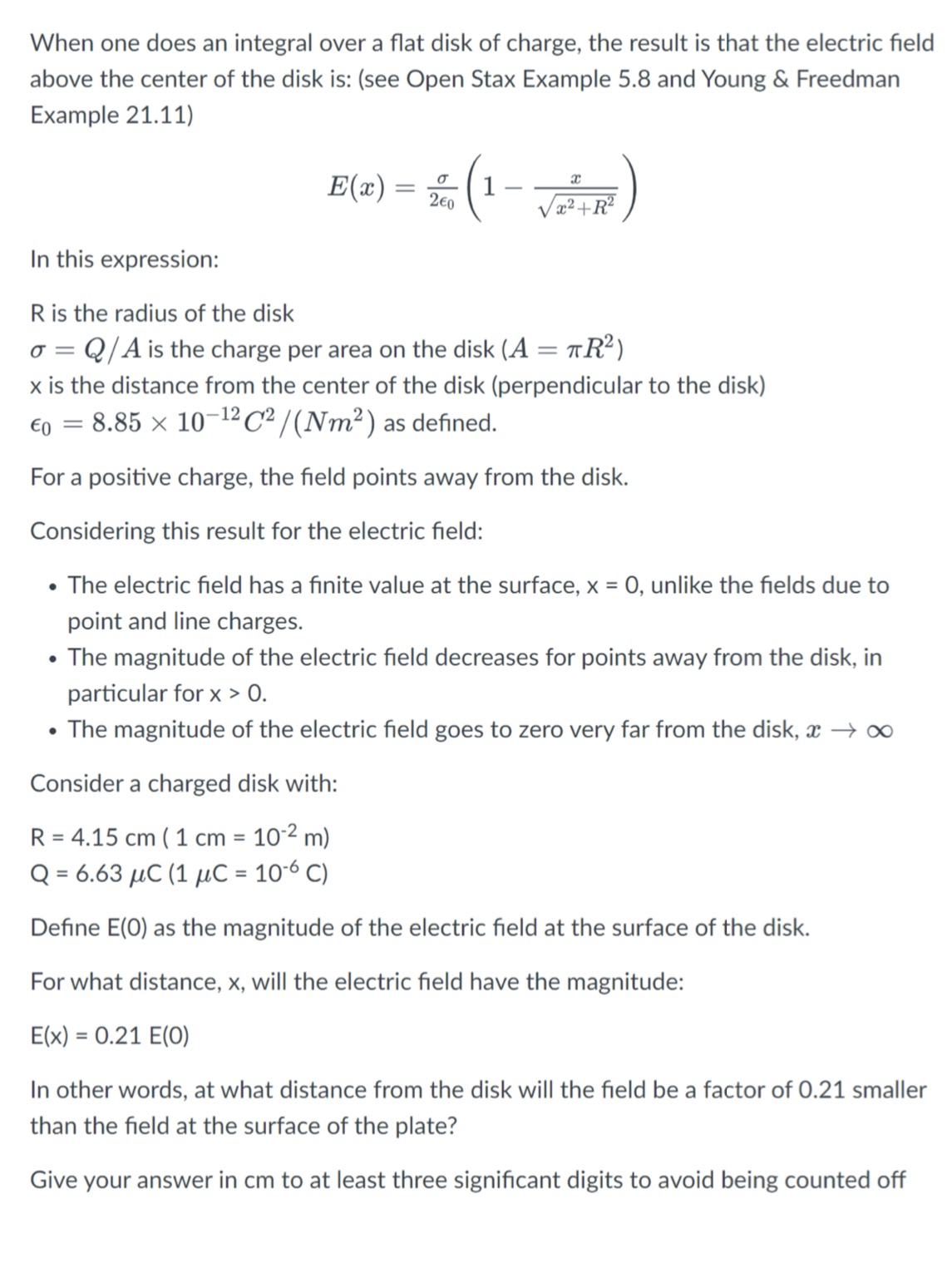
When one does an integral over a flat disk of charge, the result is that the electric field above the center of the disk is: (see Open Stax Example 5.8 and Young & Freedman Example 21.11) E(a) = 260 Vx2+ R2 In this expression: R is the radius of the disk o = Q/ A is the charge per area on the disk (A = TR2) x is the distance from the center of the disk (perpendicular to the disk) Co = 8.85 x 10⁻¹² C2 /(Nm2) as defined. For a positive charge, the field points away from the disk. Considering this result for the electric field: . The electric field has a finite value at the surface, x = 0, unlike the fields due to point and line charges. . The magnitude of the electric field decreases for points away from the disk, in particular for x > O. . The magnitude of the electric field goes to zero very far from the disk, x - co Consider a charged disk with: R = 4.15 cm ( 1 cm = 10-2 m) Q = 6.63 MC (1 MC = 10-6 C) Define E(O) as the magnitude of the electric field at the surface of the disk. For what distance, x, will the electric field have the magnitude: E(x) = 0.21 E(0) In other words, at what distance from the disk will the field be a factor of 0.21 smaller than the field at the surface of the plate? Give your answer in cm to at least three significant digits to avoid being counted off
Step by Step Solution
There are 3 Steps involved in it

Get step-by-step solutions from verified subject matter experts
 Study Help