







Question: When the user first runs the program, you will display the following menu:Welcome to 1 to 4 Demultiplexer!a ) Compute and Display the outputsb )
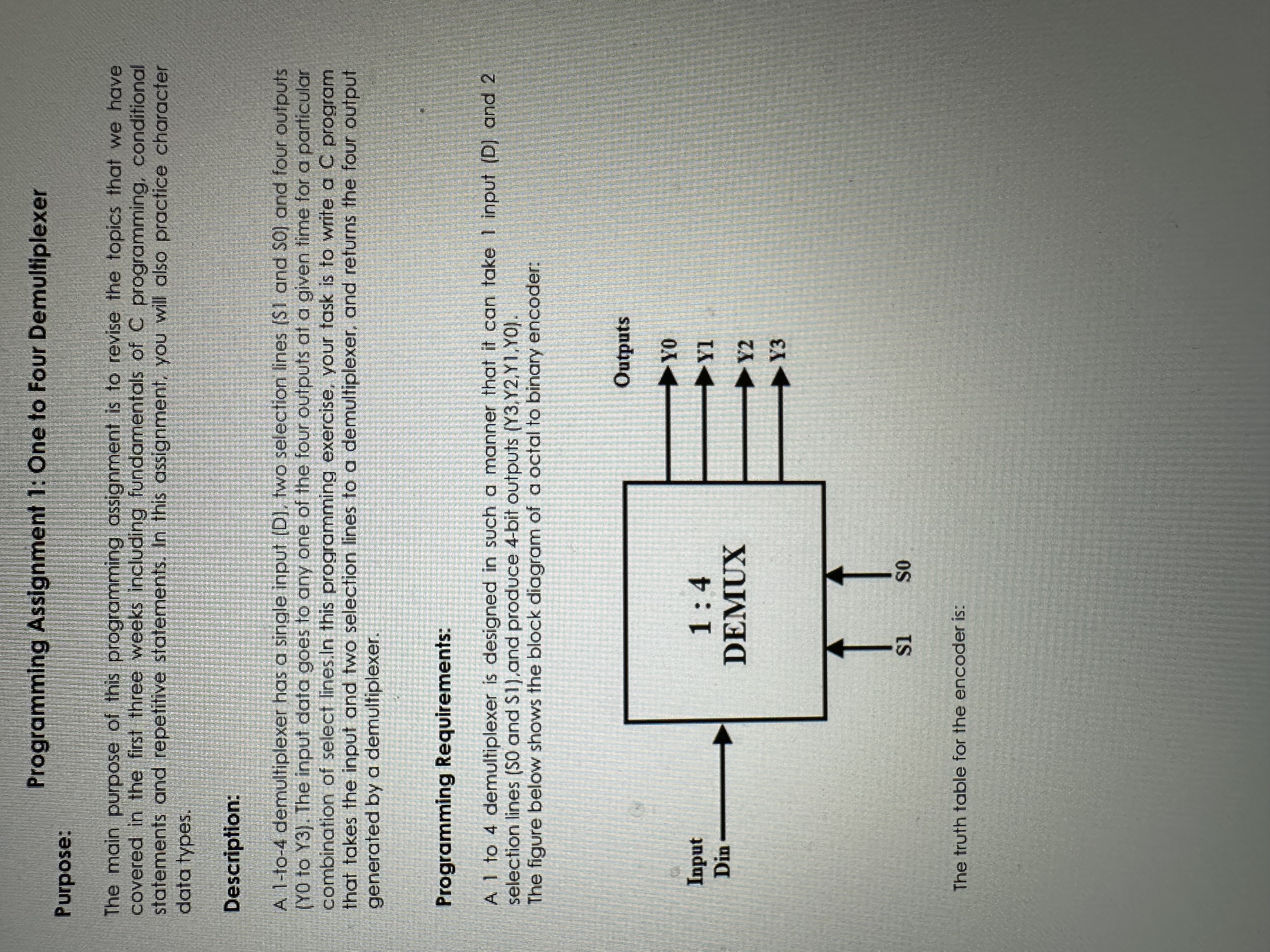
When the user first runs the program, you will display the following menu:Welcome to to Demultiplexer!a Compute and Display the outputsb QuitDepending on the option given by the user, your program will work as follows:Option a: When the user chooses this option, your program will first ask you to enter digit binary inputs. If more than bits is entered, then your program should print an error message and ask the user to reenter the input. digits will be used as inputs required by the demultiplexer. First digit is S the second digit is SO and the last digit is DThe inputs can be entered in base or base If the user enters in base then you will not need to make base conversions. However, if the user enters in base then you will need to convert it to binary. If the user enters a value in base then your program will display"not possible to convert it to digit binary number" and will ask the user to reenter the value again.Which base will you use to enter input base or base Please enter your input: From the above table, the output Y becomes l if all of the digits Sland SO and D are one.Thus, we can write its expression asYONOT SI AND NOT SO AND DYNOT S AND SO AND DY S AND NOT SO AND DY S AND SO AND DFor your reference, the truth table for bitwise AND and NOT are as follows:
Step by Step Solution
There are 3 Steps involved in it
1 Expert Approved Answer
Step: 1 Unlock

Question Has Been Solved by an Expert!
Get step-by-step solutions from verified subject matter experts
Step: 2 Unlock
Step: 3 Unlock
 Study Help