



Question: When Thomas Edison invented the electric light bulb, he patented his invention, so that no one but him could sell them. This made his
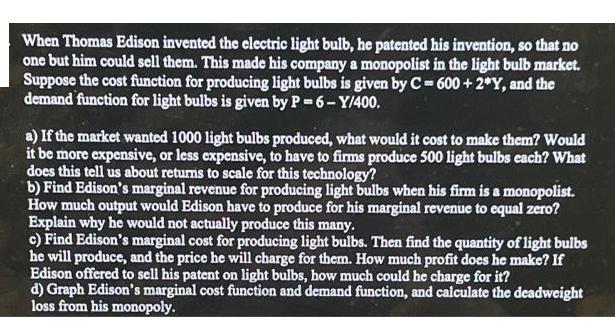
When Thomas Edison invented the electric light bulb, he patented his invention, so that no one but him could sell them. This made his company a monopolist in the light bulb market. Suppose the cost function for producing light bulbs is given by C=600+ 2*Y, and the demand function for light bulbs is given by P = 6 - Y/400. a) If the market wanted 1000 light bulbs produced, what would it cost to make them? Would it be more expensive, or less expensive, to have to firms produce 500 light bulbs each? What does this tell us about returns to scale for this technology? b) Find Edison's marginal revenue for producing light bulbs when his firm is a monopolist. How much output would Edison have to produce for his marginal revenue to equal zero? Explain why he would not actually produce this many. c) Find Edison's marginal cost for producing light bulbs. Then find the quantity of light bulbs he will produce, and the price he will charge for them. How much profit does he make? If Edison offered to sell his patent on light bulbs, how much could he charge for it? d) Graph Edison's marginal cost function and demand function, and calculate the deadweight loss from his monopoly.
Step by Step Solution
3.28 Rating (172 Votes )
There are 3 Steps involved in it

Get step-by-step solutions from verified subject matter experts