







Question: When we consider the orbit of celestial objects in Physics 101 we usually consider systems where a small object orbits around a much larger
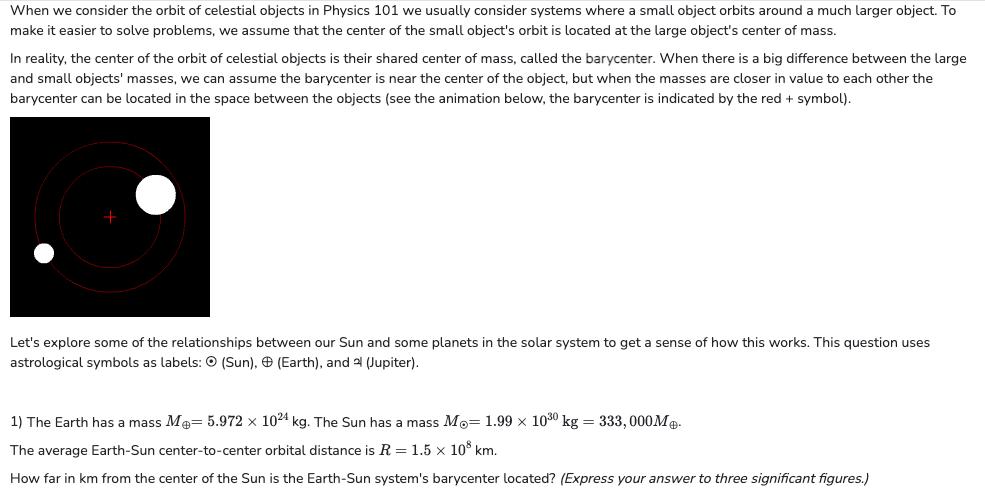

When we consider the orbit of celestial objects in Physics 101 we usually consider systems where a small object orbits around a much larger object. To make it easier to solve problems, we assume that the center of the small object's orbit is located at the large object's center of mass. In reality, the center of the orbit of celestial objects is their shared center of mass, called the barycenter. When there is a big difference between the large and small objects' masses, we can assume the barycenter is near the center of the object, but when the masses are closer in value to each other the barycenter can be located in the space between the objects (see the animation below, the barycenter is indicated by the red + symbol). Let's explore some of the relationships between our Sun and some planets in the solar system to get a sense of how this works. This question uses astrological symbols as labels: (Sun), (Earth), and 24 (Jupiter). 1) The Earth has a mass M= 5.972 x 1024 kg. The Sun has a mass Mo= 1.99 1030 kg = 333,000M. The average Earth-Sun center-to-center orbital distance is R = 1.5 108 km. How far in km from the center of the Sun is the Earth-Sun system's barycenter located? (Express your answer to three significant figures.) 2) The radius of the Sun is Ro= 696000 km. How many Sun-radii distances is the Earth-Sun barycenter from the center of the Sun? (Express your answer to three significant figures. You can enter numbers in scientific notation using the 'E' notation, e.g. 3 x 10⁸ can be input as 3E8.)
Step by Step Solution
There are 3 Steps involved in it

Get step-by-step solutions from verified subject matter experts
 Study Help