







Question: When we estimate distances from velocity data, it is sometimes necessary to use times t 0 , t 1 , t 2 , t 3
When we estimate distances from velocity data, it is sometimes necessary to use times
t
t
t
t
that are not equally spaced. We can still estimate distances using the time periods
ti ti ti
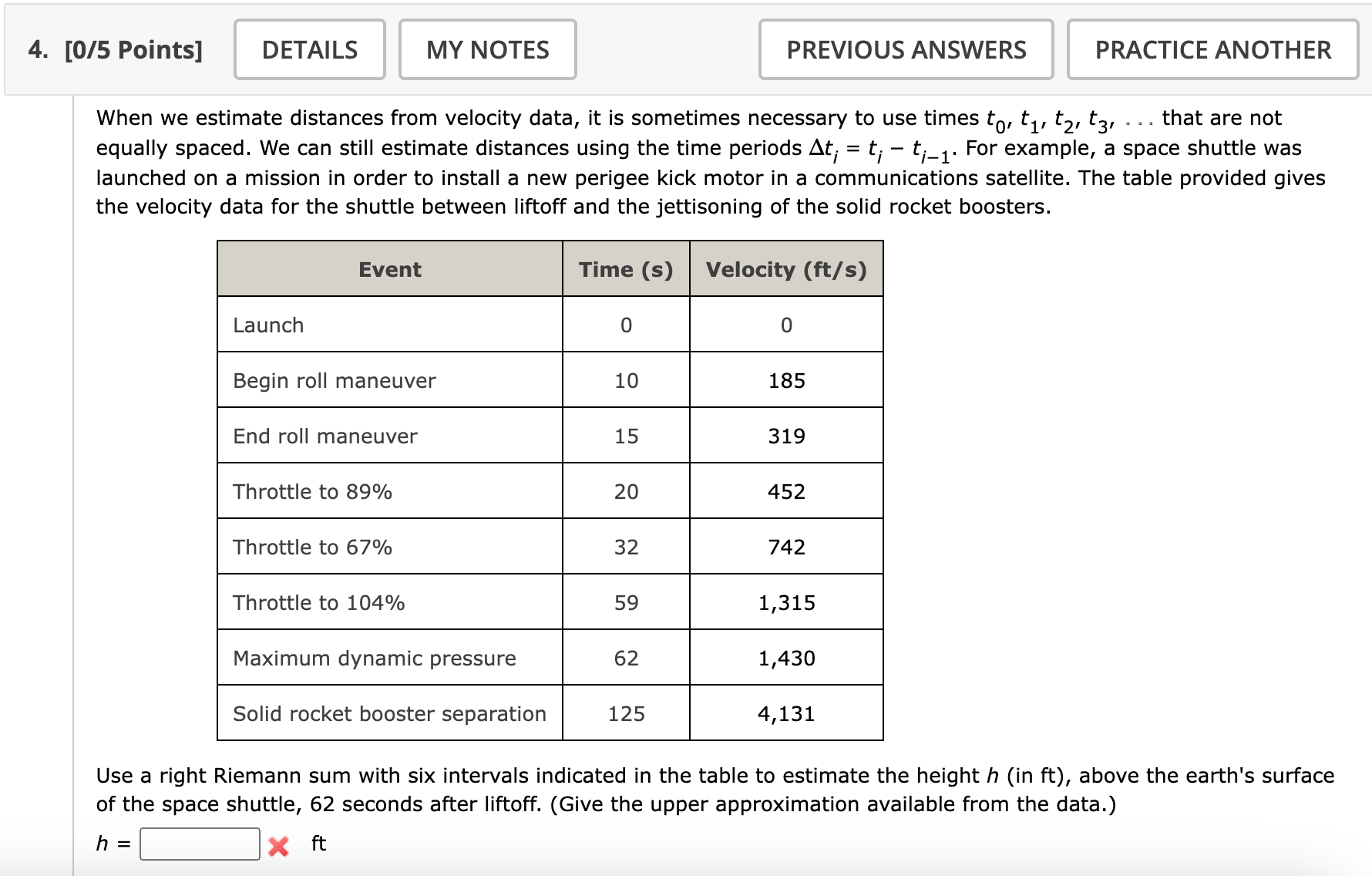
For example, a space shuttle was launched on a mission in order to install a new perigee kick motor in a communications satellite. The table provided gives the velocity data for the shuttle between liftoff and the jettisoning of the solid rocket boosters.
EventTime sVelocity ftsLaunchBegin roll maneuverEnd roll maneuverThrottle to Throttle to Throttle to Maximum dynamic pressureSolid rocket booster separation
Use a right Riemann sum with six intervals indicated in the table to estimate the height h in ft above the earth's surface of the space shuttle, seconds after liftoff. Give the upper approximation available from the data.
h ft Points
When we estimate distances from velocity data, it is sometimes necessary to use times t t t tldots that are not equally spaced. We can still estimate distances using the time periods Delta tititi For example, a space shuttle was launched on a mission in order to install a new perigee kick motor in a communications satellite. The table provided gives the velocity data for the shuttle between liftoff and the jettisoning of the solid rocket boosters.
begintabularlcc
hline multicolumnc Event & Time s & Velocity fts
hline Launch & &
hline Begin roll maneuver & &
hline End roll maneuver & &
hline Throttle to & &
hline Throttle to & &
hline Throttle to & &
hline Maximum dynamic pressure & &
hline Solid rocket booster separation & &
hline
endtabular
Use a right Riemann sum with six intervals indicated in the table to estimate the height h in ft above the earth's surface of the space shuttle, seconds after liftoff. Give the upper approximation available from the data.
hsquare
Step by Step Solution
There are 3 Steps involved in it
1 Expert Approved Answer
Step: 1 Unlock

Question Has Been Solved by an Expert!
Get step-by-step solutions from verified subject matter experts
Step: 2 Unlock
Step: 3 Unlock
 Study Help