







Question: When we estimate distances from velocity data, it is sometimes necessary to use times t 0 , t 1 , t 2 , t 3
When we estimate distances from velocity data, it is sometimes necessary to use times t0, t1, t2, t3, . . . that are not equally spaced. We can still estimate distances using the time periods Dti = ti - ti-1. For example, on May 7, 1992, the space shuttle Endeavour was launched on mission STS-49, the purpose of which was to install a new perigee kick motor in an Intelsat communications satellite. The table, provided by NASA, gives the velocity data for the shuttle between liftoff and the jettisoning of the solid rocket boosters. Use these data to estimate the height above the earth’s surface of the Endeavour, 62 seconds after lift off.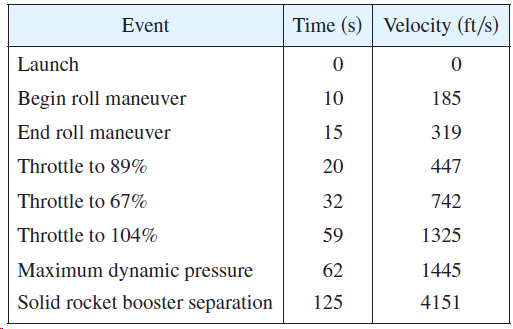
Velocity (ft/s) Time (s) Event Launch Begin roll maneuver 10 185 End roll maneuver 15 319 Throttle to 89% 20 447 Throttle to 67% 32 742 Throttle to 104% 59 1325 Maximum dynamic pressure 62 1445 Solid rocket booster separation 125 4151
Step by Step Solution
3.40 Rating (163 Votes )
There are 3 Steps involved in it
We can find an upper estimate by using the fi... View full answer

Get step-by-step solutions from verified subject matter experts
 Study Help