







Question: When we start working With the dot and the cross product in real life, things can get a little bit more tricky,
\ \ \ When we start working With the dot and the cross product in real life, things can get a little bit more tricky, so this next part is designed to get us used to working with different inputs and outputs for the dot and cross products.\
|(:1,3,4:)\\\\times (:2,-1,3:)|\
r=|[i,j,k],[1,3,4],[2,-1,3]|\
(a\\\\times b)*cwhere
a=(:1,3,4:),b=(:2,-1,3:)and
c=5.\
(a*b)/(|a||b|)where
a=(:1,3,4:),b=(:2,-1,3:)\
(a*b)\\\\times cwhere
a=(:1,3,4:),b=(:2,-1,3:)and
c=(:3,2,7:).\
(a\\\\times b)\\\\times cwhere
a=(:1,3,4:),b=
(:2,-1,3:)and
c=(:3,2,7:).\ a. The thing doesn't even make sense.\ b. A scalar.\ c. A vector.\ d. A vector perpendicular to both
(:1,3,4:)and
(:2,-1,3:).\ e. The area of the parallelogram whose edges are the vectors
(:1,3,4:)and
(:2,-1,3:).\ f. The cosine of the angle between
aand
b\ g. The sine of the angle between a and
b 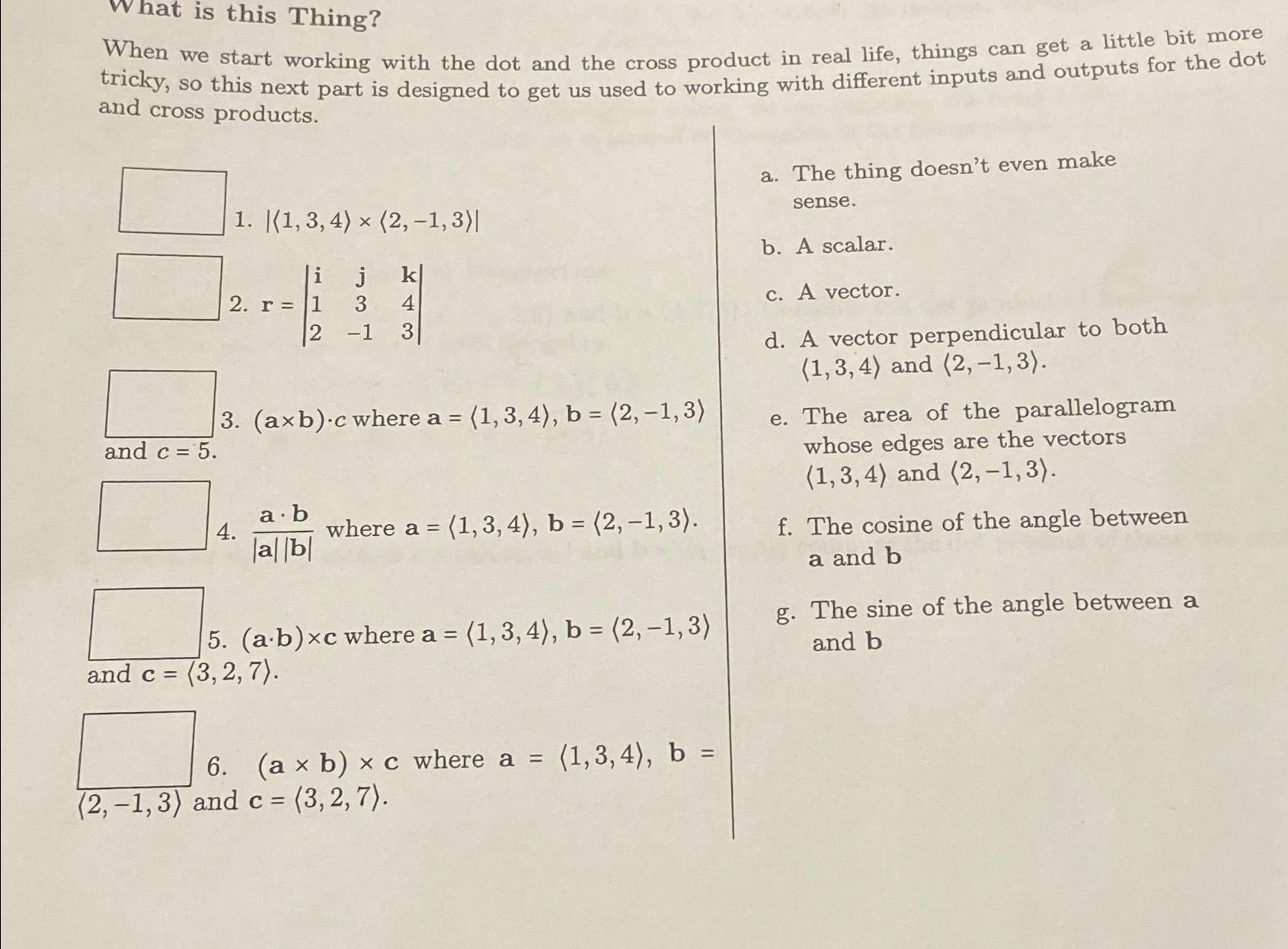
hat is this Thing? When we start working with the dot and the cross product in real life, things can get a little bit more tricky, so this next part is designed to get us used to working with different inputs and outputs for the dot and cross products. 1. 1,3,42,1,3 2. r=i12j31k43 3. (ab)c where a=1,3,4,b=2,1,3 and c=5. 4. abab where a=1,3,4,b=2,1,3. 5. (ab)c where a=1,3,4,b=2,1,3 and c=3,2,7. 6. (ab)c where a=1,3,4,b= 2,1,0 and c=3,2,7. a. The thing doesn't even make sense. b. A scalar. c. A vector. d. A vector perpendicular to both 1,3,4 and 2,1,3. e. The area of the parallelogram whose edges are the vectors 1,3,4 and 2,1,3. f. The cosine of the angle between a and b g. The sine of the angle between a and b
Step by Step Solution
There are 3 Steps involved in it

Get step-by-step solutions from verified subject matter experts
 Study Help