



Question: where k = I L is the stiffness, = L is the span's cord rotation, and ( FEM ) ? A B is the fixed
where is the stiffness, is the span's cord rotation, and FEM is the fixed end moment at A due to any loads applied on the span A similar equation can be written for the moment at
The two equations are very similar. By using to represent the near end and for the far end, they can both be written as
The sign convention for all these equations is that a positive moment is clockwise and positive angles are measured clockwise.
The previous equations are typically applied twice to each span for internal spans or end spans that are fixed supported. When the end is pin or roller supported, the internal moment at the end must be zero. In this case, the equation below can be derived for the moment at the other near support, and only one equation needs to be used for the span,
Figure
of
Part A Internal spans
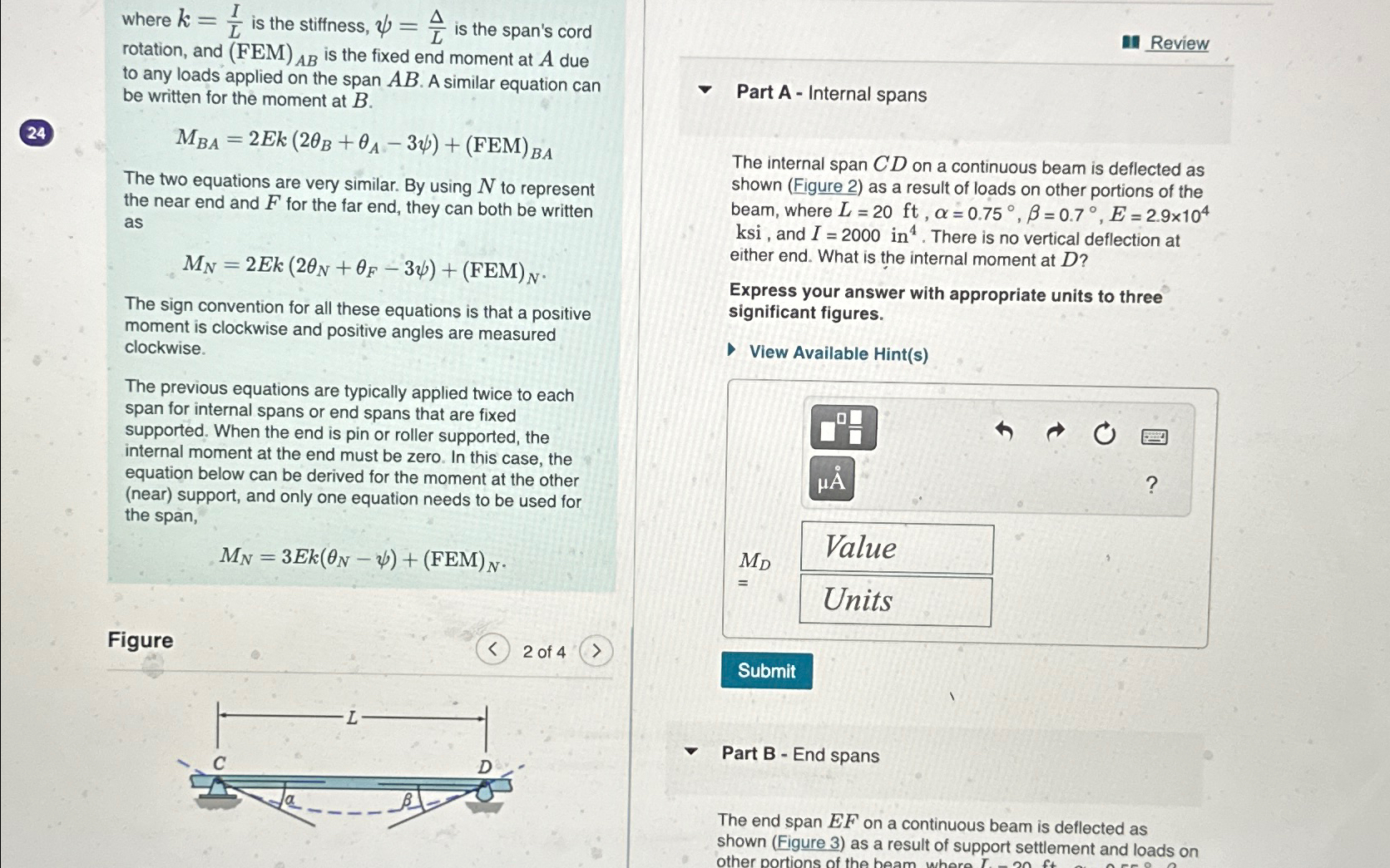
The internal span on a continuous beam is deflected as shown Figure as a result of loads on other portions of the beam, where ksi, and There is no vertical deflection at either end. What is the internal moment at
Express your answer with appropriate units to three significant figures.
View Available Hints
Part B End spans
The end span on a continuous beam is deflected as shown Figure as a result of support settlement and loads on
PLEASE USE THE SLOPE DEFLECTION EQUATION AND SOLVE FOR MD USING THE FIGURE IN THE BOTTOM LEFT OF PICTURE
Step by Step Solution
There are 3 Steps involved in it
1 Expert Approved Answer
Step: 1 Unlock

Question Has Been Solved by an Expert!
Get step-by-step solutions from verified subject matter experts
Step: 2 Unlock
Step: 3 Unlock