Question: Which options are true? Select one: O a. The sample statistics for the c-chart is the sample proportion defective. b. All processes contain a certain

Which options are true?
Which options are true? Select one: O a. TheWhich options are true? Select one: O a. TheWhich options are true? Select one: O a. The

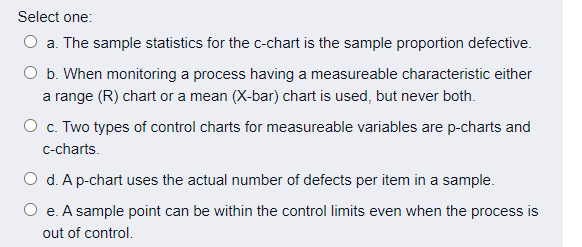
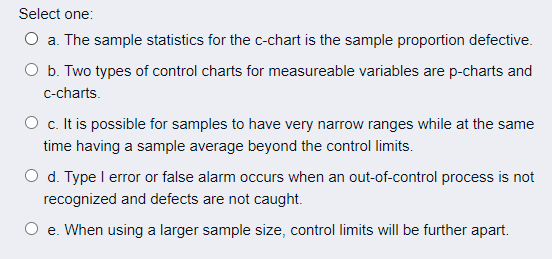
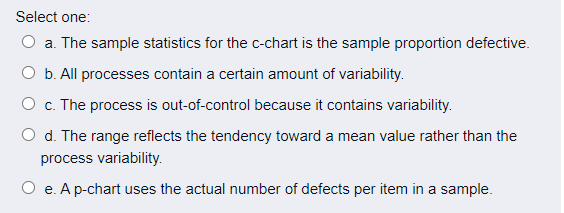
Select one: O a. The sample statistics for the c-chart is the sample proportion defective. b. All processes contain a certain amount of variability. O c. The process is out-of-control because it contains variability. O d. The range reflects the tendency toward a mean value rather than the process variability e. A p-chart uses the actual number of defects per item in a sample. Select one: O a. The sample statistics for the c-chart is the sample proportion defective. O b. When monitoring a process having a measureable characteristic either a range (R) chart or a mean (X-bar) chart is used, but never both. O c. Two types of control charts for measureable variables are p-charts and c-charts. O d. A p-chart uses the actual number of defects per item in a sample. O e. A sample point can be within the control limits even when the process is out of control Select one: O a. The sample statistics for the c-chart is the sample proportion defective. O b. Two types of control charts for measureable variables are p-charts and c-charts. O c. It is possible for samples to have very narrow ranges while at the same time having a sample average beyond the control limits. O d. Type I error or false alarm occurs when an out-of-control process is not recognized and defects are not caught. O e. When using a larger sample size, control limits will be further apart

Step by Step Solution

There are 3 Steps involved in it

1 Expert Approved Answer
Step: 1 Unlock blur-text-image

Question Has Been Solved by an Expert!

Get step-by-step solutions from verified subject matter experts

Step: 2 Unlock
Step: 3 Unlock

Students Have Also Explored These Related General Management Questions!