Question: Which response is better and give justification Response 1 Response 2 Sure, I can help you solve this second-order differential equation Sure, I'd be happy
Which response is better and give justification
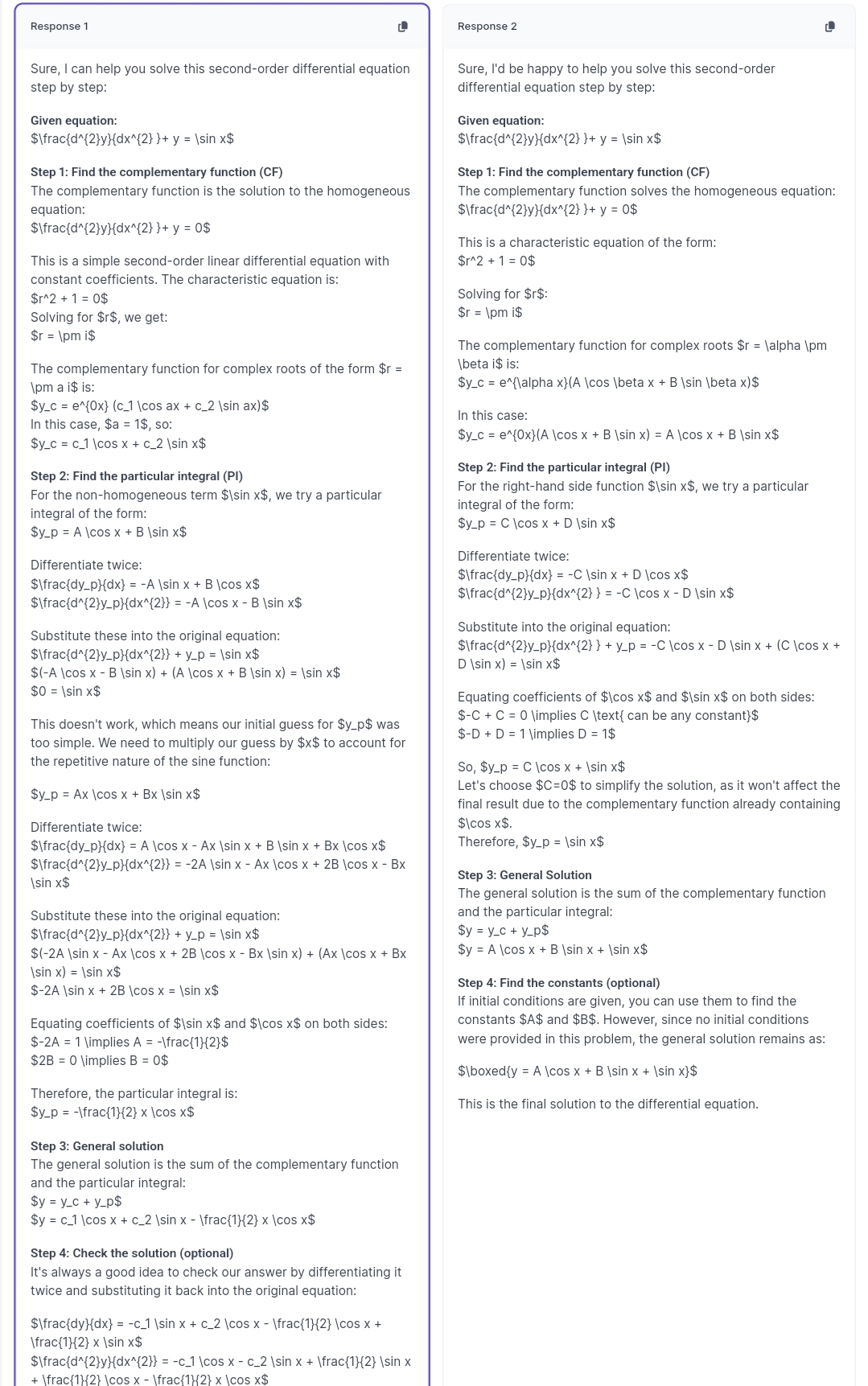
Response 1 Response 2 Sure, I can help you solve this second-order differential equation Sure, I'd be happy to help you solve this second-order step by step: differential equation step by step: Given equation: Given equation: $\\frac{d~{2}y}{dx^{2} }+ y = \\sin x$ $\\frac{d~{2)y}dx^{2} }+ y = \\sin x$ Step 1: Find the complementary function (CF) Step 1: Find the complementary function (CF) The complementary function is the solution to the homogeneous The complementary function solves the homogeneous equation: equation: $\\frac{d (2)y}dx^{2} }+ y = 0$ $\\frac{d~{2)y}dx^{2} }+ y = 0$ This is a characteristic equation of the form: This is a simple second-order linear differential equation with $r^2 + 1 = 0$ constant coefficients. The characteristic equation is: $r^2 + 1 = 0$ Solving for $r$: Solving for $r$, we get: $r = \\pm i$ $r = \\pm i$ The complementary function for complex roots $r = \\alpha \\pm The complementary function for complex roots of the form $r = \\beta i$ is: \\pm a i$ is: $y_c = e~{\\alpha x}(A \\cos \\beta x + B \\sin \\beta x)$ $y_c = e~{0x} (c_1 \\cos ax + c_2 \\sin ax) $ In this case, $a = 1$, so: In this case: $y_c = c_1 \\cos x + c_2 \\sin x$ $y_c = e~{0x}(A \\cos x + B \\sin x) = A \\cos x + B \\sin x$ Step 2: Find the particular integral (PI) Step 2: Find the particular integral (PI) For the non-homogeneous term $\\sin x$, we try a particular For the right-hand side function $\\sin x$, we try a particular integral of the form: integral of the form: $y_p = A \\cos x + B \\sin x$ $y_p = C \\cos x + D \\sin x$ Differentiate twice: Differentiate twice: $\\frac{dy_p}{dx} = -C \\sin x + D \\cos x$ $\\frac{dy_p}dx} = -A \\sin x + B \\cos x$ $\\frac(d~{2)y_p}{dx^{2}} = -A \\cos x - B \\sin x$ $\\frac{d~{2)y_p}{dx~{2} } = -C \\cos x - D \\sin x$ Substitute these into the original equation: Substitute into the original equation: $\\frac(d~{2}y_p}dx^{2}} + y_p = \\sin x$ $\\frac{d {2}y_p}{dx^{2} } + y_p = -C \\cos x - D \\sin x + (C \\cos x + $(-A \\cos x - B \\sin x) + (A \\cos x + B \\sin x) = \\sin x$ D \\sin x) = \\sin x$ $0 = \\sin x$ Equating coefficients of $\\cos x$ and $\\sin x$ on both sides: This doesn't work, which means our initial guess for $y_p$ was $-C + C = 0 \\implies C \\text{ can be any constant}$ too simple. We need to multiply our guess by $x$ to account for $-D + D = 1 \\implies D = 1$ the repetitive nature of the sine function: So, $y_p = C \\cos x + \\sin x$ $y_p = Ax \\cos x + Bx \\sin x$ Let's choose $C=0$ to simplify the solution, as it won't affect the final result due to the complementary function already containing Differentiate twice: $1cos x$. $\\frac{dy_p}dx} = A \\cos x - Ax \\sin x + B \\sin x + Bx \\cos x$ Therefore, $y_p = \\sin x$ $\\frac{d~{2}y_p}dx~{2}} = -2A \\sin x - Ax \\cos x + 2B \\cos x - Bx Step 3: General Solution Isin x$ The general solution is the sum of the complementary function Substitute these into the original equation: and the particular integral: $\\frac(d~{2)y_p}dx^{2}} + y_p = \\sin x$ $y = y_c + y_p$ $(-2A \\sin x - Ax (cos x + 2B \\cos x - Bx (sin x) + (Ax \\cos x + Bx $y = A \\cos x + B \\sin x + \\sin x$ (sin x) = \\sin x$ $-2A \\sin x + 2B \\cos x = \\sin x$ Step 4: Find the constants (optional) If initial conditions are given, you can use them to find the Equating coefficients of $\\sin x$ and $\\cos x$ on both sides: constants $A$ and $B$. However, since no initial conditions $-2A = 1 \\implies A = -\\frac{1}{2}$ were provided in this problem, the general solution remains as: $2B = 0 \\implies B = 0$ $\\boxed{y = A \\cos x + B \\sin x + (sin x}$ Therefore, the particular integral is: $y_p = -\\frac{1}{2} x \\cos x$ This is the final solution to the differential equation. Step 3: General solution The general solution is the sum of the complementary function and the particular integral: $y = y_c + y_p$ $y = c_1 \\cos x + c_2 \\sin x - \\frac(1}{2} x \\cos x$ Step 4: Check the solution (optional) It's always a good idea to check our answer by differentiating it twice and substituting it back into the original equation: $\\frac{dy}dx} = -c_1 \\sin x + c_2 \\cos x - \\frac{1}{2} \\cos x + \\frac{1}{2} x \\sin x$ $\\frac{d~{2)y}dx^{2)) = -c_1 \\cos x - c_2 \\sin x + (frac{1}2} \\sin x \\frac/1 2) \\cos x - \\fracf1}{2) x \\cos x$









 Study Help