







Question: Which type of wave gets absorbed, and therefore does not pass trough. when it hits the outer core layer of Earth? * O P-wave O
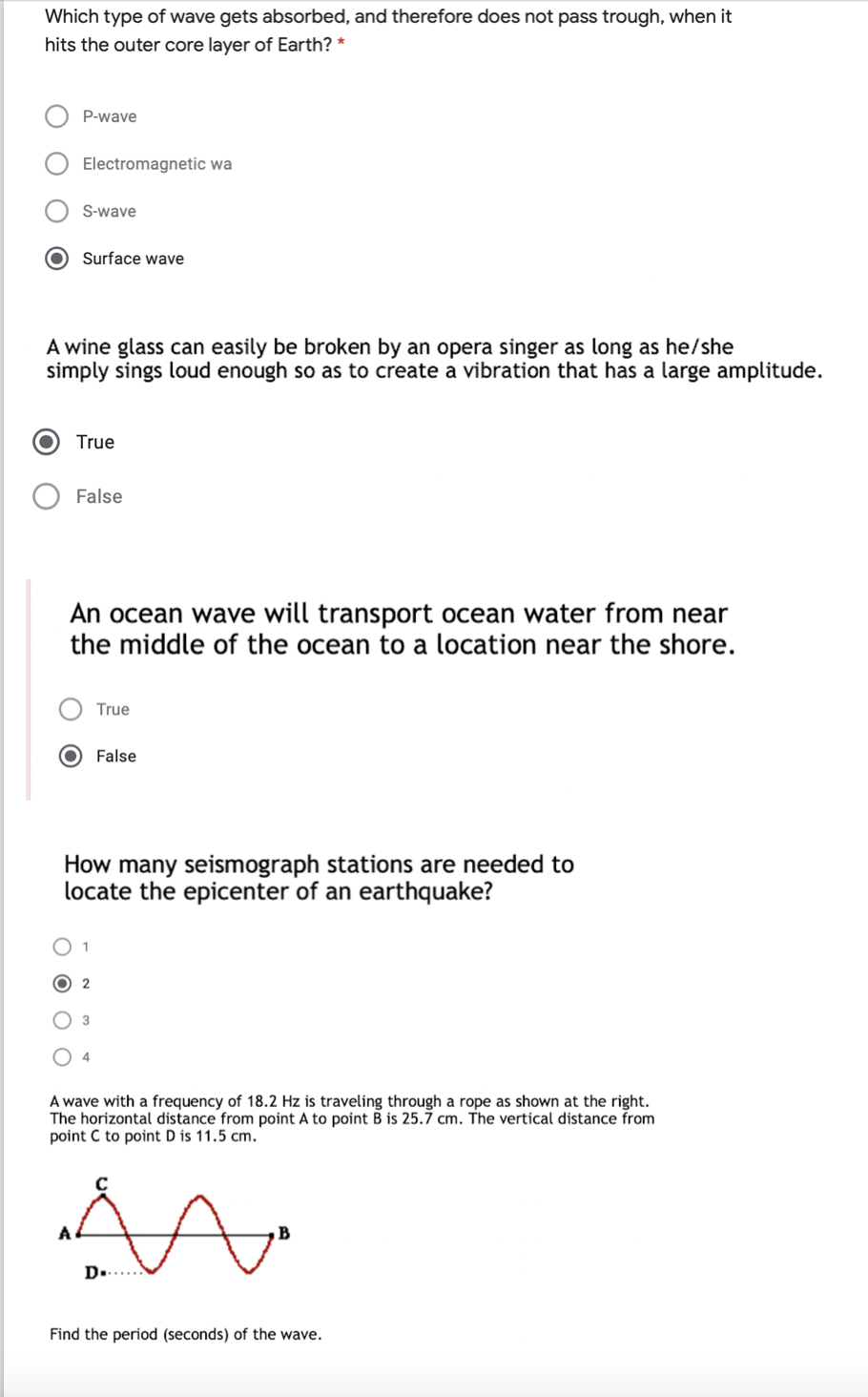
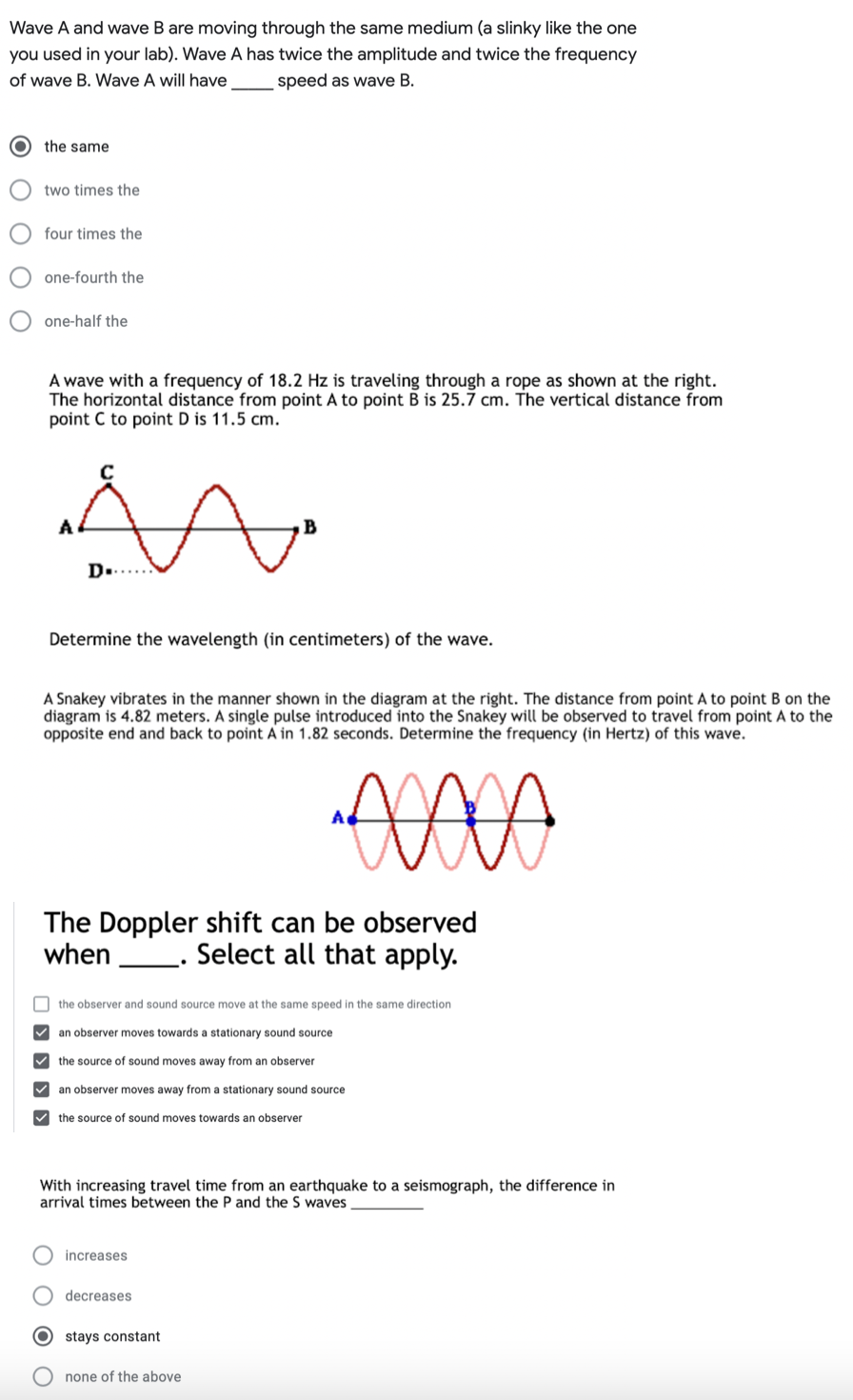
Which type of wave gets absorbed, and therefore does not pass trough. when it hits the outer core layer of Earth? * O P-wave O Electromagnetic we 0 S-wave (0) Surface were A wine glass can easily be broken by an opera singer as long as hefshe simply sings loud enough so as to create a vibration that has a large amplitude. An ocean wave will transport ocean water from near the middle of the ocean to a location near the shore. How many seismograph stations are needed to locate the epicenter of an earthquake? A wave with a frequency of 18. 2 Hz is traveling through a rope as shown at the right. The horizontal distance from point A to point B is 25.7 cm. The vertical distance from point C to point D is 11.5 cm. Find the period (seconds) of the wave. Wave A and wave B are moving through the same medium (a slinky like the one you used in your lab). Wave A has twice the amplitude and twice the frequency of wave B. Wave A will have speed as wave B. O the same O two times the O four times the O one-fourth the O one-half the A wave with a frequency of 18.2 Hz is traveling through a rope as shown at the right. The horizontal distance from point A to point B is 25.7 cm. The vertical distance from point C to point D is 11.5 cm. D.. . Determine the wavelength (in centimeters) of the wave. A Snakey vibrates in the manner shown in the diagram at the right. The distance from point A to point B on the diagram is 4.82 meters. A single pulse introduced into the Snakey will be observed to travel from point A to the opposite end and back to point A in 1.82 seconds. Determine the frequency (in Hertz) of this wave. The Doppler shift can be observed when Select all that apply. the observer and sound source move at the same speed in the same direction V an observer moves towards a stationary sound source the source of sound moves away from an observer an observer moves away from a stationary sound source the source of sound moves towards an observer With increasing travel time from an earthquake to a seismograph, the difference in arrival times between the P and the S waves O increases O decreases O stays constant O none of the above
Step by Step Solution
There are 3 Steps involved in it

Get step-by-step solutions from verified subject matter experts
 Study Help