Question: Why do you think upper management would have to be convinced to accept a change that would benefit the organisation? VIGNETTE: A SUPPLIER ALLIANCE AT
Why do you think upper management would have to be convinced to accept a change that would benefit the organisation?
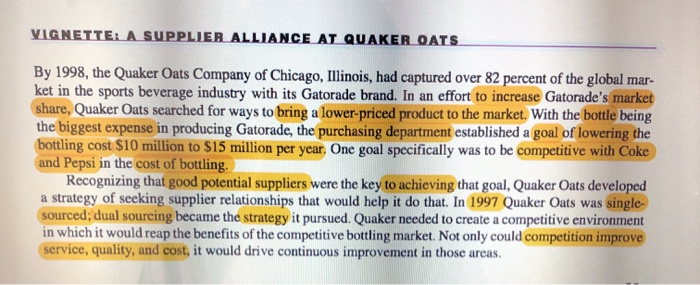
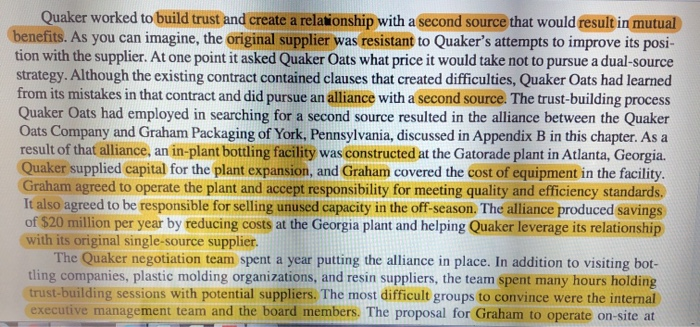
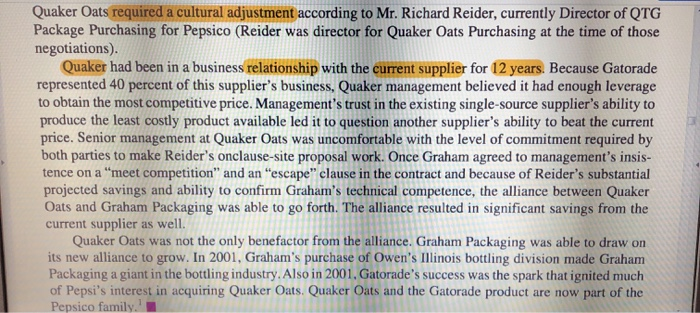
VIGNETTE: A SUPPLIER ALLIANCE AT QUAKER OATS By 1998, the Quaker Oats Company of Chicago, Illinois, had captured over 82 percent of the global mar- ket in the sports beverage industry with its Gatorade brand. In an effort to increase Gatorade's market share, Quaker Oats searched for ways to bring a lower-priced product to the market. With the bottle being the biggest expense in producing Gatorade, the purchasing department established a goal of lowering the bottling cost $10 million to $15 million per year. One goal specifically was to be competitive with Coke and Pepsi in the cost of bottling. Recognizing that good potential suppliers were the key to achieving that goal, Quaker Oats developed a strategy of seeking supplier relationships that would help it do that. In 1997 Quaker Oats was single- sourced; dual sourcing became the strategy it pursued. Quaker needed to create a competitive environment in which it would reap the benefits of the competitive bottling market. Not only could competition improve service, quality, and cost, it would drive continuous improvement in those areas. Quaker worked to build trust and create a relationship with a second source that would result in mutual benefits. As you can imagine, the original supplier was resistant to Quaker's attempts to improve its posi- tion with the supplier. At one point it asked Quaker Oats what price it would take not to pursue a dual-source strategy. Although the existing contract contained clauses that created difficulties, Quaker Oats had learned from its mistakes in that contract and did pursue an alliance with a second source. The trust-building process Quaker Oats had employed in searching for a second source resulted in the alliance between the Quaker Oats Company and Graham Packaging of York, Pennsylvania, discussed in Appendix B in this chapter. As a result of that alliance, an in-plant bottling facility was constructed at the Gatorade plant in Atlanta, Georgia. Quaker supplied capital for the plant expansion, and Graham covered the cost of equipment in the facility. Graham agreed to operate the plant and accept responsibility for meeting quality and efficiency standards. It also agreed to be responsible for selling unused capacity in the off-season. The alliance produced savings of $20 million per year by reducing costs at the Georgia plant and helping Quaker leverage its relationship with its original single-source supplier. The Quaker negotiation team spent a year putting the alliance in place. In addition to visiting bot- tling companies, plastic molding organizations, and resin suppliers, the team spent many hours holding trust-building sessions with potential suppliers. The most difficult groups to convince were the internal executive management team and the board members. The proposal for Graham to operate on-site at Quaker Oats required a cultural adjustment according to Mr. Richard Reider, currently Director of QTG Package Purchasing for Pepsico (Reider was director for Quaker Oats Purchasing at the time of those negotiations). Quaker had been in a business relationship with the current supplier for 12 years. Because Gatorade represented 40 percent of this supplier's business, Quaker management believed it had enough leverage to obtain the most competitive price. Management's trust in the existing single-source supplier's ability to produce the least costly product available led it to question another supplier's ability to beat the current price. Senior management at Quaker Oats was uncomfortable with the level of commitment required by both parties to make Reider's onclause-site proposal work. Once Graham agreed to management's insis- tence on a meet competition" and an "escape" clause in the contract and because of Reider's substantial projected savings and ability to confirm Graham's technical competence, the alliance between Quaker Oats and Graham Packaging was able to go forth. The alliance resulted in significant savings from the current supplier as well. Quaker Oats was not the only benefactor from the alliance. Graham Packaging was able to draw on its new alliance to grow. In 2001, Graham's purchase of Owen's Illinois bottling division made Graham Packaging a giant in the bottling industry. Also in 2001, Gatorade's success was the spark that ignited much of Pepsi's interest in acquiring Quaker Oats. Quaker Oats and the Gatorade product are now part of the Pepsico family









 Study Help