





Question: Why does the previous program print what you selected? Why does the previous program print what you selected? Why does the previous program print what
 Why does the previous program print what you selected? Why does
Why does the previous program print what you selected?
the previous program print what you selected? Why does the previous program

Why does the previous program print what you selected?

print what you selected? Question 1 (1 point) What does the following

Why does the previous program print what you selected?

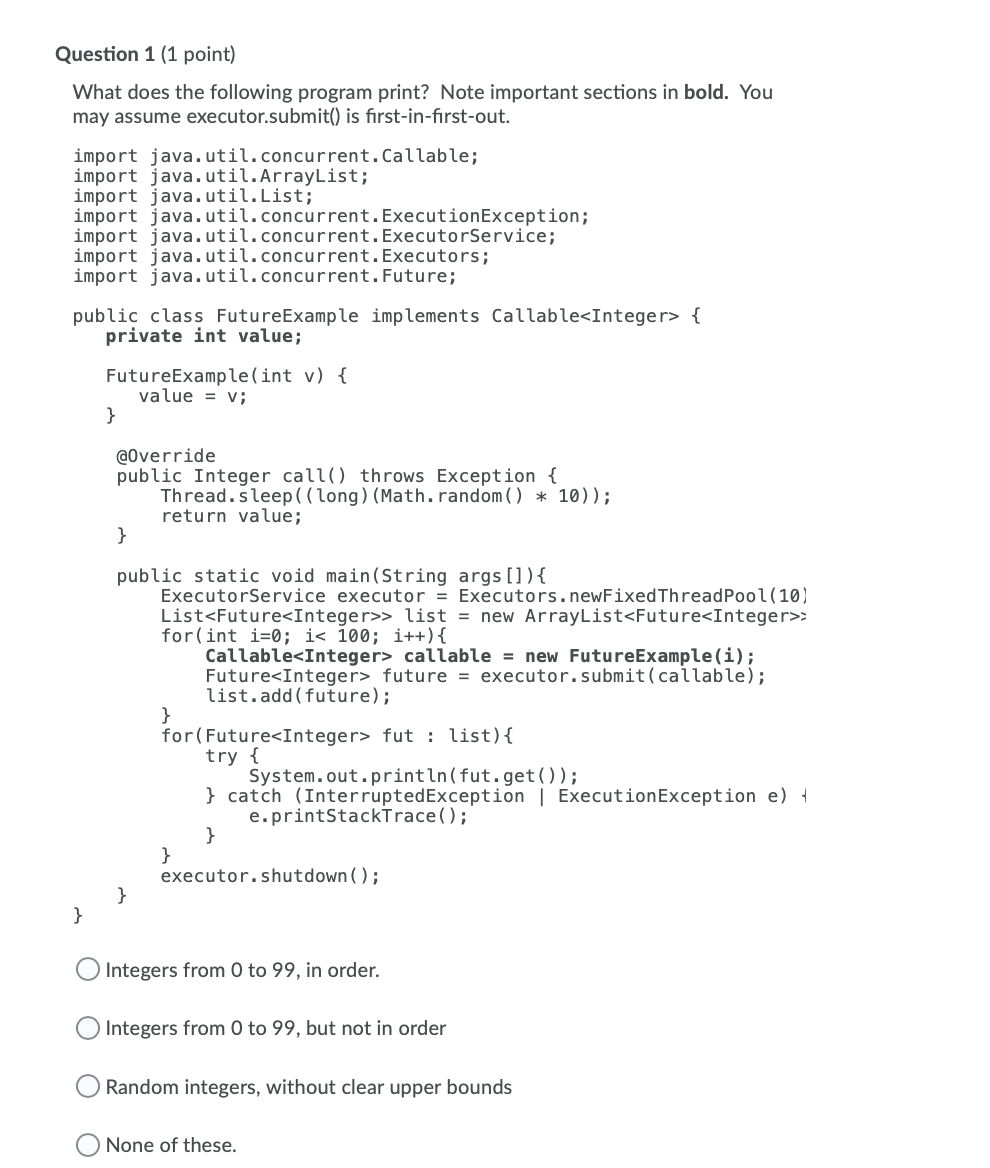
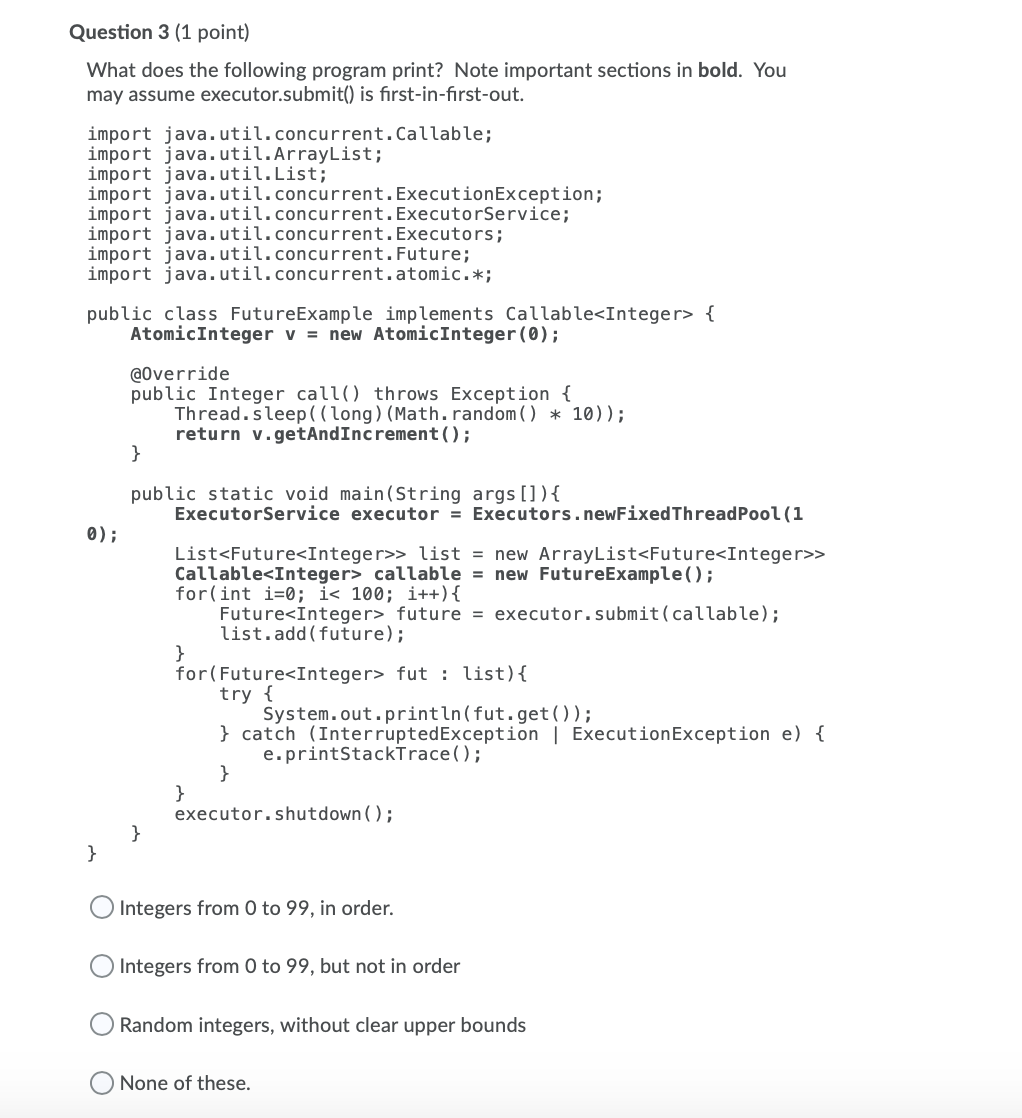
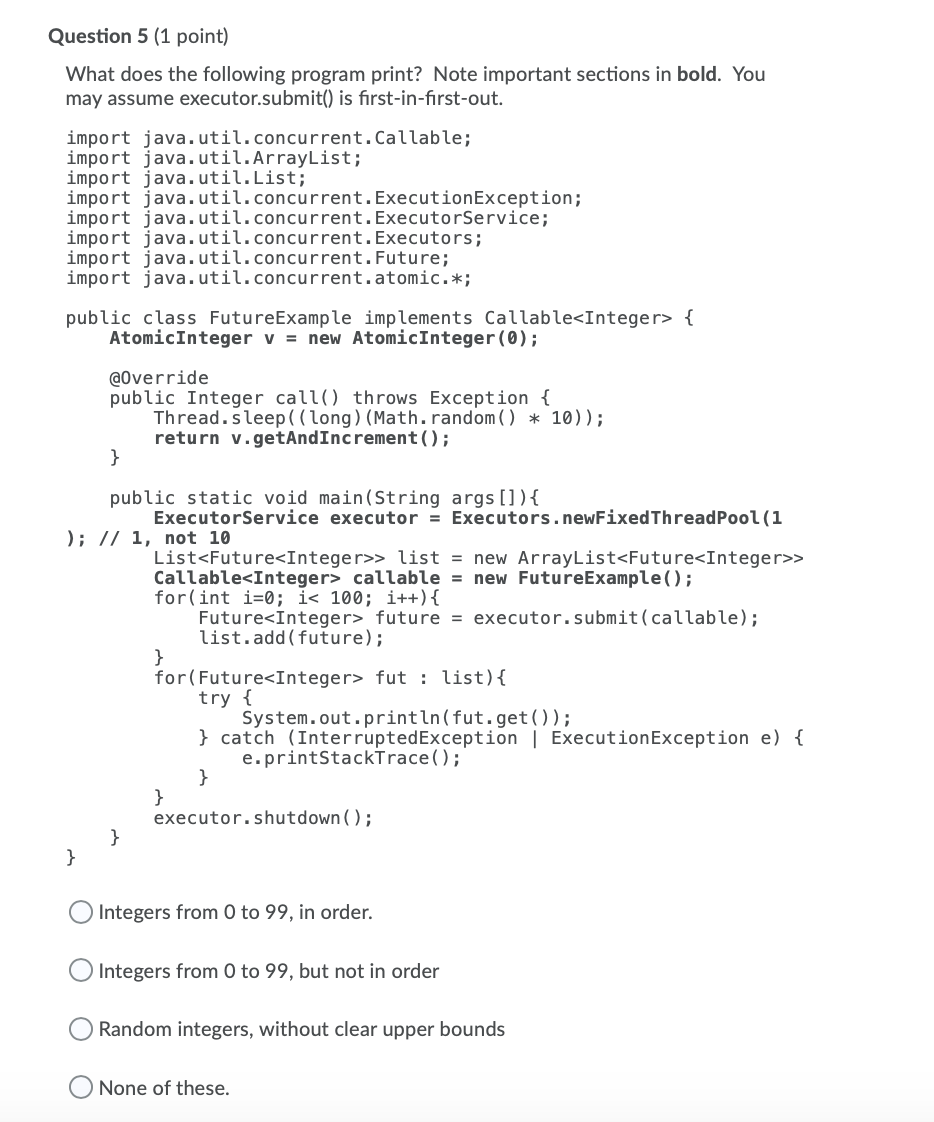
Question 1 (1 point) What does the following program print? Note important sections in bold. You may assume executor.submit() is first-in-first-out. import java.util.concurrent.Callable; import java.util.ArrayList; import java.util.List; import java.util.concurrent. ExecutionException; import java.util.concurrent. ExecutorService; import java.util.concurrent. Executors; import java.util.concurrent. Future; public class FutureExample implements Callable { private int value; FutureExample(int v) { value = V; } @Override public Integer call() throws Exception { Thread.sleep((long) (Math.random() * 10)); return value; } public static void main(String args[]) { Executor Service executor = Executors.newFixedThreadPool(10) List> list = new ArrayList> for(int i=0; i callable = new FutureExample(i); Future future = executor.submit(callable); list.add(future); } for(Future fut : list) { try { System.out.println(fut.get()); } catch (InterruptedException | ExecutionException e) { e.printStackTrace(); } } executor.shutdown(); } } Integers from 0 to 99, in order. Integers from 0 to 99, but not in order Random integers, without clear upper bounds None of these. Question 3 (1 point) What does the following program print? Note important sections in bold. You may assume executor.submit() is first-in-first-out. import java.util.concurrent. Callable; import java.util.ArrayList; import java.util.List; import java.util.concurrent. ExecutionException; import java.util.concurrent. ExecutorService; import java.util.concurrent. Executors; import java.util.concurrent. Future; import java.util.concurrent.atomic.*; public class FutureExample implements Callable { Atomic Integer v = new AtomicInteger(0); @Override public Integer call() throws Exception { Thread.sleep( (long) (Math.random() * 10)); return v.getAndIncrement(); } public static void main(String args[]) { ExecutorService executor = Executors.newFixedThreadPool(1 0); List> list = new ArrayList> Callable callable = new FutureExample(); for(int i=0; i future = executor.submit(callable); list.add(future); } for(Future fut : list) { try { System.out.println(fut.get()); } catch (InterruptedException | ExecutionException e) { e.printStackTrace(); } } executor.shutdown(); } } Integers from 0 to 99, in order. Integers from 0 to 99, but not in order Random integers, without clear upper bounds None of these. Question 5 (1 point) What does the following program print? Note important sections in bold. You may assume executor.submit() is first-in-first-out. import java.util.concurrent. Callable; import java.util.ArrayList; import java.util.List; import java.util.concurrent. ExecutionException; import java.util.concurrent. ExecutorService; import java.util.concurrent. Executors; import java.util.concurrent. Future; import java.util.concurrent.atomic.*; public class FutureExample implements Callable { Atomic Integer v = new AtomicInteger(0); @Override public Integer call() throws Exception { Thread.sleep((long) (Math.random() * 10)); return v.getAndIncrement(); } public static void main(String args[]) { ExecutorService executor = Executors.newFixedThreadPool(1 ); // 1, not 10 List> list = new ArrayList> Callable callable = new FutureExample(); for(int i=0; i future = executor.submit(callable); list.add(future); } for(Future fut : list) { try { System.out.println(fut.get()); } catch (InterruptedException | ExecutionException e) { e.printStackTrace(); } } executor. shutdown(); } } Integers from 0 to 99, in order. Integers from 0 to 99, but not in order Random integers, without clear upper bounds None of these

Step by Step Solution

There are 3 Steps involved in it

1 Expert Approved Answer
Step: 1 Unlock blur-text-image
Question Has Been Solved by an Expert!

Get step-by-step solutions from verified subject matter experts

Step: 2 Unlock
Step: 3 Unlock

Students Have Also Explored These Related Databases Questions!