



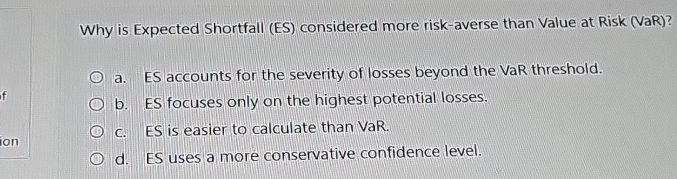
Question: Why is Expected Shortfall ( ES ) considered more risk - averse than Value at Risk ( VaR ) ? a . ES accounts for
Why is Expected Shortfall ES considered more riskaverse than Value at Risk VaR
a ES accounts for the severity of losses beyond the VaR threshold.
b ES focuses only on the highest potential losses.
c ES is easier to calculate than VaR.
d ES uses a more conservative confidence level.
Step by Step Solution
There are 3 Steps involved in it
1 Expert Approved Answer
Step: 1 Unlock

Question Has Been Solved by an Expert!
Get step-by-step solutions from verified subject matter experts
Step: 2 Unlock
Step: 3 Unlock