







Question: Why must unit costs often be interpreted with caution? O A. Unit costs often fall outside of the relevant range of predicting total cost for
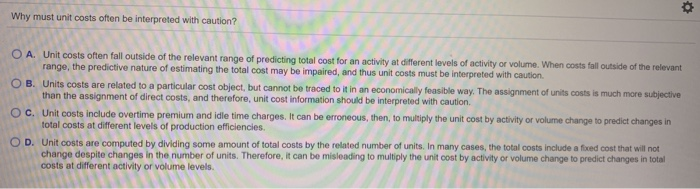
Why must unit costs often be interpreted with caution? O A. Unit costs often fall outside of the relevant range of predicting total cost for an activity at different levels of activity or volume. When costs fall outside of the relevant rango, the predictive nature of estimating the total cost may be impaired, and thus unit costs must be interpreted with caution. OB. Units costs are related to a particular cost object, but cannot be traced to it in an economically feasible way. The assignment of units costs is much more subjective than the assignment of direct costs, and therefore, unit cost information should be interpreted with caution OC. Unit costs include overtime premium and idle time charges. It can be erroneous, then, to multiply the unit cost by activity or volume change to predict changes in total costs at different levels of production efficiencies. OD. Unit costs are computed by dividing some amount of total costs by the related number of units. In many cases, the total costs include a faced cost that will not change despite changes in the number of units. Therefore, it can be misleading to multiply the unit cost by activity or volume change to predict changes in total costs at different activity or volume levels
Step by Step Solution
There are 3 Steps involved in it

Get step-by-step solutions from verified subject matter experts
 Study Help