Question: wil an improvement team use the problem statement? 5. Read Example 4.16 Q. As if you were the project manager responsible for solving this problem,
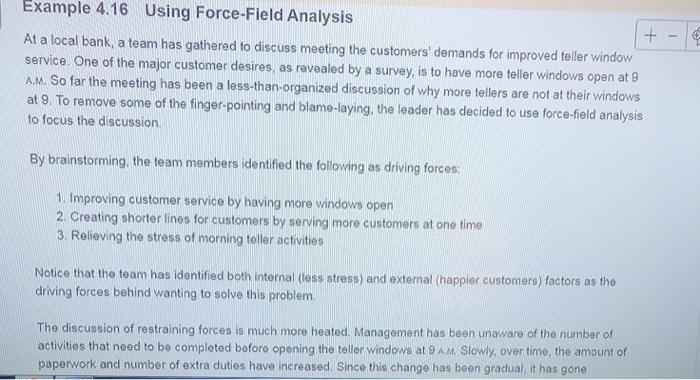
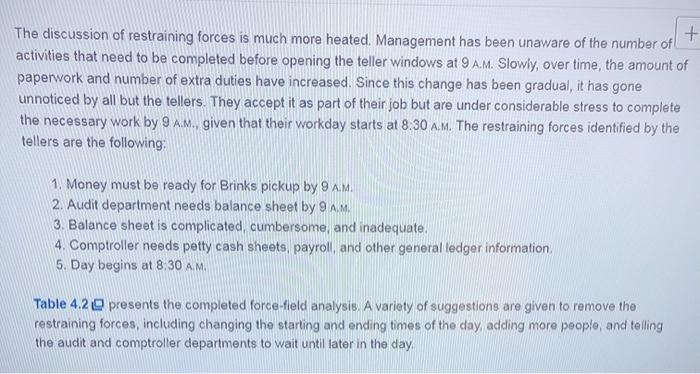
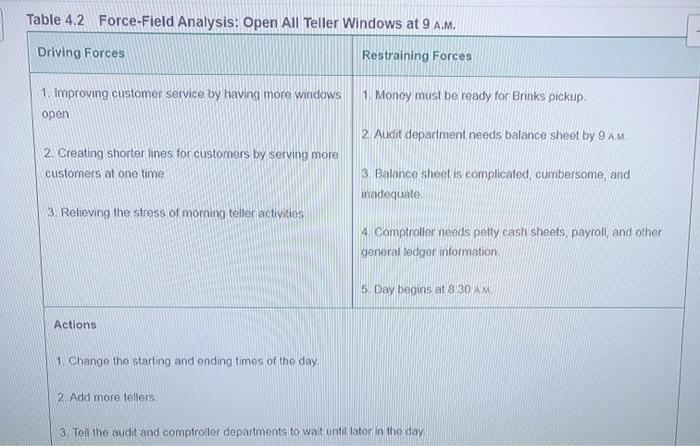
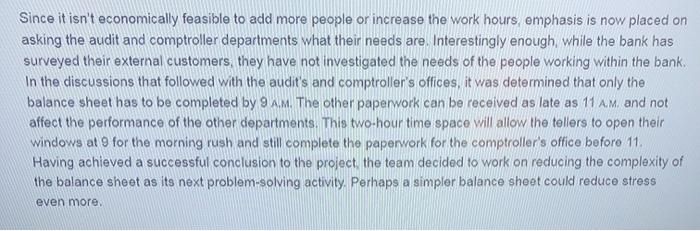
wil an improvement team use the problem statement? 5. Read Example 4.16 Q. As if you were the project manager responsible for solving this problem, describe the steps you would take to plan this problem investigation. 6. A pizza company with stores located citywide usee nne order call in nhono numb + - Example 4.16 Using Force-Field Analysis At a local bank, a team has gathered to discuss meeting the customers' demands for improved teller window service. One of the major customer desires, as revealed by a survey, is to have more teller windows open at 9 A.M. So far the meeting has been a less-than-organized discussion of why more tellers are not at their windows at 9. To remove some of the finger-pointing and blame-laying, the leader has decided to use force-field analysis to focus the discussion By brainstorming, the team members identified the following as driving forces: 1. Improving customer service by having more windows open 2. Creating shorter lines for customers by serving more customers at one time 3. Relieving the stress of morning teller activities Notice that the team has identified both internal (less stress) and external (happier customers) factors as the driving forces behind wanting to solve this problem The discussion of restraining forces is much more heated. Management has been unaware of the number of activities that need to be completed before opening the toller windows at OAM. Slowly, over time, the amount of paperwork and number of extra duties have increased. Since this change has been gradual, it has gone + The discussion of restraining forces is much more heated. Management has been unaware of the number of activities that need to be completed before opening the teller windows at 9 A.M. Slowly, over time, the amount of paperwork and number of extra duties have increased. Since this change has been gradual, it has gone unnoticed by all but the tellers. They accept it as part of their job but are under considerable stress to complete the necessary work by 9 A.M., given that their workday starts at 8:30 a.m. The restraining forces identified by the tellers are the following: 1. Money must be ready for Brinks pickup by 9 AM 2. Audit department needs balance sheet by 9 AM 3. Balance sheet is complicated, cumbersome, and inadequate 4. Comptroller needs petty cash sheets payroll, and other general ledger information 5. Day begins at 8.30 AM. Table 4.20 presents the completed force-field analysis. A variety of suggestions are given to remove the restraining forces, including changing the starting and ending times of the day, adding more people, and telling the audit and comptroller departments to wait until later in the day Table 4.2 Force-Field Analysis: Open All Teller Windows at 9 A.M. Driving Forces Restraining Forces 1. Improving customer service by having more windows open 1. Monoy must be ready for Brinks pickup 2. Audit department needs balance sheet by 9 AM 2. Creating shorter lines for customers by serving more customers at one time 3 Balance sheet is complicated, cumbersome, and inadequate 3. Relieving the stress of morning teller activities 4. Comptroller needs petty cash sheets, payroll, and other general ledger information 5 Day begins at 8:30 AM Actions 1. Change the starting and ending times of the day 2. Add more tellers. 3. Tell the audit and comptroller departments to wait until later in the day Since it isn't economically feasible to add more people or increase the work hours, emphasis is now placed on asking the audit and comptroller departments what their needs are. Interestingly enough, while the bank has surveyed their external customers, they have not investigated the needs of the people working within the bank. In the discussions that followed with the audit's and comptroller's offices, it was determined that only the balance sheet has to be completed by 9 AM. The other paperwork can be received as late as 11 Am. and not affect the performance of the other departments. This two-hour time space will allow the tellers to open their windows at 9 for the morning rush and still complete the paperwork for the comptroller's office before 11. Having achieved a successful conclusion to the project the team decided to work on reducing the complexity of the balance sheet as its next problem-solving activity. Perhaps a simpler balance sheet could reduce stress even more wil an improvement team use the problem statement? 5. Read Example 4.16 Q. As if you were the project manager responsible for solving this problem, describe the steps you would take to plan this problem investigation. 6. A pizza company with stores located citywide usee nne order call in nhono numb + - Example 4.16 Using Force-Field Analysis At a local bank, a team has gathered to discuss meeting the customers' demands for improved teller window service. One of the major customer desires, as revealed by a survey, is to have more teller windows open at 9 A.M. So far the meeting has been a less-than-organized discussion of why more tellers are not at their windows at 9. To remove some of the finger-pointing and blame-laying, the leader has decided to use force-field analysis to focus the discussion By brainstorming, the team members identified the following as driving forces: 1. Improving customer service by having more windows open 2. Creating shorter lines for customers by serving more customers at one time 3. Relieving the stress of morning teller activities Notice that the team has identified both internal (less stress) and external (happier customers) factors as the driving forces behind wanting to solve this problem The discussion of restraining forces is much more heated. Management has been unaware of the number of activities that need to be completed before opening the toller windows at OAM. Slowly, over time, the amount of paperwork and number of extra duties have increased. Since this change has been gradual, it has gone + The discussion of restraining forces is much more heated. Management has been unaware of the number of activities that need to be completed before opening the teller windows at 9 A.M. Slowly, over time, the amount of paperwork and number of extra duties have increased. Since this change has been gradual, it has gone unnoticed by all but the tellers. They accept it as part of their job but are under considerable stress to complete the necessary work by 9 A.M., given that their workday starts at 8:30 a.m. The restraining forces identified by the tellers are the following: 1. Money must be ready for Brinks pickup by 9 AM 2. Audit department needs balance sheet by 9 AM 3. Balance sheet is complicated, cumbersome, and inadequate 4. Comptroller needs petty cash sheets payroll, and other general ledger information 5. Day begins at 8.30 AM. Table 4.20 presents the completed force-field analysis. A variety of suggestions are given to remove the restraining forces, including changing the starting and ending times of the day, adding more people, and telling the audit and comptroller departments to wait until later in the day Table 4.2 Force-Field Analysis: Open All Teller Windows at 9 A.M. Driving Forces Restraining Forces 1. Improving customer service by having more windows open 1. Monoy must be ready for Brinks pickup 2. Audit department needs balance sheet by 9 AM 2. Creating shorter lines for customers by serving more customers at one time 3 Balance sheet is complicated, cumbersome, and inadequate 3. Relieving the stress of morning teller activities 4. Comptroller needs petty cash sheets, payroll, and other general ledger information 5 Day begins at 8:30 AM Actions 1. Change the starting and ending times of the day 2. Add more tellers. 3. Tell the audit and comptroller departments to wait until later in the day Since it isn't economically feasible to add more people or increase the work hours, emphasis is now placed on asking the audit and comptroller departments what their needs are. Interestingly enough, while the bank has surveyed their external customers, they have not investigated the needs of the people working within the bank. In the discussions that followed with the audit's and comptroller's offices, it was determined that only the balance sheet has to be completed by 9 AM. The other paperwork can be received as late as 11 Am. and not affect the performance of the other departments. This two-hour time space will allow the tellers to open their windows at 9 for the morning rush and still complete the paperwork for the comptroller's office before 11. Having achieved a successful conclusion to the project the team decided to work on reducing the complexity of the balance sheet as its next problem-solving activity. Perhaps a simpler balance sheet could reduce stress even more










 Study Help