







Question: Winter 2 0 2 4 Applied Advanced Calculus - ENGR 2 3 3 Project 2 Topic: Application of multiple integrals to engineering design Deadline: Second
Winter
Applied Advanced Calculus ENGR
Project
Topic: Application of multiple integrals to engineering design
Deadline: Second lecture of the week starting on April
Important Notes:
Projects must be done in groups of students, who are from the same tutorial section:
Group must be autonomously made by students themselves. This is the sole responsibility of students to demonstrate their ability to conduct team work, one of the main Graduate Attributes of ENGR Neither instructors nor TAs will facilitate or contribute into formation of group.
Group members must be in the same tutorial section. Otherwise, their report will not be marked.
Each group musc submit ONE report with the name of both members to the instructors: Instructors will determine whether reports should be submitted as a hardcopy or they ean be submitted electronically through Moodle as an attachment.
Team members must articulate on the total amount of time they work specifically on the project, total smount of time spent on group interaction, and proportion of the work done by each group member.
Concordia University plans to build a new Science and Engineering library. It will be the largest library in Quebec with at least floors with the minimum floor celling height of meter for books, journals and data archives, along with an exhibition centreand a meeting space on the very top of the structure. A Concordia alumnus, who is now a famous reelance architect and structural engineer based in London, attended the bid for the design of this library.
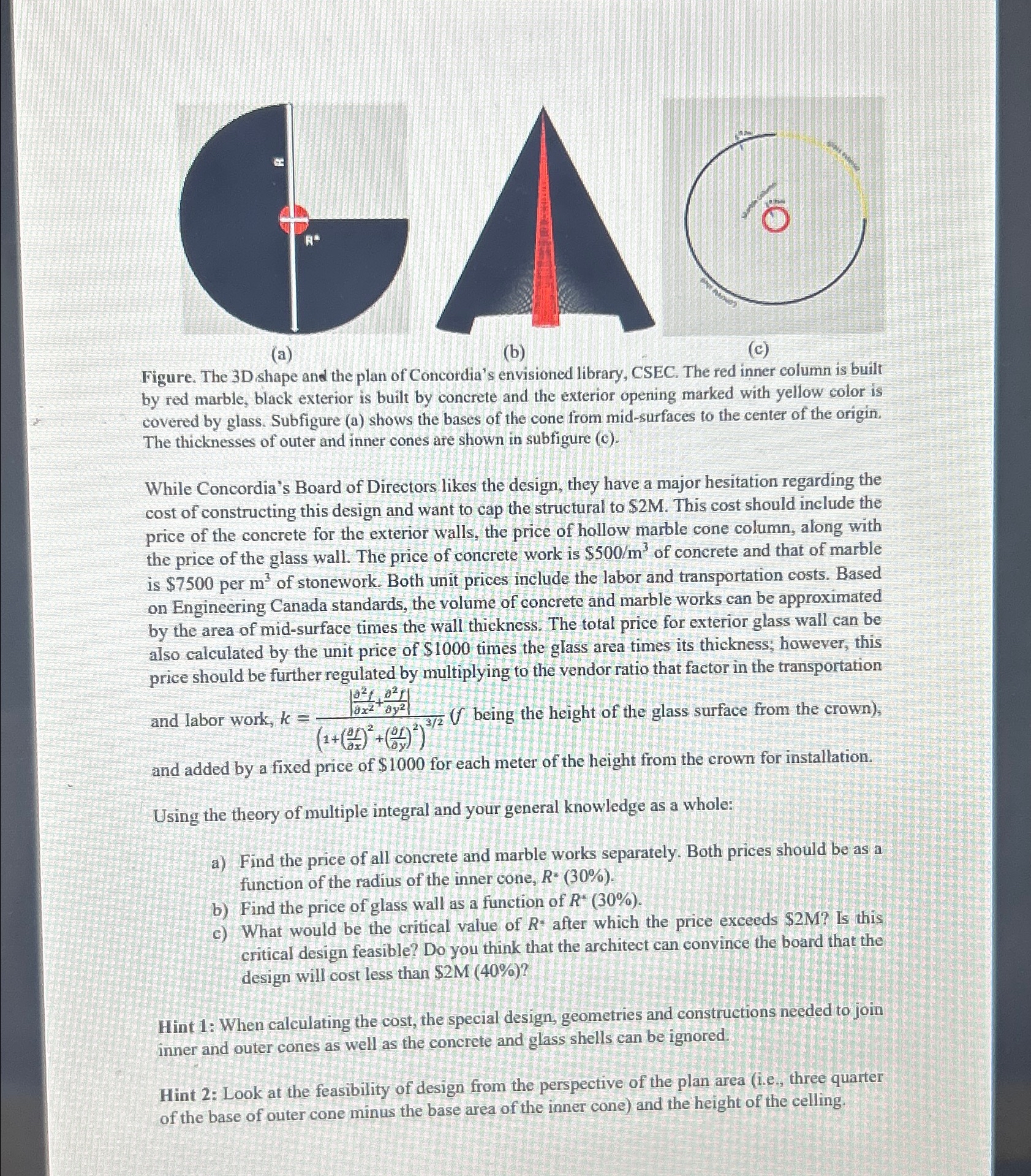
The architect imagined the structure as a cone and therefore called the design CSEC, abbreviating Concordia's Science and Engineering Cone. For the initial design, the architect considered the centre of the origin at the top of the structure and considered the exterior structure as a coneshape shell with the constant thickness of for which the equation of the midshell surface ie the inside surface centimeters from outer and inner surfaces of the shell is described by the equation The architect designed three quarter of this surface with concrete. For the other quarter of the exterior shell, the architect considered a glass surface with the same thickness and equation for the midsurface, ie the surface that is far from the inner and outer surfaces of the glass wall. To maintain structural stability, the structure must include a central loading column. The architect designed this column as a hollow red marble cone and imagined using the inside hollow to place two elevators see the figure below.
Based on design standards, the architect determined that the radius of the hollow cone column must be at least one eighth of the radius for the base for outer cone and its wall thickness should be at least The crowns of the inner and outer cone meet at the top of the structure. Assuming again this point as the centre of the origin, the middle surface of the inner hollow cone, ie the surface centimetre from the inner and outer surfaces of the hollow cone, can be described by
a
v
Figure. The D shape and the plan of Concordia's envisioned library, CSEC. The red inner column is built by red marble, black exterior is built by concrete and the exterior opening marked with yellow color is covered by glass. Subfigure a shows the bases of the cone from midsurfaces to the center of the origin. The thicknesses of outer and inner cones are shown in subfigure c
While Concordia's Board of Directors likes the design, they have a major hesitation regarding the cost of constructing this design and want to cap the structural to $ This cost should include the price of the concrete for the exterior walls, the price of hollow marble cone column, along with the price of the glass wall. The price of concrete work is $ of concrete and that of marble is $ per of stonework. Both unit prices include the labor and transportation costs. Based on Engineering Canada standards, the volume of concrete and marble works can be approximated by the area of midsurface times the wall thickness. The total price for exterior glass wall can be also calculated by the unit price of $ times the glass area times its thickness; however, this price should be further regulated by multiplying to the vendor ratio that factor in the transportation and labor work, being the height of the glass surface from the cr
Step by Step Solution
There are 3 Steps involved in it
1 Expert Approved Answer
Step: 1 Unlock

Question Has Been Solved by an Expert!
Get step-by-step solutions from verified subject matter experts
Step: 2 Unlock
Step: 3 Unlock
 Study Help