Question: with OSHA 2. Ergonomics in Practice case: Why do you think the staff at Riverlea does not like the lift system? Explain how Tim Montana
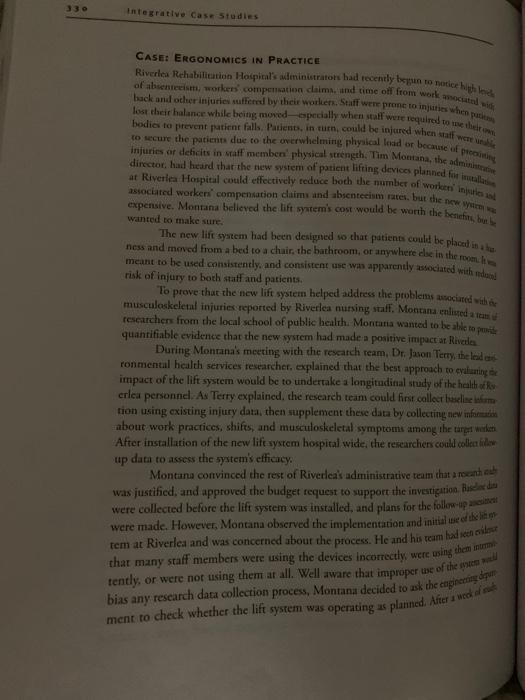
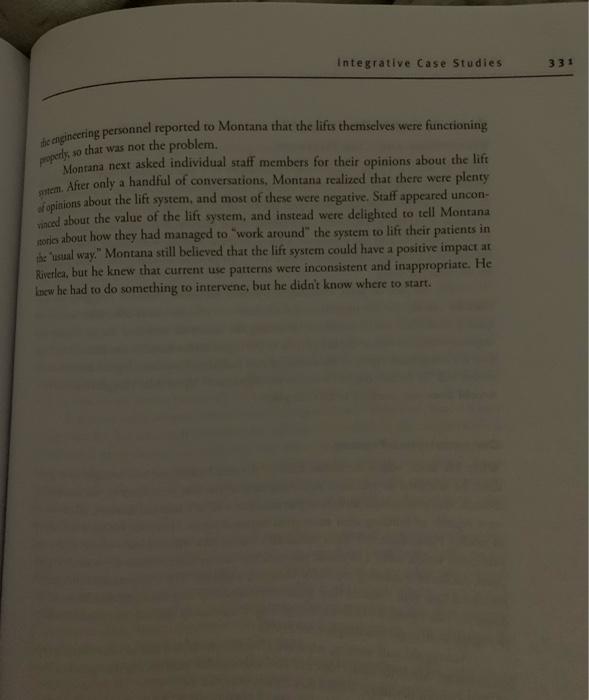
with OSHA 2. Ergonomics in Practice case: Why do you think the staff at Riverlea does not like the lift system? Explain how Tim Montana could apply Lewin's three-step process at Riverlea to implement the new lift system. ment to check whether the lift system was operating as planned. After a woda Riverla Rehabilitation Hospital's administrators had recently in to notice od of absent workers compensation claims and time off from work with hack and other injuries suffered by their worker. Staff were prone to me when lose their balance while being moved apecially when staff were required to the bodies to prevent tiene falls. Patients, in turn could be injured when statt We to secure the patients due to the overwhelming physical lead or because of injuries or deficits in wat memben physical strength, Tim Montana, the admin director, had heard that the new system of patient lifting devices planned to at Riverla Hospital could effectively reduce both the number of workers expensive. Montana believed the lift systems cost would be worth the benefits 330 Integrative Case Studies CASE: ERGONOMICS IN PRACTICE wanted to make sure. bias any research data collection process, Montana decided to ask the engine du The new life system had been designed so that patients could be placed in a be ness and moved from a bed to a chair, the bathroom, or anywhere else in the more meant to be used consistently and consistent we was apparently associated with modern risk of injury to both staff and patients. To prove that the new lift system helped address the problems asociated with musculoskeletal injuries reported by Riverlea nursing staff Montana enlisted a tean researchers from the local school of public health. Montana wanted to be able to punite quantifiable evidence that the new system had made a positive impact at Rivele During Montana's meeting with the research team. Dr. Jason Terry, the leader ronmental health services researcher, explained that the best approach to evaluering de impact of the lift system would be to undertake a longitudinal study of the health of crica personnel. As Terry explained the research team could first calleet baseline whom tion using existing injury data, then supplement these data by collecting new information about work practices, shifts, and musculoskeletal symptoms among the tarpet winket After installation of the new life system hospital wide, the researchers could collection up data to assess the system's efficacy. Montana convinced the rest of Riverlas administrative team that arenhet was justified, and approved the budget request to support the investigation. Badar des were collected before the lift system was installed, and plans for the follow-up anodiel were made. However, Montana observed the implementation and initial use of the line tem at Riverlea and was concerned about the process. He and his team had been idee that many staff members were using the devices incorrectly, were using them inuen tently, or were not using them at all. Well aware that improper use of the western parte 331 ne engineering personnel reported to Montana that the lifts themselves were functioning Integrative Case Studies so that was not the problem. Montana next asked individual staff members for their opinions about the lift ortem. After only a handful of conversations, Montana realized that there were plenty af opinions about the lift system, and most of these were negative. Staff appeared uncon- vinced about the value of the lift system, and instead were delighted to tell Montana gories about how they had managed to work around" the system to lift their patients in the sul way." Montana still believed that the lift system could have a positive impact at Riverica, but he knew that current use patterns were inconsistent and inappropriate. He Inew he had to do something to intervene, but he didn't know where to start properly