



Question: 1. Describe the crystals you have obtained 2. With reference to the optical rotations you recorded on the polarimeter, discuss the effectiveness of your
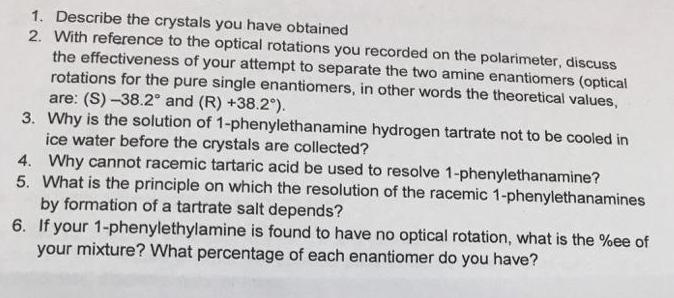
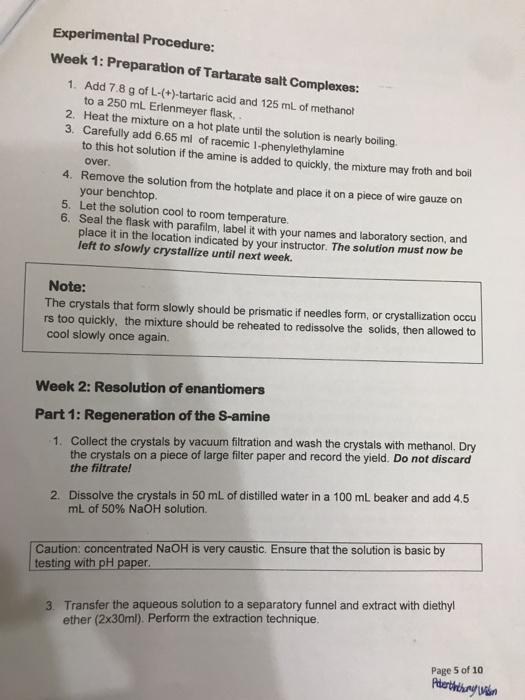
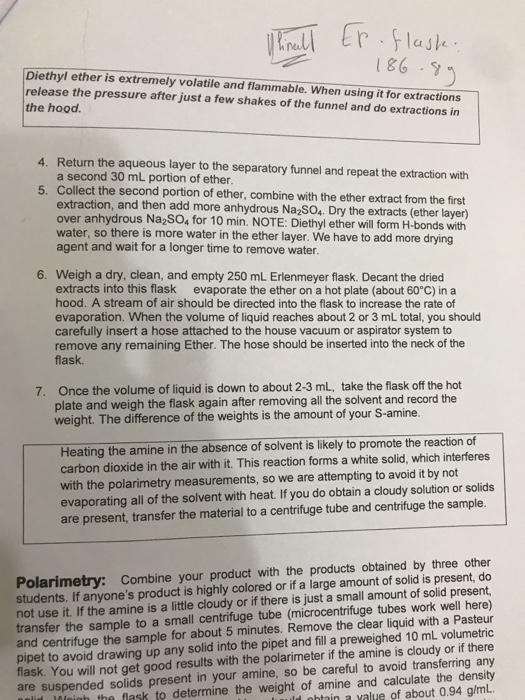
1. Describe the crystals you have obtained 2. With reference to the optical rotations you recorded on the polarimeter, discuss the effectiveness of your attempt to separate the two amine enantiomers (optical rotations for the pure single enantiomers, in other words the theoretical values, are: (S) -38.2 and (R) +38.2). 3. Why is the solution of 1-phenylethanamine hydrogen tartrate not to be cooled in ice water before the crystals are collected? 4. Why cannot racemic tartaric acid be used to resolve 1-phenylethanamine? 5. What is the principle on which the resolution of the racemic 1-phenylethanamines by formation of a tartrate salt depends? 6. If your 1-phenylethylamine is found to have no optical rotation, what is the %ee of your mixture? What percentage of each enantiomer do you have? Experimental Procedure: Week 1: Preparation of Tartarate salt Complexes: 1. Add 7.8 g of L-(+)-tartaric acid and 125 ml of methanot to a 250 ml Erienmeyer flask,. 2. Heat the mixture on a hot plate until the solution is nearly boiling. 3. Carefully add 6.65 ml of racemic I-phenylethylamine to this hot solution if the amine is added to quickly, the mixture may froth and boil over. 4. Remove the solution from the hotplate and place it on a piece of wire gauze on your benchtop. 5. Let the solution cool to room temperature. 6. Seal the flask with parafilm, label it with your names and laboratory section, and place it in the location indicated by your instructor. The solution must now be left to slowly crystallize until next week. Note: The crystals that form slowly should be prismatic if needles form, or crystallization occu rs too quickly, the mixture should be reheated to redissolve the solids, then allowed to cool slowly once again. Week 2: Resolution of enantiomers Part 1: Regeneration of the S-amine 1. Collect the crystals by vacuum filtration and wash the crystals with methanol. Dry the crystals on a piece of large filter paper and record the yield. Do not discard the filtrate! 2. Dissolve the crystals in 50 ml of distilled water in a 100 mL beaker and add 4.5 mL of 50% NaOH solution. Caution: concentrated NaOH is very caustic. Ensure that the solution is basic by testing with pH paper. 3. Transfer the aqueous solution to a separatory funnel and extract with diethyl ether (2x30ml). Perform the extraction technique. Page 5 of 10 Er Flask Diethyl ether is extremely volatile and flammable. When using it for extractions release the pressure after just a few shakes of the funnel and do extractions in the hogd. 66.981 4. Return the aqueous layer to the separatory funnel and repeat the extraction with a second 30 mL portion of ether. 5. Collect the second portion of ether, combine with the ether extract from the first extraction, and then add more anhydrous Nazso, Dry the extracts (ether layer) over anhydrous NazSO, for 10 min. NOTE: Diethyl ether will form H-bonds with water, so there is more water in the ether layer. We have to add more drying agent and wait for a longer time to remove water. 6. Weigh a dry, clean, and empty 250 mL Erlenmeyer flask. Decant the dried extracts into this flask evaporate the ether on a hot plate (about 60C) in a hood. A stream of air should be directed into the flask to increase the rate of evaporation. When the volume of liquid reaches about 2 or 3 mL total, you should carefully insert a hose attached to the house vacuum or aspirator system to remove any remaining Ether. The hose should be inserted into the neck of the flask. 7. Once the volume of liquid is down to about 2-3 mL, take the flask off the hot plate and weigh the flask again after removing all the solvent and record the weight. The difference of the weights is the amount of your S-amine. Heating the amine in the absence of solvent is likely to promote the reaction of carbon dioxide in the air with it. This reaction forms a white solid, which interferes with the polarimetry measurements, so we are attempting to avoid it by not evaporating all of the solvent with heat. If you do obtain a cloudy solution or solids are present, transfer the material to a centrifuge tube and centrifuge the sample. Polarimetry: Combine your product with the products obtained by three other students. If anyone's product is highly colored or if a large amount of solid is present, do not use it. If the amine is a little cloudy or if there is just a small amount of solid present, transfer the sample to a small centrifuge tube (microcentrifuge tubes work well here) and centrifuge the sample for about 5 minutes. Remove the clear liquid with a Pasteur pipet to avoid drawing up any solid into the pipet and fill a preweighed 10 mL volumetric flask. You will not get good results with the polarimeter if the amine is cloudy or if there are suspended solids present in your amine, so be careful to avoid transferring any ld obtain a value of about 0.94 g/ml. alid 10lninh the flask to determine the weight of amine and calculate the density
Step by Step Solution
3.44 Rating (144 Votes )
There are 3 Steps involved in it

Get step-by-step solutions from verified subject matter experts