



Question: Within an organization, when an employee is assessed based upon his or her performance, it is critical that the employee can provide feedback associated with
Within an organization, when an employee is assessed based upon his or her performance, it is critical that the employee can provide feedback associated with their performance review. In fact, employees should be able to disagree with aspects of the performance review (as applicable).
Many organizations have processes associated with appealing a performance review. Explain what factors you believe should be included in the appeals process. Then, justify who you believe should be involved, at each step of the appeal, in the process.
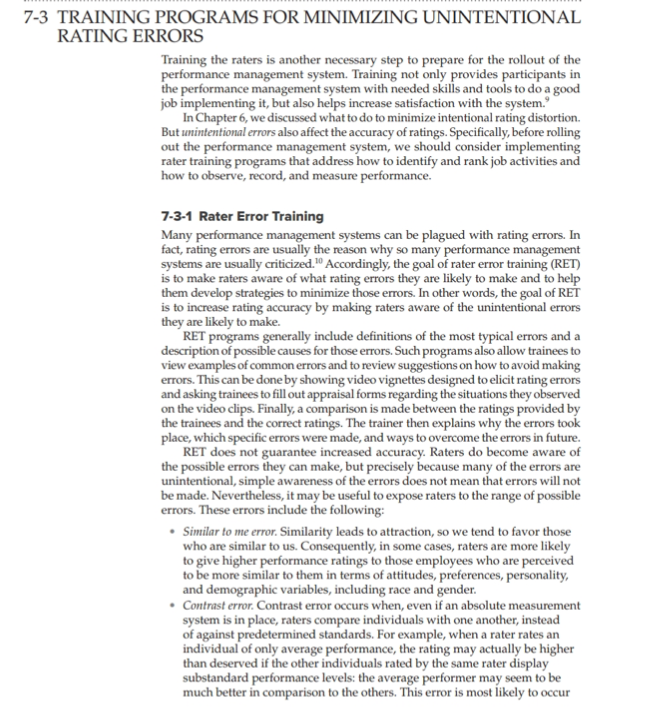
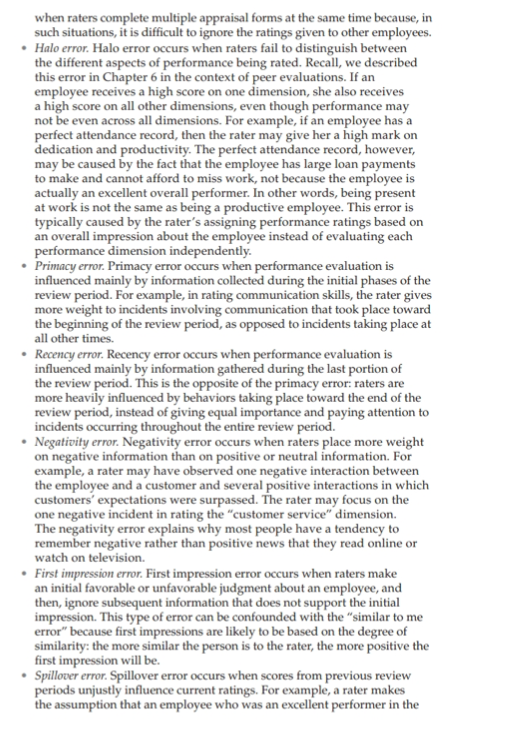
Additionally, explain how two of the errors found in Section 7-3 (page 206 in your textbook), can impact performance reviews. Then, identify how these errors can be corrected/prevented.
It is important to present an in-depth analysis and integrate sufficient support from scholarly resources throughout the assignment. Use suitable headings and subheadings to organize the work in an appropriate manner. Be sure to support your statements with logic and argument, citing any sources referenced.
7-3 TRAINING PROGRAMS FOR MINIMIZING UNINTENTIONAL RATING ERRORS Training the raters is another necessary step to prepare for the rollout of the performance management system. Training not only provides participants in the performance management system with needed skills and tools to do a good job implementing it, but also helps increase satisfaction with the system. In Chapter 6, we discussed what to do to minimize intentional rating distortion. But unintentional errors also affect the accuracy of ratings. Specifically, before rolling out the performance management system, we should consider implementing rater training programs that address how to identify and rank job activities and how to observe, record, and measure performance. 7-3-1 Rater Error Training Many performance management systems can be plagued with rating errors. In fact, rating errors are usually the reason why so many performance management systems are usually criticized. Accordingly, the goal of rater error training (RET) is to make raters aware of what rating errors they are likely to make and to help them develop strategies to minimize those errors. In other words, the goal of RET is to increase rating accuracy by making raters aware of the unintentional errors they are likely to make. RET programs generally include definitions of the most typical errors and a description of possible causes for those errors. Such programs also allow trainees to view examples of common errors and to review suggestions on how to avoid making errors. This can be done by showing video vignettes designed to elicit rating errors and asking trainees to fill out appraisal forms regarding the situations they observed on the video clips. Finally, a comparison is made between the ratings provided by the trainees and the correct ratings. The trainer then explains why the errors took place, which specific errors were made, and ways to overcome the errors in future. RET does not guarantee increased accuracy. Raters do become aware of the possible errors they can make, but precisely because many of the errors are unintentional, simple awareness of the errors does not mean that errors will not be made. Nevertheless, it may be useful to expose raters to the range of possible errors. These errors include the following: Similar to me error. Similarity leads to attraction, so we tend to favor those who are similar to us. Consequently, in some cases, raters are more likely to give higher performance ratings to those employees who are perceived to be more similar to them in terms of attitudes, preferences, personality, and demographic variables, including race and gender. Contrast error. Contrast error occurs when, even if an absolute measurement system is in place, raters compare individuals with one another, instead of against predetermined standards. For example, when a rater rates an individual of only average performance, the rating may actually be higher than deserved if the other individuals rated by the same rater display substandard performance levels: the average performer may seem to be much better in comparison to the others. This error is most likely to occur when raters complete multiple appraisal forms at the same time because, in such situations, it is difficult to ignore the ratings given to other employees. Halo error. Halo error occurs when raters fail to distinguish between the different aspects of performance being rated. Recall, we described this error in Chapter 6 in the context of peer evaluations. If an employee receives a high score on one dimension, she also receives a high score on all other dimensions, even though performance may not be even across all dimensions. For example, if an employee has a perfect attendance record, then the rater may give her a high mark on dedication and productivity. The perfect attendance record, however, may be caused by the fact that the employee has large loan payments to make and cannot afford to miss work, not because the employee is actually an excellent overall performer. In other words, being present at work is not the same as being a productive employee. This error is typically caused by the rater's assigning performance ratings based on an overall impression about the employee instead of evaluating each performance dimension independently. Primacy error. Primacy error occurs when performance evaluation is influenced mainly by information collected during the initial phases of the review period. For example, in rating communication skills, the rater gives more weight to incidents involving communication that took place toward the beginning of the review period, as opposed to incidents taking place at all other times. Recency error. Recency error occurs when performance evaluation is influenced mainly by information gathered during the last portion of the review period. This is the opposite of the primacy error: raters are more heavily influenced by behaviors taking place toward the end of the review period, instead of giving equal importance and paying attention to incidents occurring throughout the entire review period. Negativity error. Negativity error occurs when raters place more weight on negative information than on positive or neutral information. For example, a rater may have observed one negative interaction between the employee and a customer and several positive interactions in which customers' expectations were surpassed. The rater may focus on the one negative incident in rating the "customer service" dimension The negativity error explains why most people have a tendency to remember negative rather than positive news that they read online or watch on television First impression error. First impression error occurs when raters make an initial favorable or unfavorable judgment about an employee, and then, ignore subsequent information that does not support the initial impression. This type of error can be confounded with the "similar to me error" because first impressions are likely to be based on the degree of similarity: the more similar the person is to the rater, the more positive the first impression will be Spillover error. Spillover error occurs when scores from previous review periods unjustly influence current ratings. For example, a rater makes the assumption that an employee who was an excellent performer in theStep by Step Solution
There are 3 Steps involved in it

Get step-by-step solutions from verified subject matter experts