







Question: Worked Example To form the converse of a conditional statement, interchange the hypothesis and conclusion. Conditional Statement: If a point lies on the perpendicular
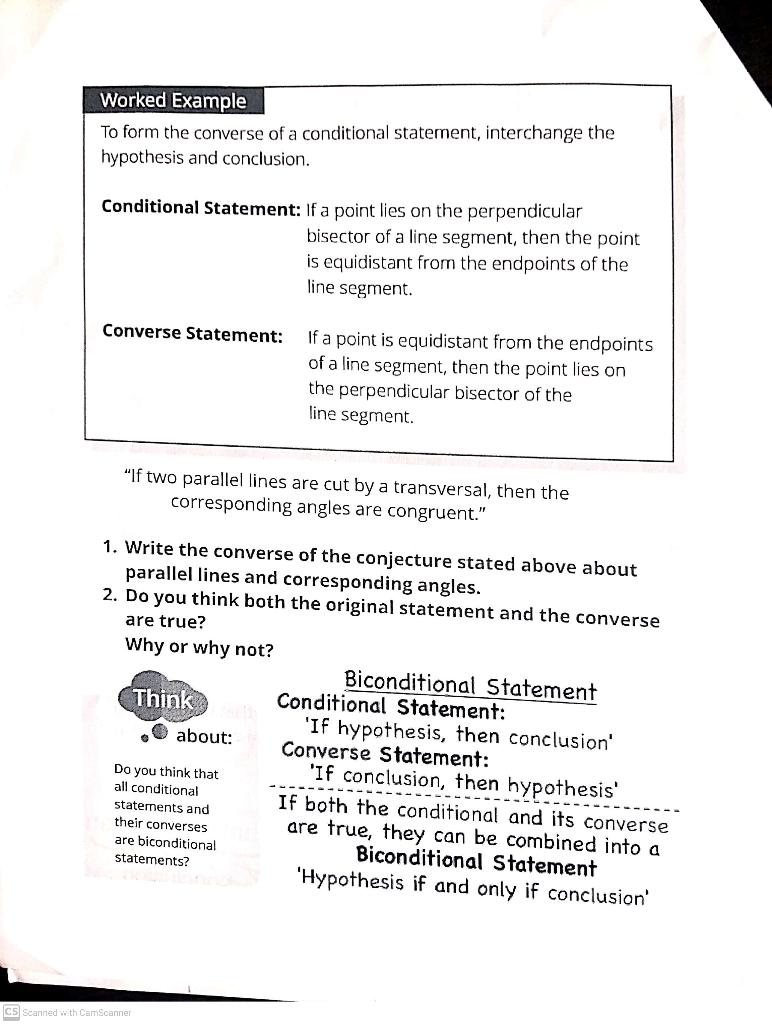
Worked Example To form the converse of a conditional statement, interchange the hypothesis and conclusion. Conditional Statement: If a point lies on the perpendicular bisector of a line segment, then the point Converse Statement: is equidistant from the endpoints of the line segment. If a point is equidistant from the endpoints of a line segment, then the point lies on the perpendicular bisector of the line segment. "If two parallel lines are cut by a transversal, then the corresponding angles are congruent." 1. Write the converse of the conjecture stated above about parallel lines and corresponding angles. 2. Do you think both the original statement and the converse are true? Why or why not? Think about: Do you think that all conditional statements and their converses are biconditional statements? Biconditional Statement Conditional Statement: 'If hypothesis, then conclusion' Converse Statement: 'If conclusion, then hypothesis' If both the conditional and its converse are true, they can be combined into a Biconditional Statement 'Hypothesis if and only if conclusion' CS Scanned with CamScanner
Step by Step Solution
There are 3 Steps involved in it

Get step-by-step solutions from verified subject matter experts
 Study Help