







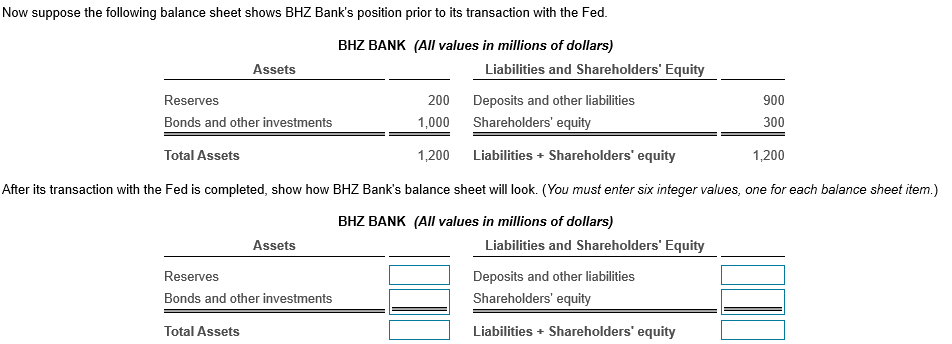
Question: Would it be too much to ask a second question in this post? Now suppose the following balance sheet shows BHZ Bank's position prior to
Would it be too much to ask a second question in this post?
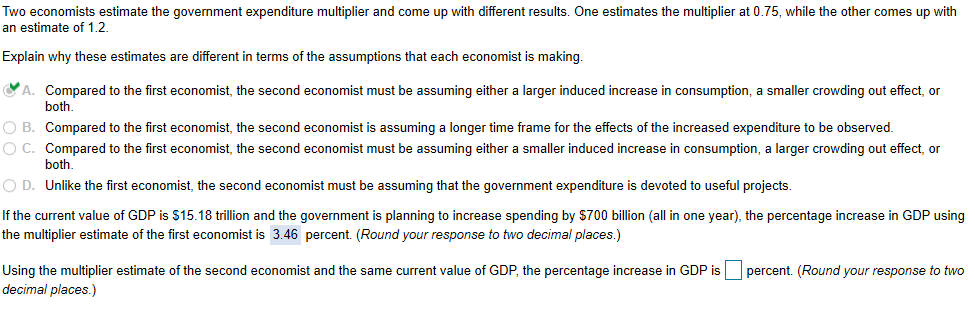
Now suppose the following balance sheet shows BHZ Bank's position prior to its transaction with the Fed BHZ BANK (All values in millions of dollars) Assets 900 300 1,200 Reserves Bonds and other investments Total Assets 200 1,000 Deposits and other liabilities Shareholders' equity ,200 Liabilities Shareholders' equity After its transaction with the Fed is completed, show how BHZ Bank's balance sheet will look. (You must enter six integer values, one for each balance sheet item.) BHZ BANK (All values in millions of dollars) Liabilities and Shareholders' Equity Deposits and other liabilities Shareholders' equity Liabilities+Shareholders' equity Assets Reserves Bonds and other investments Total Assets Two economists estimate the government expenditure multiplier and come up with different results. One estimates the multiplier at 0.75, while the other comes up with an estimate of 1.2. Explain why these estimates are different in terms of the assumptions that each economist is making A. Compared to the first economist, the second economist must be assuming either a larger induced increase in consumption, a smaller crowding out effect, or both B Compared to the first economist, the second economist is assuming a longer time frame for the effects of the increased expenditure to be observed. Compared to the first economist, the second economist must be assuming either a smaller induced increase in consumption, a larger crowding out effect, or both D. Unlike the first economist, the second economist must be assuming that the government expenditure is devoted to useful projects. If the current value of GDP is $15.18 trillion and the government is planning to increase spending by $700 billion (all in one year), the percentage increase in GDP using the multiplier estimate of the first economist is 3.46 percent. (Round your response to two decimal places.) Using the multiplier estimate of the second economist and the same current value of GDP,the percentage increase in GDP ispercent. (Round your response to two decimal places.) Now suppose the following balance sheet shows BHZ Bank's position prior to its transaction with the Fed BHZ BANK (All values in millions of dollars) Assets 900 300 1,200 Reserves Bonds and other investments Total Assets 200 1,000 Deposits and other liabilities Shareholders' equity ,200 Liabilities Shareholders' equity After its transaction with the Fed is completed, show how BHZ Bank's balance sheet will look. (You must enter six integer values, one for each balance sheet item.) BHZ BANK (All values in millions of dollars) Liabilities and Shareholders' Equity Deposits and other liabilities Shareholders' equity Liabilities+Shareholders' equity Assets Reserves Bonds and other investments Total Assets Two economists estimate the government expenditure multiplier and come up with different results. One estimates the multiplier at 0.75, while the other comes up with an estimate of 1.2. Explain why these estimates are different in terms of the assumptions that each economist is making A. Compared to the first economist, the second economist must be assuming either a larger induced increase in consumption, a smaller crowding out effect, or both B Compared to the first economist, the second economist is assuming a longer time frame for the effects of the increased expenditure to be observed. Compared to the first economist, the second economist must be assuming either a smaller induced increase in consumption, a larger crowding out effect, or both D. Unlike the first economist, the second economist must be assuming that the government expenditure is devoted to useful projects. If the current value of GDP is $15.18 trillion and the government is planning to increase spending by $700 billion (all in one year), the percentage increase in GDP using the multiplier estimate of the first economist is 3.46 percent. (Round your response to two decimal places.) Using the multiplier estimate of the second economist and the same current value of GDP,the percentage increase in GDP ispercent. (Round your response to two decimal places.)
Step by Step Solution
There are 3 Steps involved in it

Get step-by-step solutions from verified subject matter experts
 Study Help