







Question: Would like some detailed guidance / assistance in a solution to this problem. Thanks. SHOW ALL WORK (2) [Pts. 45] A spherical cell of radius
Would like some detailed guidance / assistance in a solution to this problem. Thanks.
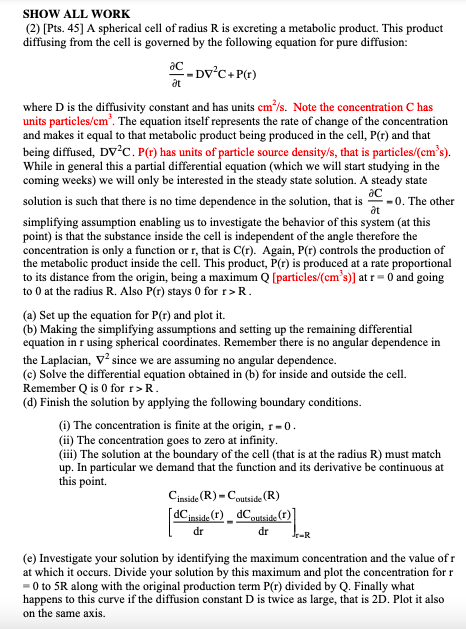
SHOW ALL WORK (2) [Pts. 45] A spherical cell of radius R is excreting a metabolic product. This product diffusing from the cell is governed by the following equation for pure diffusion: at - DV-C+P(r) where D is the diffusivity constant and has units cm /s. Note the concentration C has units particles/cm". The equation itself represents the rate of change of the concentration and makes it equal to that metabolic product being produced in the cell, P(r) and that being diffused, DV-C. P(r) has units of particle source density's, that is particles/(cm's). While in general this a partial differential equation (which we will start studying in the coming weeks) we will only be interested in the steady state solution. A steady state solution is such that there is no time dependence in the solution, that is - -0. The other at simplifying assumption enabling us to investigate the behavior of this system (at this point) is that the substance inside the cell is independent of the angle therefore the concentration is only a function or r, that is C(r). Again, P(r) controls the production of the metabolic product inside the cell. This product, P(r) is produced at a rate proportional to its distance from the origin, being a maximum Q [particles/(cm's)] atr = 0 and going to 0 at the radius R. Also P(r) stays 0 for r > R. (a) Set up the equation for P(r) and plot it. (b) Making the simplifying assumptions and setting up the remaining differential equation in r using spherical coordinates. Remember there is no angular dependence in the Laplacian, V since we are assuming no angular dependence. (c) Solve the differential equation obtained in (b) for inside and outside the cell. Remember Q is 0 for r > R. (d) Finish the solution by applying the following boundary conditions. (i) The concentration is finite at the origin, r= 0. (ii) The concentration goes to zero at infinity. (iii) The solution at the boundary of the cell (that is at the radius R) must match up. In particular we demand that the function and its derivative be continuous at this point. Cinside (R) - Coutside (R) dC inside (1) dCutsite () dr dr -R (e) Investigate your solution by identifying the maximum concentration and the value of r at which it occurs. Divide your solution by this maximum and plot the concentration for r -0 to SR along with the original production term P(r) divided by Q. Finally what happens to this curve if the diffusion constant D is twice as large, that is 2D. Plot it also on the same axis
Step by Step Solution
There are 3 Steps involved in it

Get step-by-step solutions from verified subject matter experts
 Study Help