







Question: Would really appreciate some help on this: Practice Questions for Revision: Trimester One 2020-2021 *in the following question - I would love some help with
Would really appreciate some help on this:
Practice Questions for Revision: Trimester One 2020-2021
*in the following question - I would love some help with the the main tasks, with the drawing of graphs etc. for question (A) and (B) ! and then if you had any suggestions for what to talk about for the discussion I'd love some advice :))
Part One: Consider the following open economy IS-LM-UIP model (in this question the LM curve will is sloping upwards because the money supply is held fixed not the interest rate).
- IS:Y = C(Y-T)+I(Y,i)+G+NX(Y,Y*,E)
- LM:M / P= YL(i)
- UIP Condition:i = i*- [(E^e - E)/E]
where Eeis expected future nominal exchange rate and E is the current nominal exchange rate.
This model can be used to reflect either a floating exchange rate regime or a fixed exchange rate regime. You should assume that: the expected future inflation rate is zero (which is why i rather than r appears in the IS expression); the Marshall-Lerner condition holds; and P* and P are exogenously fixed and unchanging (which is why E rather than?appears in the IS expression).
Use this model to show diagrammatically and explain the impact that enhancedexpectationsof a nominaldepreciation/devaluation of New Zealand's exchange rate would have on current i, Y, E and business fixed investment expenditure, I, for an economy that is operating under:
(a) a floating exchange rate regime
(b) a fixed exchange rate regime.
In the fixed exchange rate case, comment briefly on the difficulties that a government would have in defending the exchange rate.
Part Two: (attached photograph)
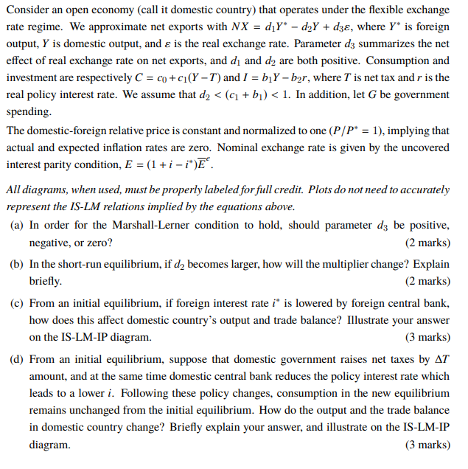
Consider an open economy (call it domestic country) that operates under the flexible exchange rate regime. We approximate net exports with NX = dil"* - del + dee, where }" is foreign output, } is domestic output, and s is the real exchange rate. Parameter da summarizes the net effect of real exchange rate on net exports, and dj and dy are both positive. Consumption and investment are respectively C = co + cj(1 -) and / = bjY - ber, where I is net tax and r is the real policy interest rate. We assume that de
Step by Step Solution
There are 3 Steps involved in it

Get step-by-step solutions from verified subject matter experts
 Study Help