







Question: Would the dollar error using the duration approximation be larger or smaller if the term structure would shift from 15% to 16% (instead of from
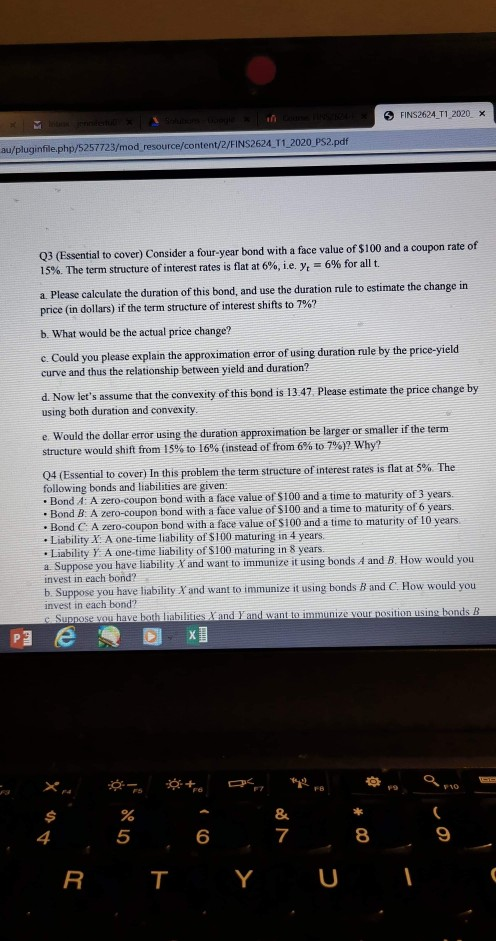
Would the dollar error using the duration approximation be larger or smaller if the term structure would shift from 15% to 16% (instead of from 6% to 7%)? Why?
3d
FINS2624_T1 2020 x Bu/pluginfile.php/5257723/mod resource/content/2/FINS2624_11_2020 PS2.pdf Q3 (Essential to cover) Consider a four-year bond with a face value of $100 and a coupon rate of 15%. The term structure of interest rates is flat at 6%, i.e. y, = 6% for all t. a. Please calculate the duration of this bond, and use the duration rule to estimate the change in price in dollars) if the term structure of interest shifts to 7%? b. What would be the actual price change? c. Could you please explain the approximation error of using duration rule by the price yield curve and thus the relationship between yield and duration? d. Now let's assume that the convexity of this bond is 13.47. Please estimate the price change by using both duration and convexity. e. Would the dollar error using the duration approximation be larger or smaller if the term structure would shift from 15% to 16% (instead of from 6% to 7%)? Why? 04 (Essential to cover) In this problem the term structure of interest rates is flat at 5%. The following bonds and liabilities are given: Bond 4: A zero-coupon bond with a face value of $100 and a time to maturity of 3 years Bond B: A zero-coupon bond with a face value of $100 and a time to maturity of 6 years. Bond C A zero-coupon bond with a face value of $100 and a time to maturity of 10 years Liability X A one-time liability of $100 maturing in 4 years Liability Y: A one-time liability of S100 maturing in 8 years. a Suppose you have liability X and want to immunize it using bonds A and B. How would you invest in each bond? b. Suppose you have liability X and want to immunize it using bonds B and C How would you invest in each bond? Supnose you have both liabilities X and Y and want to immunize your position using bonds B P3e DX R I Y U I FINS2624_T1 2020 x Bu/pluginfile.php/5257723/mod resource/content/2/FINS2624_11_2020 PS2.pdf Q3 (Essential to cover) Consider a four-year bond with a face value of $100 and a coupon rate of 15%. The term structure of interest rates is flat at 6%, i.e. y, = 6% for all t. a. Please calculate the duration of this bond, and use the duration rule to estimate the change in price in dollars) if the term structure of interest shifts to 7%? b. What would be the actual price change? c. Could you please explain the approximation error of using duration rule by the price yield curve and thus the relationship between yield and duration? d. Now let's assume that the convexity of this bond is 13.47. Please estimate the price change by using both duration and convexity. e. Would the dollar error using the duration approximation be larger or smaller if the term structure would shift from 15% to 16% (instead of from 6% to 7%)? Why? 04 (Essential to cover) In this problem the term structure of interest rates is flat at 5%. The following bonds and liabilities are given: Bond 4: A zero-coupon bond with a face value of $100 and a time to maturity of 3 years Bond B: A zero-coupon bond with a face value of $100 and a time to maturity of 6 years. Bond C A zero-coupon bond with a face value of $100 and a time to maturity of 10 years Liability X A one-time liability of $100 maturing in 4 years Liability Y: A one-time liability of S100 maturing in 8 years. a Suppose you have liability X and want to immunize it using bonds A and B. How would you invest in each bond? b. Suppose you have liability X and want to immunize it using bonds B and C How would you invest in each bond? Supnose you have both liabilities X and Y and want to immunize your position using bonds B P3e DX R I Y U
Step by Step Solution
There are 3 Steps involved in it

Get step-by-step solutions from verified subject matter experts
 Study Help