







Question: Write a Case Brief for this case. Harkey v. Abate Michigan Court of Appeals. 346 N.W.2d 74 (Mich.App. 1983). BACKGROUND AND FACTS Plaintiff's original complaint,
Write a Case Brief for this case.
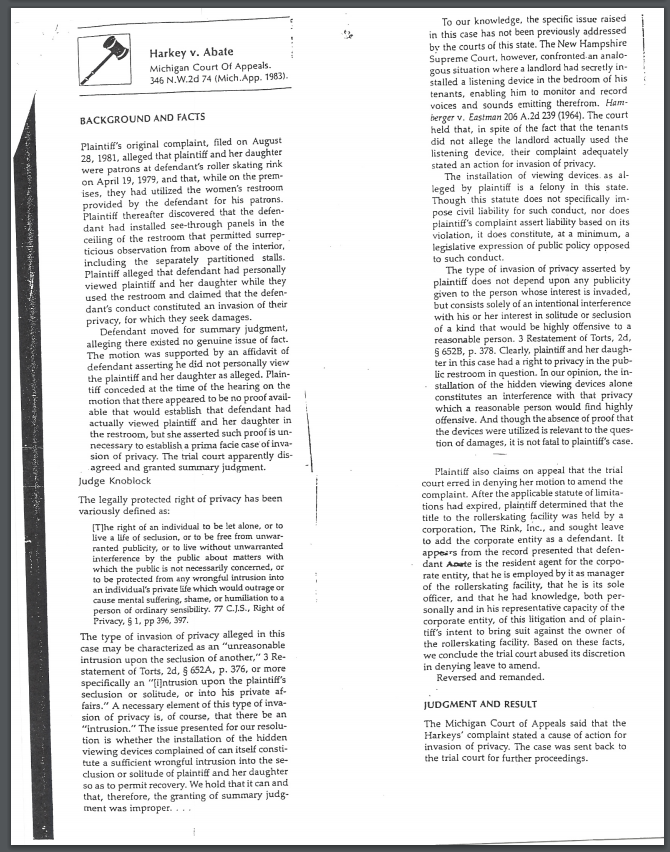
Harkey v. Abate Michigan Court of Appeals. 346 N.W.2d 74 (Mich.App. 1983). BACKGROUND AND FACTS Plaintiff's original complaint, filed on August 28, 1981, alleged that plaintiff and her daughter were patrons at defendant's roller skating rink on April 19, 1979, and that, while on the prem- ises, they had utilized the women's restroom provided by the defendant for his patrons. Plaintiff thereafter discovered that the defen- dant had installed see-through panels in the ceiling of the restroom that permitted surrep- ticious observation from above of the interior, including the separately partitioned stalls. Plaintiff alleged that defendant had personally viewed plaintiff and her daughter while they used the restroom and daimed that the defen- dant's conduct constituted an invasion of their privacy, for which they seek damages. Defendant moved for summary judgment, alleging there existed no genuine issue of fact. The motion was supported by an affidavit of defendant asserting he did not personally view the plaintiff and her daughter as alleged. Plain- tiff conceded at the time of the hearing on the motion that there appeared to be no proof avail able that would establish that defendant had actually viewed plaintiff and her daughter in the restroom, but she asserted such proof is un- necessary to establish a prima facie case of inva- sion of privacy. The trial court apparently dis- agreed and granted summary judgment. Judge Knoblock To our knowledge, the specific issue raised in this case has not been previously addressed by the courts of this state. The New Hampshire Supreme Court, however, confronted an analo- gous situation where a landlord had secretly in stalled a listening device in the bedroom of his tenants, enabling him to monitor and record voices and sounds emitting therefrom. Ham berger v. Eestman 206 A.2d 239 (1964). The court held that, in spite of the fact that the tenants did not allege the landlord actually used the listening device, their complaint adequately stated an action for invasion of privacy. The installation of viewing devices as al- leged by plaintiff is a felony in this state. Though this statute does not specifically im- pose civil liability for such conduct, nor does plaintiff's complaint assert liability based on its violation, it does constitute, at a minimum, a legislative expression of public policy opposed to such conduct The type of invasion of privacy asserted by plaintiff does not depend upon any publicity given to the person whose interest is invaded, but consists solely of an intentional interference with his or her interest in solitude or seclusion of a kind that would be highly offensive to a reasonable person 3 Restatement of Torts, 2d, 9 6528, p. 378. Clearly, plaintiff and her daugh- ter in this case had a right to privacy in the pub- lic restroom in question. In our opinion, the in- stallation of the hidden Viewing devices alone constitutes an interference with that privacy which a reasonable person would find highly offensive. And though the absence of proof that the devices were utilized is relevant to the ques. tion of damages, it is not fatal to plaintiff's case. The legally protected right of privacy has been variously defined as: The right of an individual to be let alone, or to live a life of seclusion, or to be free from unwar ranted publicity, or to live without unwarranted interference by the public about matters with which the public is not necessarily concerned, or to be protected from any wrongful intrusion into an individual's private life which would outrage or cause mental suffering, shame, or humillation to person of ordinary sensibility. 77 CJS., Right of Privacy. 51. Pp 396 397. The type of invasion of privacy alleged in this case may be characterized as an "unreasonable intrusion upon the seclusion of another," 3 Re- statement of Torts, 2d, 9 652A, P. 376, or more specifically an intrusion upon the plaintiff's seclusion or solitude, or into his private af- fairs." A necessary element of this type of inva- sion of privacy is, of course, that there be an "intrusion." The issue presented for our resolu- tion is whether the installation of the hidden viewing devices complained of can itself consti- tute a sufficient wrongful intrusion into the se- clusion or solitude of plaintiff and her daughter so as to permit recovery. We hold that it can and that, therefore, the granting of summary judg. ment was improper... Plaintief also claims on appeal that the trial court erred in denying her motion to amend the complaint. After the applicable statute of limita- tions had expired, plaintiff determined that the title to the rollerskating facility was held by a corporation, The Rink, Inc., and sought leave to add the corporate entity as a defendant. It appears from the record presented that defen- dant Aorte is the resident agent for the corpo- rate entity, that he is employed by it as manager of the rollerskating facility, that he is its sole officer, and that he had knowledge, both per- sonally and in his representative capacity of the corporate entity, of this litigation and of plain- tiff's intent to bring suit against the owner of the rollerskating facility. Based on these facts, we conclude the trial court abused its discretion in denying leave to amend. Reversed and remanded. JUDGMENT AND RESULT The Michigan Court of Appeals said that the Harkeys' complaint stated a cause of action for invasion of privacy. The case was sent back to the trial court for further proceedingsStep by Step Solution
There are 3 Steps involved in it
1 Expert Approved Answer
Step: 1 Unlock

Question Has Been Solved by an Expert!
Get step-by-step solutions from verified subject matter experts
Step: 2 Unlock
Step: 3 Unlock
 Study Help