Question: Write a case report ( at least 1,500 words) on the case A late Bloomer: ZPMC CEO Guan Tongxian. Analyze the background, the problems,
Write a case report ( at least 1,500 words) on the case " A late Bloomer: ZPMC CEO Guan Tongxian. Analyze the background, the problems, etc., and give your solutions.
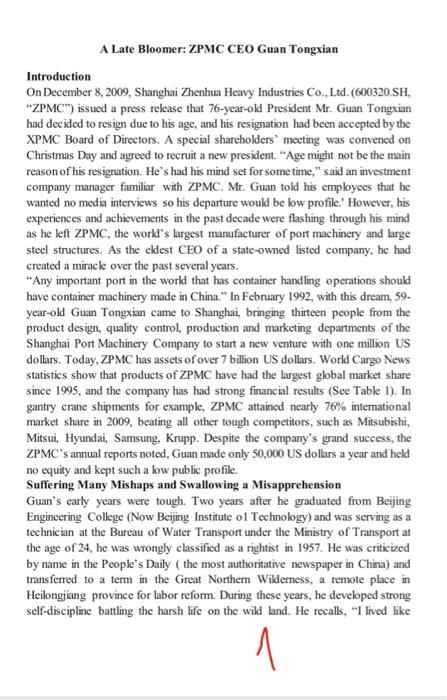
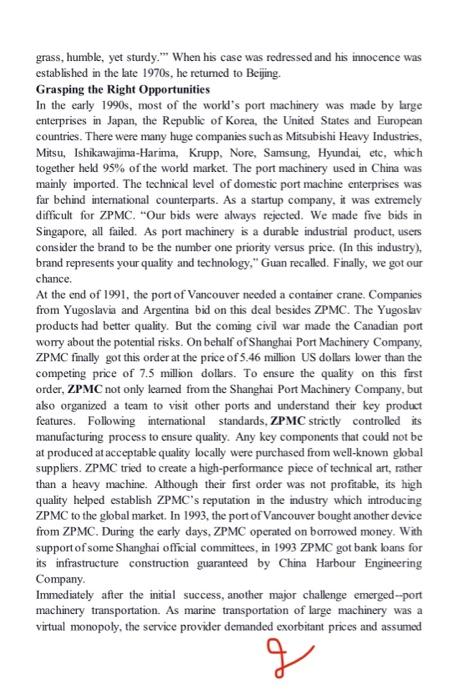
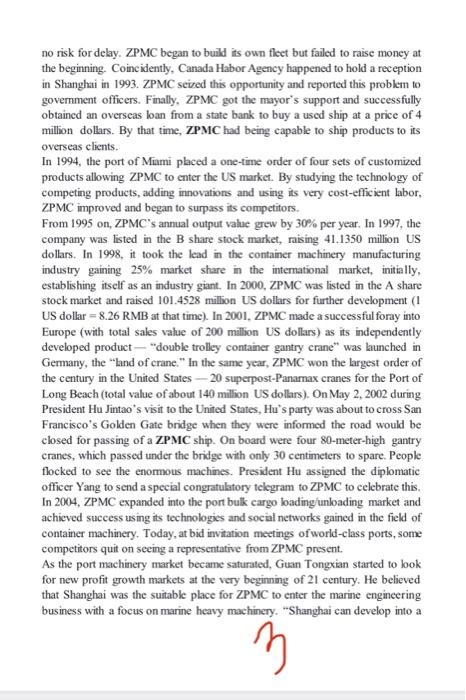
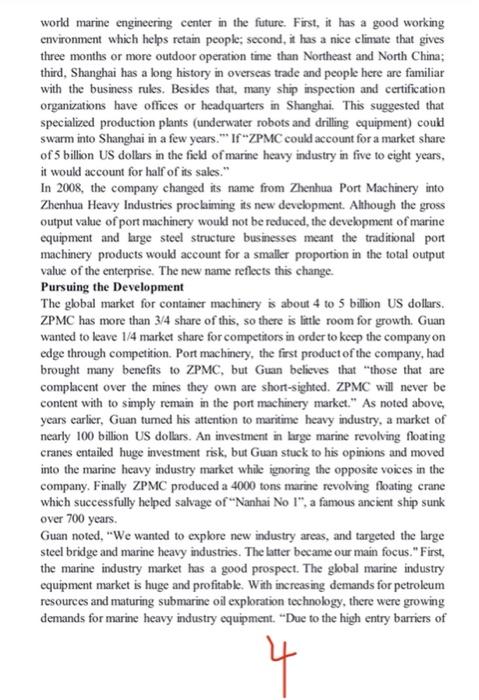
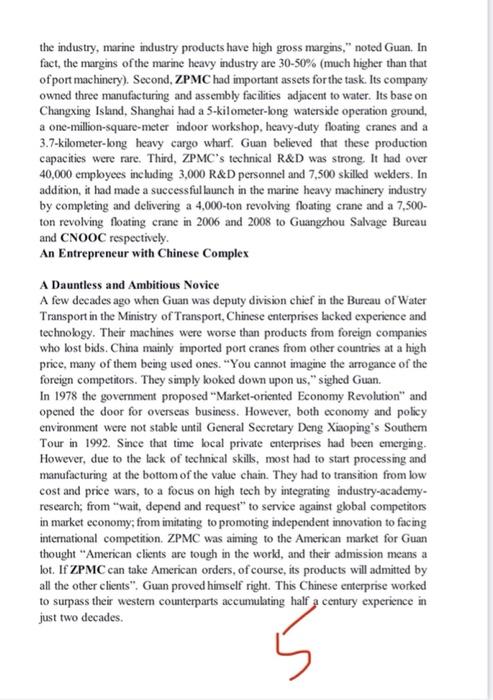
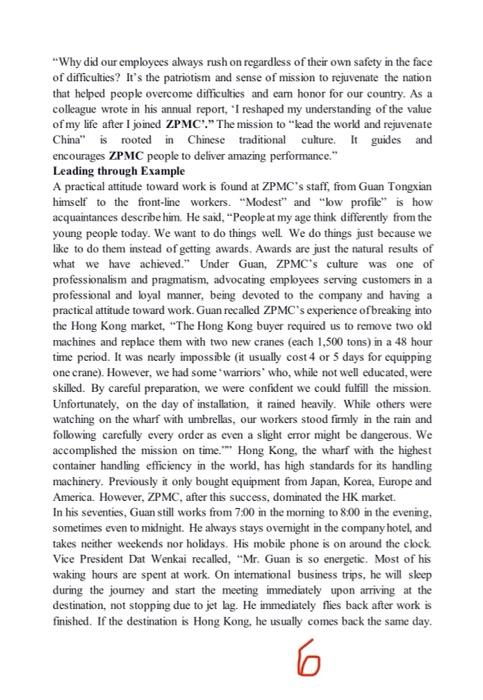
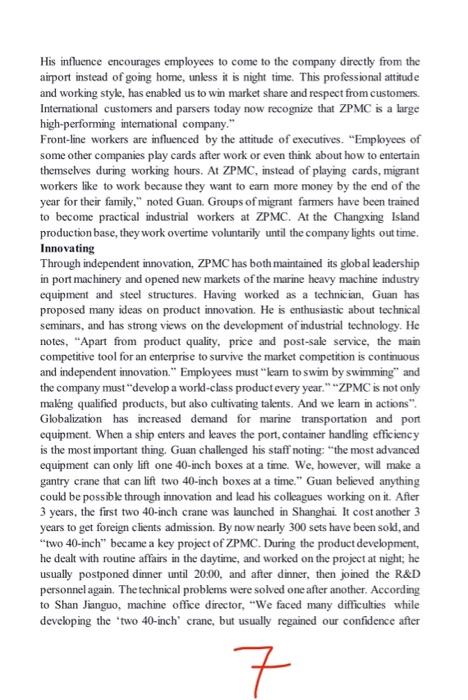
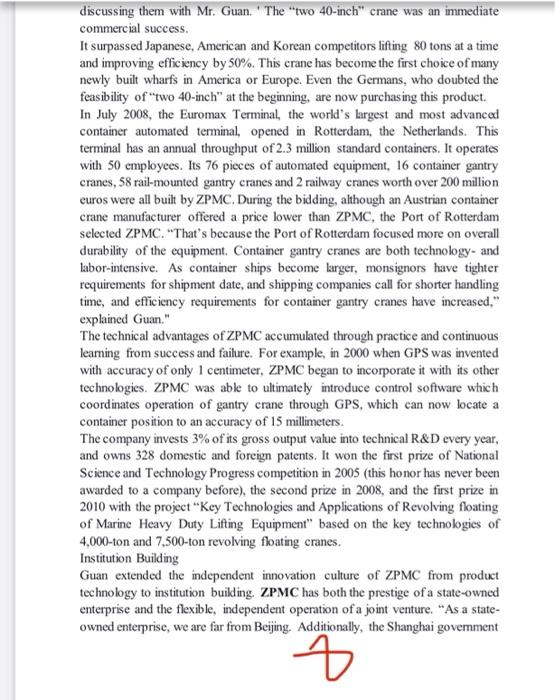
A Late Bloomer: ZPMC CEO Guan Tongxian Introduction On December 8, 2009, Shanghai Zhenhua Heavy Industries Co., Ltd. (600320.SH. "ZPMC") issued a press release that 76-year-old President Mr. Guan Tongxian had decided to resign due to his age, and his resignation had been accepted by the XPMC Board of Directors. A special shareholders' meeting was convened on Christmas Day and agreed to recruit a new president. "Age might not be the main reason of his resignation. He's had his mind set for some time," said an investment company manager familiar with ZPMC. Mr. Guan told his employees that he wanted no media interviews so his departure would be low profile. However, his experiences and achievements in the past decade were flashing through his mind as he left ZPMC, the world's largest manufacturer of port machinery and large steel structures. As the eldest CEO of a state-owned listed company, he had created a miracle over the past several years. "Any important port in the world that has container handling operations should have container machinery made in China." In February 1992, with this dream, 59- year-old Guan Tongxian came to Shanghai, bringing thirteen people from the product design, quality control, production and marketing departments of the Shanghai Port Machinery Company to start a new venture with one million US dollars. Today, ZPMC has assets of over 7 billion US dollars. World Cargo News statistics show that products of ZPMC have had the largest global market share since 1995, and the company has had strong financial results (See Table 1). In gantry crane shipments for example, ZPMC attained nearly 76% international market share in 2009, beating all other tough competitors, such as Mitsubishi, Mitsui, Hyundai, Samsung, Krupp. Despite the company's grand success, the ZPMC's annual reports noted, Guan made only 50,000 US dollars a year and held no equity and kept such a low public profile. Suffering Many Mishaps and Swallowing a Misapprehension Guan's early years were tough. Two years after he graduated from Beijing Engineering College (Now Beijing Institute of Technology) and was serving as a technician at the Bureau of Water Transport under the Ministry of Transport at the age of 24, he was wrongly classified as a rightist in 1957. He was criticized by name in the People's Daily (the most authoritative newspaper in China) and transferred to a term in the Great Northern Wilderness, a remote place in Heilongjiang province for labor reform. During these years, he developed strong self-discipline battling the harsh life on the wild land. He recalls, "I lived like 1 grass, humble, yet sturdy." When his case was redressed and his innocence was established in the late 1970s, he returned to Beijing. Grasping the Right Opportunities In the early 1990s, most of the world's port machinery was made by large enterprises in Japan, the Republic of Korea, the United States and European countries. There were many huge companies such as Mitsubishi Heavy Industries, Mitsu, Ishikawajima-Harima, Krupp, Nore, Samsung, Hyundai, etc, which together held 95% of the world market. The port machinery used in China was mainly imported. The technical level of domestic port machine enterprises was far behind international counterparts. As a startup company, it was extremely difficult for ZPMC. "Our bids were always rejected. We made five bids in Singapore, all failed. As port machinery is a durable industrial product, users consider the brand to be the number one priority versus price. (In this industry), brand represents your quality and technology," Guan recalled. Finally, we got our chance. At the end of 1991, the port of Vancouver needed a container crane. Companies from Yugoslavia and Argentina bid on this deal besides ZPMC. The Yugoslav products had better quality. But the coming civil war made the Canadian port worry about the potential risks. On behalf of Shanghai Port Machinery Company, ZPMC finally got this order at the price of 5.46 million US dollars lower than the competing price of 7.5 million dollars. To ensure the quality on this first order, ZPMC not only learned from the Shanghai Port Machinery Company, but also organized a team to visit other ports and understand their key product features. Following international standards, ZPMC strictly controlled its manufacturing process to ensure quality. Any key components that could not be at produced at acceptable quality locally were purchased from well-known global suppliers. ZPMC tried to create a high-performance piece of technical art, rather than a heavy machine. Although their first order was not profitable, its high quality helped establish ZPMC's reputation in the industry which introducing ZPMC to the global market. In 1993, the port of Vancouver bought another device from ZPMC. During the early days, ZPMC operated on borrowed money. With support of some Shanghai official committees, in 1993 ZPMC got bank loans for its infrastructure construction guaranteed by China Harbour Engineering Company. Immediately after the initial success, another major challenge emerged--port machinery transportation. As marine transportation of large machinery was a virtual monopoly, the service provider demanded exorbitant prices and assumed g no risk for delay. ZPMC began to build its own fleet but failed to raise money at the beginning. Coincidently, Canada Habor Agency happened to hold a reception in Shanghai in 1993. ZPMC seized this opportunity and reported this problem to government officers. Finally, ZPMC got the mayor's support and successfully obtained an overseas loan from a state bank to buy a used ship at a price of 4 million dollars. By that time, ZPMC had being capable to ship products to its overseas clients. In 1994, the port of Miami placed a one-time order of four sets of customized products allowing ZPMC to enter the US market. By studying the technology of competing products, adding innovations and using its very cost-efficient labor, ZPMC improved and began to surpass its competitors. From 1995 on, ZPMC's annual output value grew by 30% per year. In 1997, the company was listed in the B share stock market, raising 41.1350 million US dollars. In 1998, it took the lead in the container machinery manufacturing industry gaining 25% market share in the international market, initially, establishing itself as an industry giant. In 2000, ZPMC was listed in the A share stock market and raised 101.4528 million US dollars for further development (1 US dollar = 8.26 RMB at that time). In 2001, ZPMC made a successful foray into Europe (with total sales value of 200 million US dollars) as its independently developed product- "double trolley container gantry crane" was launched in Germany, the "land of crane." In the same year, ZPMC won the largest order of the century in the United States-20 superpost-Panarnax cranes for the Port of Long Beach (total value of about 140 million US dollars). On May 2, 2002 during President Hu Jintao's visit to the United States, Hu's party was about to cross San Francisco's Golden Gate bridge when they were informed the road would be closed for passing of a ZPMC ship. On board were four 80-meter-high gantry cranes, which passed under the bridge with only 30 centimeters to spare. People flocked to see the enormous machines. President Hu assigned the diplomatic officer Yang to send a special congratulatory telegram to ZPMC to celebrate this. In 2004, ZPMC expanded into the port bulk cargo loading/unloading market and achieved success using its technologies and social networks gained in the field of container machinery. Today, at bid invitation meetings of world-class ports, some competitors quit on seeing a representative from ZPMC present. As the port machinery market became saturated, Guan Tongxian started to look for new profit growth markets at the very beginning of 21 century. He believed that Shanghai was the suitable place for ZPMC to enter the marine engineering business with a focus on marine heavy machinery. "Shanghai can develop into a 3 world marine engineering center in the future. First, it has a good working environment which helps retain people; second, it has a nice climate that gives three months or more outdoor operation time than Northeast and North China; third, Shanghai has a long history in overseas trade and people here are familiar with the business rules. Besides that, many ship inspection and certification organizations have offices or headquarters in Shanghai. This suggested that specialized production plants (underwater robots and drilling equipment) could swarm into Shanghai in a few years." If "ZPMC could account for a market share of 5 billion US dollars in the field of marine heavy industry in five to eight years, it would account for half of its sales." In 2008, the company changed its name from Zhenhua Port Machinery into Zhenhua Heavy Industries proclaiming its new development. Although the gross output value of port machinery would not be reduced, the development of marine equipment and large steel structure businesses meant the traditional port machinery products would account for a smaller proportion in the total output value of the enterprise. The new name reflects this change. Pursuing the Development The global market for container machinery is about 4 to 5 billion US dollars. ZPMC has more than 3/4 share of this, so there is little room for growth. Guan wanted to leave 1/4 market share for competitors in order to keep the company on edge through competition. Port machinery, the first product of the company, had brought many benefits to ZPMC, but Guan believes that "those that are complacent over the mines they own are short-sighted. ZPMC will never be content with to simply remain in the port machinery market." As noted above, years earlier, Guan turned his attention to maritime heavy industry, a market of nearly 100 billion US dollars. An investment in large marine revolving floating cranes entailed huge investment risk, but Guan stuck to his opinions and moved into the marine heavy industry market while ignoring the opposite voices in the company. Finally ZPMC produced a 4000 tons marine revolving floating crane which successfully helped salvage of "Nanhai No 1", a famous ancient ship sunk over 700 years. Guan noted, "We wanted to explore new industry areas, and targeted the large steel bridge and marine heavy industries. The latter became our main focus." First, the marine industry market has a good prospect. The global marine industry equipment market is huge and profitable. With increasing demands for petroleum resources and maturing submarine oil exploration technology, there were growing demands for marine heavy industry equipment. "Due to the high entry barriers of the industry, marine industry products have high gross margins," noted Guan. In fact, the margins of the marine heavy industry are 30-50% (much higher than that of port machinery). Second, ZPMC had important assets for the task. Its company owned three manufacturing and assembly facilities adjacent to water. Its base on Changxing Island, Shanghai had a 5-kilometer-long waterside operation ground, a one-million-square-meter indoor workshop, heavy-duty floating cranes and a 3.7-kilometer-long heavy cargo wharf. Guan believed that these production capacities were rare. Third, ZPMC's technical R&D was strong. It had over 40,000 employees including 3,000 R&D personnel and 7,500 skilled welders. In addition, it had made a successful launch in the marine heavy machinery industry by completing and delivering a 4,000-ton revolving floating crane and a 7,500- ton revolving floating crane in 2006 and 2008 to Guangzhou Salvage Bureau and CNOOC respectively. An Entrepreneur with Chinese Complex A Dauntless and Ambitious Novice A few decades ago when Guan was deputy division chief in the Bureau of Water Transport in the Ministry of Transport, Chinese enterprises lacked experience and technology. Their machines were worse than products from foreign companies who lost bids. China mainly imported port cranes from other countries at a high price, many of them being used ones. "You cannot imagine the arrogance of the foreign competitors. They simply looked down upon us," sighed Guan. In 1978 the government proposed "Market-oriented Economy Revolution" and opened the door for overseas business. However, both economy and policy environment were not stable until General Secretary Deng Xiaoping's Southern Tour in 1992. Since that time local private enterprises had been emerging. However, due to the lack of technical skills, most had to start processing and manufacturing at the bottom of the value chain. They had to transition from low cost and price wars, to a focus on high tech by integrating industry-academy- research; from "wait, depend and request" to service against global competitors in market economy; from imitating to promoting independent innovation to facing international competition. ZPMC was aiming to the American market for Guan thought "American clients are tough in the world, and their admission means a lot. If ZPMC can take American orders, of course, its products will admitted by all the other clients". Guan proved himself right. This Chinese enterprise worked to surpass their western counterparts accumulating half a century experience in just two decades. 5 "Why did our employees always rush on regardless of their own safety in the face of difficulties? It's the patriotism and sense of mission to rejuvenate the nation that helped people overcome difficulties and earn honor for our country. As a colleague wrote in his annual report, "I reshaped my understanding of the value of my life after I joined ZPMC." The mission to "lead the world and rejuvenate China" is rooted in Chinese traditional culture. It guides and encourages ZPMC people to deliver amazing performance." Leading through Example A practical attitude toward work is found at ZPMC's staff, from Guan Tongxian himself to the front-line workers. "Modest" and "low profile" is how acquaintances describe him. He said, "People at my age think differently from the young people today. We want to do things well. We do things just because we like to do them instead of getting awards. Awards are just the natural results of what we have achieved." Under Guan, ZPMC's culture was one of professionalism and pragmatism, advocating employees serving customers in a professional and loyal manner, being devoted to the company and having a practical attitude toward work. Guan recalled ZPMC's experience of breaking into the Hong Kong market, "The Hong Kong buyer required us to remove two old machines and replace them with two new cranes (each 1,500 tons) in a 48 hour time period. It was nearly impossible (it usually cost 4 or 5 days for equipping one crane). However, we had some warriors' who, while not well educated, were skilled. By careful preparation, we were confident we could fulfill the mission. Unfortunately, on the day of installation, it rained heavily. While others were watching on the wharf with umbrellas, our workers stood firmly in the rain and following carefully every order as even a slight error might be dangerous. We accomplished the mission on time. Hong Kong, the wharf with the highest container handling efficiency in the world, has high standards for its handling machinery. Previously it only bought equipment from Japan, Korea, Europe and America. However, ZPMC, after this success, dominated the HK market. In his seventies, Guan still works from 7:00 in the morning to 8:00 in the evening, sometimes even to midnight. He always stays overnight in the company hotel, and takes neither weekends nor holidays. His mobile phone is on around the clock Vice President Dat Wenkai recalled, "Mr. Guan is so energetic. Most of his waking hours are spent at work. On international business trips, he will sleep during the journey and start the meeting immediately upon arriving at the destination, not stopping due to jet lag. He immediately flies back after work is finished. If the destination is Hong Kong, he usually comes back the same day. 6 His influence encourages employees to come to the company directly from the airport instead of going home, unless it is night time. This professional attitude and working style, has enabled us to win market share and respect from customers. International customers and parsers today now recognize that ZPMC is a large high-performing international company." Front-line workers are influenced by the attitude of executives. "Employees of some other companies play cards after work or even think about how to entertain themselves during working hours. At ZPMC, instead of playing cards, migrant workers like to work because they want to earn more money by the end of the year for their family," noted Guan. Groups of migrant farmers have been trained to become practical industrial workers at ZPMC. At the Changxing Island production base, they work overtime voluntarily until the company lights out time. Innovating Through independent innovation, ZPMC has both maintained its global leadership in port machinery and opened new markets of the marine heavy machine industry equipment and steel structures. Having worked as a technician, Guan has proposed many ideas on product innovation. He is enthusiastic about technical seminars, and has strong views on the development of industrial technology. He notes, "Apart from product quality, price and post-sale service, the main competitive tool for an enterprise to survive the market competition is continuous and independent innovation." Employees must "leam to swim by swimming" and the company must "develop a world-class product every year." "ZPMC is not only malng qualified products, but also cultivating talents. And we learn in actions". Globalization has increased demand for marine transportation and port equipment. When a ship enters and leaves the port, container handling efficiency is the most important thing. Guan challenged his staff noting: "the most advanced equipment can only lift one 40-inch boxes at a time. We, however, will make a gantry crane that can lift two 40-inch boxes at a time." Guan believed anything could be possible through innovation and lead his colleagues working on it. After 3 years, the first two 40-inch crane was launched in Shanghai. It cost another 3 years to get foreign clients admission. By now nearly 300 sets have been sold, and "two 40-inch" became a key project of ZPMC. During the product development, he dealt with routine affairs in the daytime, and worked on the project at night; he usually postponed dinner until 20:00, and after dinner, then joined the R&D personnel again. The technical problems were solved one after another. According to Shan Jianguo, machine office director, "We faced many difficulties while developing the two 40-inch' crane, but usually regained our confidence after 7 discussing them with Mr. Guan. The "two 40-inch" crane was an immediate commercial success. It surpassed Japanese, American and Korean competitors lifting 80 tons at a time and improving efficiency by 50%. This crane has become the first choice of many newly built wharfs in America or Europe. Even the Germans, who doubted the feasibility of "two 40-inch" at the beginning, are now purchasing this product. In July 2008, the Euromax Terminal, the world's largest and most advanced container automated terminal, opened in Rotterdam, the Netherlands. This terminal has an annual throughput of 2.3 million standard containers. It operates with 50 employees. Its 76 pieces of automated equipment, 16 container gantry cranes, 58 rail-mounted gantry cranes and 2 railway cranes worth over 200 million euros were all built by ZPMC. During the bidding, although an Austrian container crane manufacturer offered a price lower than ZPMC, the Port of Rotterdam selected ZPMC. "That's because the Port of Rotterdam focused more on overall durability of the equipment. Container gantry cranes are both technology- and labor-intensive. As container ships become larger, monsignors have tighter requirements for shipment date, and shipping companies call for shorter handling time, and efficiency requirements for container gantry cranes have increased," explained Guan." The technical advantages of ZPMC accumulated through practice and continuous learning from success and failure. For example, in 2000 when GPS was invented with accuracy of only 1 centimeter, ZPMC began to incorporate it with its other technologies. ZPMC was able to ultimately introduce control software which coordinates operation of gantry crane through GPS, which can now locate a container position to an accuracy of 15 millimeters. The company invests 3% of its gross output value into technical R&D every year, and owns 328 domestic and foreign patents. It won the first prize of National Science and Technology Progress competition in 2005 (this honor has never been awarded to a company before), the second prize in 2008, and the first prize in 2010 with the project "Key Technologies and Applications of Revolving floating of Marine Heavy Duty Lifting Equipment" based on the key technologies of 4,000-ton and 7,500-ton revolving floating cranes. Institution Building Guan extended the independent innovation culture of ZPMC from product technology to institution building. ZPMC has both the prestige of a state-owned enterprise and the flexible, independent operation of a joint venture. "As a state- owned enterprise, we are far from Beijing. Additionally, the Shanghai goverment z supports but does not intervene into our business," joked Guan." The group company is organized in full compliance with Chinese company law. The management is nominated by the President and approved by the board of directors instead of being assigned by higher authority. The enterprise is owned by shareholders and the President is responsible to shareholders. As to the role of the Party in the company, Guan explained, "According to the party constitution, the primary role of the Party is not to lead the business operation of the organization... According to Chinese company law, a party organization manages Party members instead of cadres in a company... Who decides the management? The President. How can we operate the business if I can't choose the management?" Then Guan said, "ZPMC is a company that strictly implements the Chinese company law and acts in line with national policies. ZPMC has combined advantages of a state- owned enterprise, a joint-venture and a private company." People-oriented. "We need educated ones, but not only them; we need young ones, but not only them; we need capable ones, but not only focusing their previous performance" Guan proposed his employee selection rule. He defines innovative people as lying in two categories: the first are well-educated people with basic skills in foreign languages and computers; the second are people who are not well educated but are enthusiastic and skillful. Our policy brings both categories of motivated employees together, giving full play to their respective advantages to promote business development. Some employees with medium academic education are recruited to form a technical echelon. These employees are aspiring, humble and, most importantly, stable. Influenced by ZPMC's culture, they undertake further study at night school or university. Many go on to complete university degrees and become the backbone of the company. Some become department managers. For example, the top three winners of the annual Chinese and English typing contest are always among them. An effective technical team, needs a combination of high academic degrees (master's degree and above), general academic degree (college students) and technical school students to achieve the best performance." Training and Development. Guan believes that talent cannot be bought but must be cultivated by a company. Although engineers, technicians and managers graduate from schools, they become true engineers, economists and accountants only after re-training at ZPMC. For well-educated individuals, Guan emphasizes that the company considers their special cultural requirements and psychological needs to give full play to their advantages. Innovation is what attracts these individuals to work. ZPMC creates conditions and select the right leader for them 9 so that the team can grow bigger and stronger through practice. Today, the design and R&D team of over 800 people is one of the biggest, strongest and most experienced industry teams in the world. ZPMC also focuses on training front- line workers. Guan repeatedly notes that although not well-educated, migrant workers are hard working. ZPMC can train migrant workers to become skillful. Today, ZPMC has the world's biggest welder team consisting of thousands of people." Institutional Innovation. ZPMC employees are both white collar and blue collar: white collar are non-manual workers, and they are engaged in functional management, technical development, marketing and post-sale services. Technical developers account for over half this group. Blue collar are manual workers, and they are engaged in product manufacturing and assist production at the company's facilities. Most are migrant workers with only a few from the city." The blue collar workers account for more than 90% of the total number of people at ZPMC. They are not "regular employees" but work for ZPMC through signed service contracts. The company manages the huge team of blue collar workers through a "contract system", which principle is "quantitative evaluation and more pay for more work ". In fact, ZPMC signs contract with the labor service companies. The contractors undertake construction tasks of the facilities and employ workers. They take charge of product manufacturing, technological instructing, financial accosting, quality monitoring, and safety controlling on behalf of ZPMC facilities. Generous Compensation. ZPMC employees' hard work is closely tied to the company's reward system. In ZPMC, the average salary of the first-line workers is nearly 3,000 yuan (RMB), (Analysis on Salary Condition of Grass-rooted Employee in Yangtze River Delta 2011 officially published by Suzhou Humanpool Human Resources Institute indicates the average salary of Shanghai first-line workers in 2011 is 2,193 yuan) which is comparatively higher than other companies in Shanghai. Additionally, ZPMC provides employees with generous welfare, and gives allowances or interest-free loans for home purchase, sickness leave, and children's overseas schooling. Although the company's annual profit is hundreds of millions of dollars, the annual incomes of senior executives averages only 450,000 Yuan, while Guan's annual income of 350,000 Yuan is not among the company's top ten (See Table 2). Guan said with a smile that his low salary is due to his poor English. In ZPMC, an English examination is held every year. The score is linked to salary, and the eligible employees can enjoy the allowance of thousands of Yuan per month if they do well on the test. ZPMC has about 4,000 management and professional technical personnel with 10 average monthly income of over 10,000 yuan. The maximum salary of these individuals, however, is no more than three times that of the minimum one. According to Mr. Guan, "leaders shall make some sacrifice.** However, in order to encourage innovation, ZPMC sets generous bonus targets for scientific and technical personnel with annual expenditures in this category of more than ten million yuan. In 2003, there were four one million RMB awards. Additionally, ZPMC introduced the "Toast of ZPMC" that grants the winners a gold medal and a monetary award. Winners also got better housing, medical insurance, and better support in retirement. The "Toast of ZPMC," selection is not linked to position and education background but only to company contribution. It is the highest honor and reward for independent innovation. It is an honor available for everyone. Guan insists that all employees should benefit from the development of ZPMC. For blue collars, he takes good care of their accommodation during workdays and arranges shuttle buses for their family reunion by the end of the year. Guan said: "I myself was at the bottom of society for a long time, so I know what they need and what they think." Benevolence to Employees. In 2007, Guan announced that ZPMC will annually raises the employees' salary by 10% for its rapid development, (in semi-annual increments), higher than the inflation rate. And he fulfilled his promise. During the early days, ZPMC bought houses for employees by borrowing money from banks, and providing interest-free housing loans. In addition, ZPMC also provided employees with interest-free loans for autos and their license fees. To relieve the stress on key experienced engineers, the company employs students from technical schools as their assistants or secretaries. In 2008, ZPMC established a foundation for mutual assistance among employees at the proposal of Mr. Guan, (who gave it his full amount of bonus in that year). On seeing this, all other executives (some with reluctance), also gave out their own bonus to the foundation. Not all focus was on technical personnel, ZPMC also focused on the first-line workers. In addition to the technical training for the blue-collar workers including migrant workers at the base, ZPMC also carried out seven other initiatives. These included apartments with rooms for 4-6 people, free laundry facilities and an annual physical examination. Guan Tongxian believed that an innovation culture must include both technical managers and first-line workers. Retaining Employees. According to the company's regulations, the retirement age is not age contingent. All people will be retained provided that they are in good health, capable and needed by the job. "Since it always takes 5-10 years to 11 launch a major business in an enterprise, if the people of sixty have to retire, then only those below fifty could work on these projects" Indeed, the development of ZPMC is inseparable from the retention of experienced senior employees. Guan Tongxian may be the eldest CEO in a domestic listed company. In ZPMC there is an interesting rule that if you are capable and can climb to the top of a crane (about 70-80 meters high), you can stay. To prove that he is in good health and competent for the job, he has even climbed a crane. Wu Xianda, ZPMC's chief engineer who is three years older than Mr. Guan, not only personally still draws designs, but is the head for solving the company's emergencies. Global Vision with Chinese Roots As a native Beijinger and born into a scholarly faintly, Guan was influenced by the old generation of intellectuals in lits childhood: "At that time, there were old Xiucai and Jinslii' in Beijing, and I followed them to leam Chinese poems and listen to them speak of Confucianism that promotes the idea of 'cultivating oneself, putting one's family in order, ruling the country and giving peace to the world." As one of the second year university students after the founding of the People's Republic of China, Guan recalled: "The university students at that time were all simply studying to build the country. Though majoring in engineering, everyone was active and would recite a poem after turning out the light at night. I gradually came to appreciate the beauty in the classical literature. Take Libai's Preface to Spring Banquet with Brother in Peach Garden for example, *the world is an inn for all creatures and time is a passing traveler of endless generations. The floating life is like a dream, and how brief the enjoyment is. Life was thoroughly interpreted in just such few words." When he was twenty-four years old, Guan Tongxian wrongly classified as a rightist served as a farmer for ten years and as a factory worker for another decade in the Great Northern Wildness in northeast China. At the time for reform and opening up, Guan was already middle aged. Whenever people talked about the injustice and suffering in those years, Guan always keeps silent and simply says: "It is all over now". Look for the good, the hardship strengthens his willpower. Starting ZPMC at nearly sixty, he threw himself wholeheartedly into the company. Even after his retirement, he notes. "I feel life is meaningful only by working on something. I've never thought of retirement "Although all his relatives live abroad, he still want to stay in China. As head of one of today's few China enterprises with both a world famous brand and a public listing, President Gong Tongxian still doesn't have a separate office. The area for the president is only ten square meters. Over the decades, he has 12 insisted on working beside the subordinates just as in the beginning. Guan never bought a house in Shanghai, but stays in the company hotel. Guan treats the ZPMC's employees like his family members with strict requirement and considerate care. In ZPMC, there are some "imperative" regulations. For example, whatever leadership position you take, smoking. excessive drinking and gambling are prohibited as long as you work for ZPMC. "We even prevent the employees from getting involved in extramarital affairs." Guan said, "Some people say the employees' personal affairs are beyond my control, but I disagree. Harmony brings wealth, so the family harmony is of significant importance. As I can fire them, it is more effective than the court judgment and social moral condemnation. Only by strictly implementing orders and prohibitions can an enterprise achieve combat effectiveness. According to Tian Hong, ex-Vice President of ZPMC, all executives in ZPMC have the Encyclopedia of China History, China Stories and Series of World's influential Progress presented by President Guan Tongxian as gifts. He has often stated at meetings that without ambition and vision, enterprises cannot be sustained. Without dreams, people cannot be talented. ZPMC's dream is China rejuvenation which stimulate all its employees. Tian Hong notes, "Take the President as an example. He cares little about money. His annual income is less than the scientific and technical personnel who win the major prize. His house is in Beijing but he hasn't bought a house in Shanghai although he has been here for many years. When his wife comes to Shanghai, they accommodate themselves in the company's hotel. The accommodation condition for tens of thousands of migrant workers in ZPMC may be the best in Shanghai. Six people live in one apartment that has air conditioning, color TV and bathing facilities. During the Wenchuan earthquake this year, the company made a total donation of 30 million yuan, nearly half of which was voluntarily donated by the employees. Even some first-line workers made personal donations of more than one thousand Yuan. This all embodied the enterprise's cohesion that converges into national cohesion." Guan noted "Our first crane was sold to the Port of Vancouver. At the beginning of the 21st century when we were producing the 1000th crane, Mr. Murphy from Vancouver who bought our first crane came to me to indicate that Vancouver would show the friendship and support for ZPMC by purchasing the crane. I told him that we can sell the 1000th crane to him at the same price as the previous decade (5.46 million dollars, while the market price now was more than 8 million dollars). Why to take such action? In China, we have an old saying "when drinking 13 water we should think of its source just like to remember where one's happiness comes from China is a nation that values friendship and mutual benefits. We think friendship outweighs money. Had they not purchased our first crane, we would not have the opportunity to rapidly enter the world market." Guan and colleagues from ZPMC rapidly learned about market competition. He recalled, "Initially, we had difficulties in transportation. A ship is 70-80 meters high when the port cranes are loaded on it. There was only one professional shipping company in the world with the capability to transport such a product from Shanghai to Vancouver. For the first shipment, they charged 0.95 million dollars per crane, and 1.2 million dollars for the second time. From then on, we began to construct our own fleet." We should see the good side of the pains, and they might be the sources of opportunity. At least, ZPMC benefits from them", Guan said. He believed that the secret for ZPMC's rapid growth and success was its independent innovation capability. He always quotes Mao Zedong's words that 'be shall learn to swim by swimming and learn war through battles." According to Guan, competing with the powers in the fierce market competition was the driving force for ZPMC's constant innovation. Guan's personal style is caught in his analysis of the state-owned enterprise system and the market rules. In his view, "to strictly adhere to Chinese company law" and "to be loyal to the country in thought and politics" are not mutually exclusive. Guan personally summarized ZPMC's successful experience to lead in the world as "first, a good market and core competitive advantage over the competitors; second, a highly motivated and capable team with ambition; third, constant and independent innovation. In terms of company's internal management, Guan once said: "one third of my time is used for technical development, another third for market research and the remaining third for production research. Guan said: "I've worshiped nobody throughout my life. Li Hongzhang, Zeng Guofan, Zhang Yuanji (founder of the Commercial Press), and Zhang Qian are all famous people with noble virtues and super talents. I admire them, but not worship them. Guan always attributed his achievement to the environment brought by China's reform & opening up: "Deng Xiaoping's south tour in 1992 was an unforeseen background when we started the business. Without such a tour, we cannot keep a foothold in Pudong. It changes our political officers' mind in economy. Xiaoping felt very anxious about the slow development. Sixty years after the founding of 14 the People's Republic of China, we can see the real commodity economy only started after Xiaoping's south tour which created a favorable environment for us." Although he achieved the remarkable success in career, Mr. Guan also has his regret: "I owe nobody but my mother in my life. It is she who taught me to be strong. When I encountered the misfortune, many people around me made a clean break with me. My mother didn't discard me. At the age of one hundred and one, my mother passed away in 2002, while I was in Shanghai when she was sick. ZPMC Today While Guan has resigned from his position as president of ZPMC, the enterprise continues to prosper. In September 2013, the U.S. San Francisco-Oakland Bay Bridge was successfully completed, and ZPMC, along the blueprint outlined by Mr. Guan, successfully entered the marine heavy machine industry and large- scale steel structure market as new business. In addition, ZPMC also constructed in Changxing Island the world's first environment-friendly full-automation port demonstration area for the emerging market 8 years ago, which has been highly regarded by experts at home and abroad and recognized as the direction for the future development of the world's ports. Such a fully-automated port featuring energy conservation and environmental protection creates production efficiency improvements of at least 50%. Though the one-time investment is 1/4-1/3 higher than the normal port, the operating cost is 1/2 of the normal port. ZPMC is currently researching and developing the new-generation gantry cranes. It has also manufactured the larger floating crane that can hoist 12,000 tones of goods.... Asked if he is accustomed to the retired life after resigning from ZPMC as president, Guan smiled: "It is not the time to relax totally, learning how to use a computer, teaching in college, and mentoring some graduate students. I'm still busy now, haw-haw...". 15









 Study Help