







Question: Write a class named Employee that has the following fields: name. The name field references a String object that holds the employee's name. idNumber. The
Write a class named Employee that has the following fields:
name. The name field references a String object that holds the employee's
name.
idNumber. The idNumber is an int variable that holds the employee's ID
number.
department. The department field references a String object that holds the
name of the department where the employee works.
position. The position field references a string object that holds the
employee's job title.
salary. The salary field is a double variable that holds the Employee's
annual salary salary must be between and inclusive. Any data
outside this range must assign a value of to salary
The class should have the following constructors:
A constructor that accepts the following values as arguments and
assigns them to the appropriate fields: employee's name, employee's
ID number, department, position, and salary.
A constructor that accepts the following values as arguments and
assigns them to the appropriate fields: employee's name and ID
number. The department and position fields should be assigned an empty
string r and salary should be assigned
A noarg constructor that assigns empty strings r to the name,
department, and position fields, and to the idNumber, and salary field.
Write appropriate mutator methods that store values in these fields and
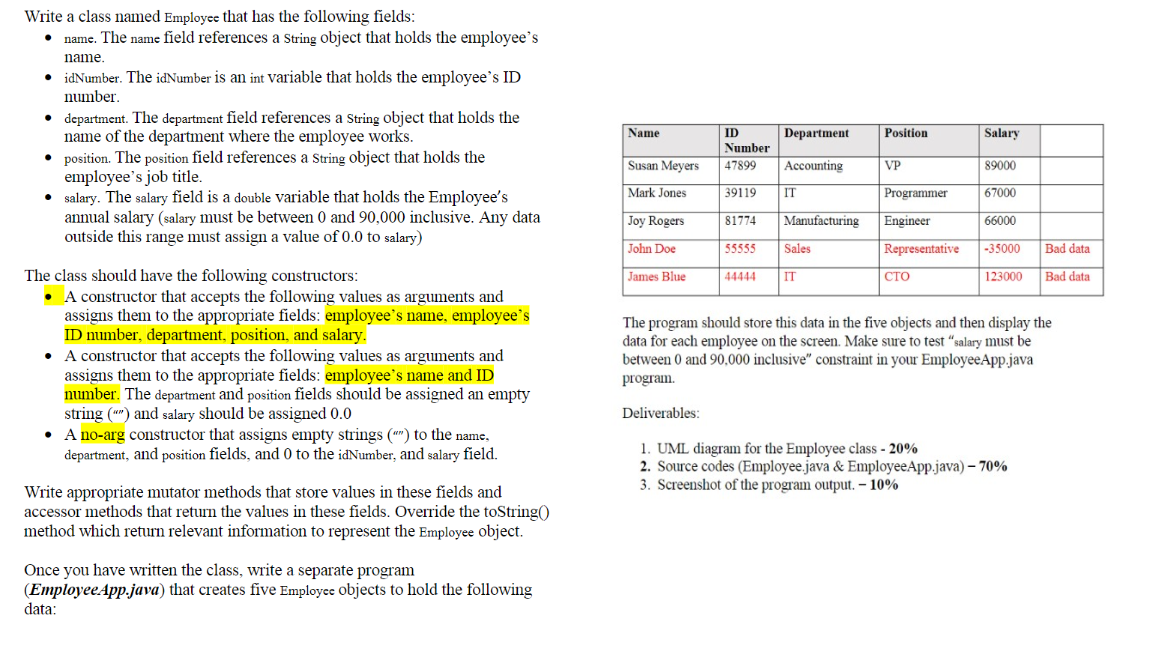
The program should store this data in the five objects and then display the
data for each employee on the screen. Make sure to test "salary must be
between and inclusive" constraint in your EmployeeApp.java
program.
Deliverables:
accessor methods that return the values in these fields. Override the toString
method which return relevant information to represent the Employee object.
Once you have written the class, write a separate program
EmployeeAppjava that creates five Employee objects to hold the following
data:
UML diagram for the Employee class
Source codes Employeejava & EmployeeApp.java
Screenshot of the program output.
Step by Step Solution
There are 3 Steps involved in it
1 Expert Approved Answer
Step: 1 Unlock

Question Has Been Solved by an Expert!
Get step-by-step solutions from verified subject matter experts
Step: 2 Unlock
Step: 3 Unlock
 Study Help