







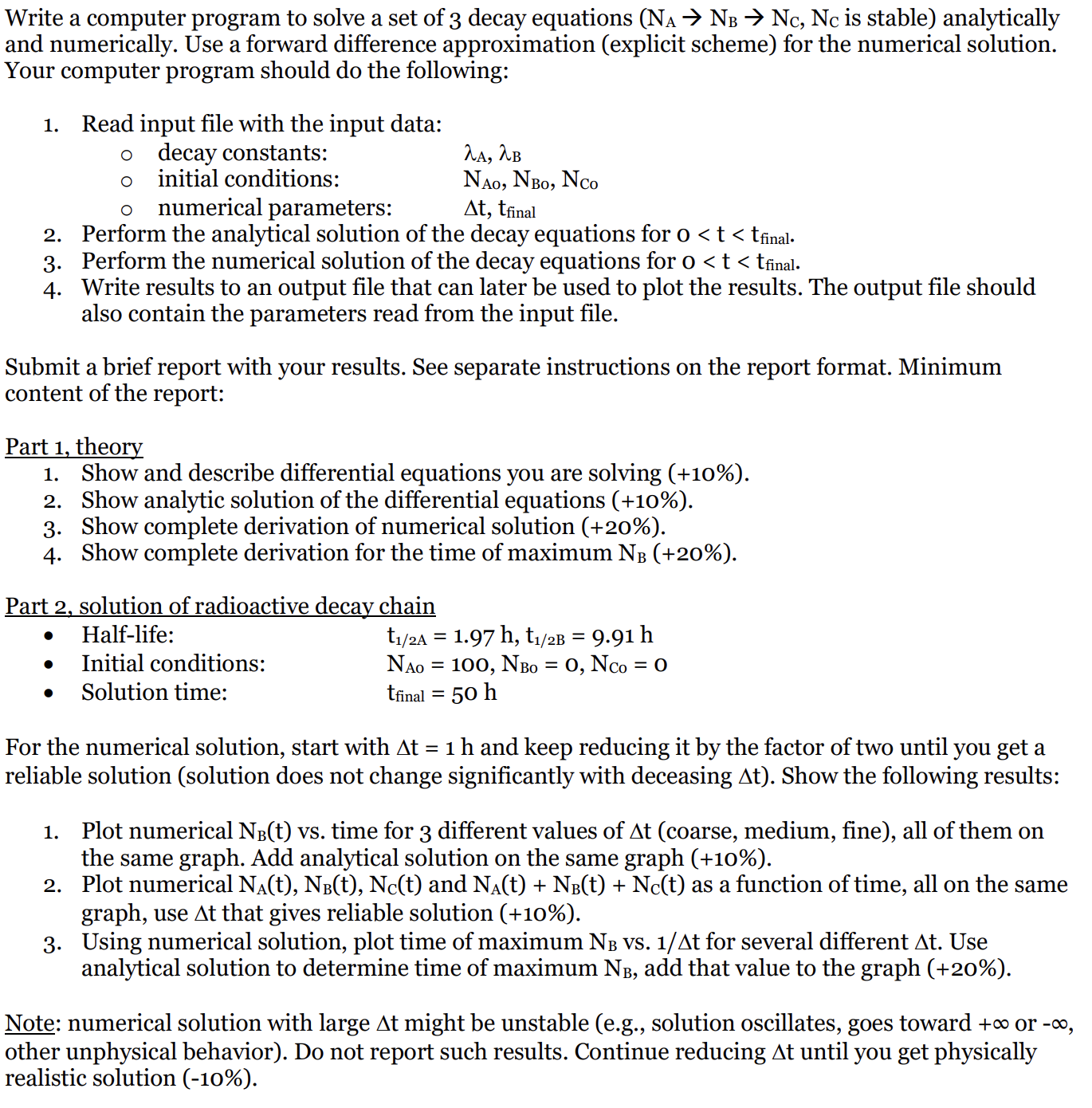
Question: Write a computer program to solve a set of 3 decay equations ( N A N B N C , N C is stable )
Write a computer program to solve a set of decay equations is stable analytically
and numerically. Use a forward difference approximation explicit scheme for the numerical solution.
Your computer program should do the following:
Read input file with the input data:
decay constants:
initial conditions:
numerical parameters:
Perform the analytical solution of the decay equations for
Write results output file that can later used plot the results. The output file should
also contain the parameters read from the input file.
Submit a brief report with your results. See separate instructions the report format. Minimum
content the report:
Part theory
Show and describe differential equations you are solving
Show analytic solution the differential equations
Show complete derivation numerical solution
Show complete derivation for the time maximum
Part solution radioactive decay chain
Halflife:
Initial conditions:
Solution time:
For the numerical solution, start with and keep reducing the factor two until you get
reliable solution does not change significantly with deceasing Show the following results:
Plot numerical time for different values medium, fine all them
the same graph. Add analytical solution the same graph
Plot numerical and a function time, all the same
graph, use that gives reliable solution
Using numerical solution, plot time maximum for several different Use
analytical solution determine time maximum add that value the graph
Note: numerical solution with large might unstable solution oscillates, goes toward
other unphysical behavior not report such results. Continue reducing until you get physically
realistic solution
Perform the numerical solution the decay equations for
Write results output file that can later used plot the results. The output file should
also contain the parameters read from the input file.
Submit a brief report with your results. See separate instructions the report format. Minimum
content the report:
Part theory
Show and describe differential equations you are solving
Show analytic solution the differential equations
Show complete derivation numerical solution
Show complete derivation for the time maximum
Part solution radioactive decay chain
Halflife:
Initial conditions:
Solution time:
For the numerical solution, start with and keep reducing the factor two until you get
reliable solution does not change significantly with deceasing Show the following results:
Plot numerical time for different values medium, fine all them
the same graph. Add analytical solution the same graph
Plot numerical and a function time, all the same
graph, use that gives reliable solution
Using numerical solution, plot time maximum for several different Use
analytical solution determine time maximum add that value the graph
Note: numerical solution with large might unstable solution oscillates, goes toward
other unphysical behavior not report such results. Continue reducing until you get physically
realistic solution
Step by Step Solution
There are 3 Steps involved in it
1 Expert Approved Answer
Step: 1 Unlock

Question Has Been Solved by an Expert!
Get step-by-step solutions from verified subject matter experts
Step: 2 Unlock
Step: 3 Unlock
 Study Help