







Question: Write a function that combines the positional arguments (*args) and keyword arguments (**kwargs) into a list of tuples. Each output tuple contains: the type of
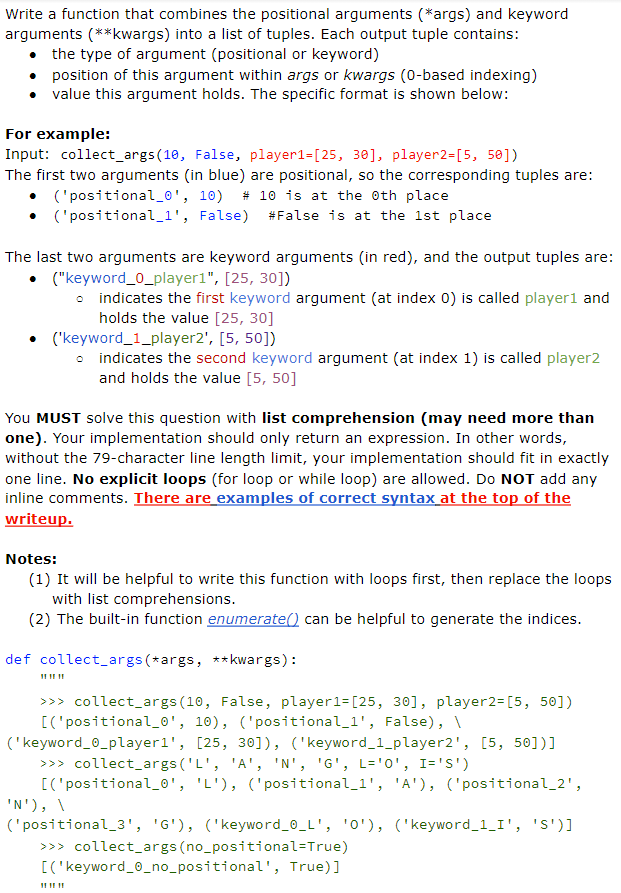
Write a function that combines the positional arguments (*args) and keyword arguments (**kwargs) into a list of tuples. Each output tuple contains: the type of argument (positional or keyword) position of this argument within args or kwargs (0-based indexing) value this argument holds. The specific format is shown below: For example: Input: collect_args (10, False, player1=[ 25, 30], player=[5, 50]) The first two arguments (in blue) are positional, so the corresponding tuples are: ('positional_o', 10) # 10 is at the oth place ('positional_l', False) #False is at the 1st place The last two arguments are keyword arguments (in red), and the output tuples are: ("keyword_0_player1", [25, 30]) o indicates the first keyword argument (at index 0) is called player1 and holds the value [25, 30] ('keyword_1_player2', [5, 50]) indicates the second keyword argument (at index 1) is called player2 and holds the value (5, 50] You MUST solve this question with list comprehension (may need more than one). Your implementation should only return an expression. In other words, without the 79-character line length limit, your implementation should fit in exactly one line. No explicit loops (for loop or while loop) are allowed. Do NOT add any inline comments. There are examples of correct syntax at the top of the writeup. Notes: (1) It will be helpful to write this function with loops first, then replace the loops with list comprehensions. (2) The built-in function enumerate() can be helpful to generate the indices. def collect_args (*args, **kwargs) : >>> collect_args (10, False, player1=[25, 30], player2=(5, 50]) [('positional_o', 10), ('positional_l', False), I ('keyword__playeri', [25, 30]), ('keyword_1_player2', [5, 50])] >>> collect_args('l', 'A', 'N', 'G', L='0', I='S') [('positional_o', 'L'), ('positional_1', 'A'), ('positional_2', 'N'), 1 ('positional_3', 'G'), ('keyword_O_L', '0'), ('keyword_1_I', 'S')] >>> collect_args (no_positional=True) [('keyword_0_no_positional', True)]
Step by Step Solution
There are 3 Steps involved in it

Get step-by-step solutions from verified subject matter experts
 Study Help