







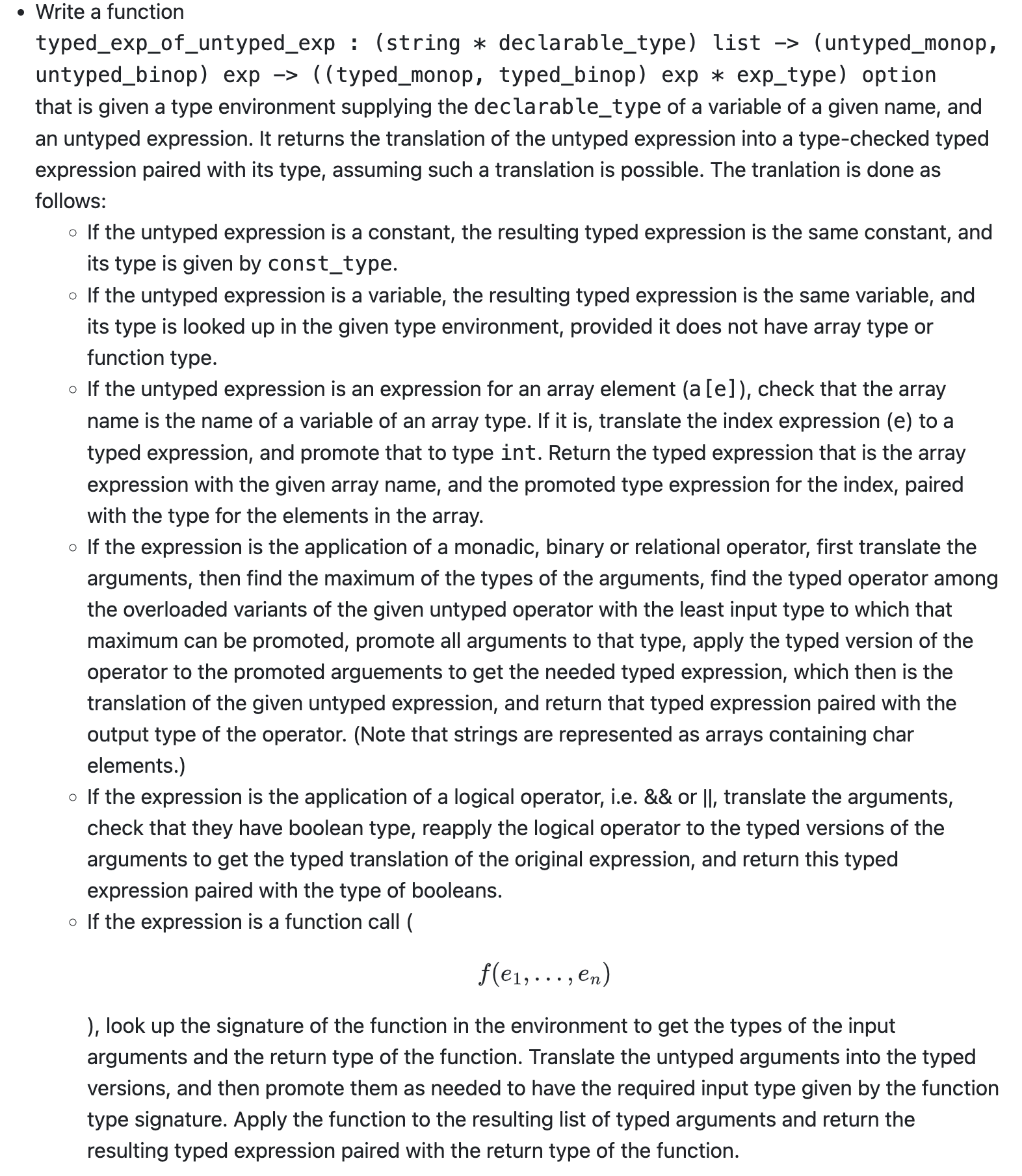
Question: Write a function typed _ exp _ of _ untyped _ exp : ( string * declarable _ type ) list - > ( untyped
Write a function
typedexpofuntypedexp : string declarabletype list untypedmonop,
untypedbinop exp typedmonop, typedbinop exp exptype option
that is given a type environment supplying the dec larabletype of a variable of a given name, and
an untyped expression. It returns the translation of the untyped expression into a typechecked typed
expression paired with its type, assuming such a translation is possible. The tranlation is done as
follows:
If the untyped expression is a constant, the resulting typed expression is the same constant, and
its type is given by consttype.
If the untyped expression is a variable, the resulting typed expression is the same variable, and
its type is looked up in the given type environment, provided it does not have array type or
function type.
If the untyped expression is an expression for an array element a e check that the array
name is the name of a variable of an array type. If it is translate the index expression e to a
typed expression, and promote that to type int. Return the typed expression that is the array
expression with the given array name, and the promoted type expression for the index, paired
with the type for the elements in the array.
If the expression is the application of a monadic, binary or relational operator, first translate the
arguments, then find the maximum of the types of the arguments, find the typed operator among
the overloaded variants of the given untyped operator with the least input type to which that
maximum can be promoted, promote all arguments to that type, apply the typed version of the
operator to the promoted arguements to get the needed typed expression, which then is the
translation of the given untyped expression, and return that typed expression paired with the
output type of the operator. Note that strings are represented as arrays containing char
elements.
If the expression is the application of a logical operator, ie && or II translate the arguments,
check that they have boolean type, reapply the logical operator to the typed versions of the
arguments to get the typed translation of the original expression, and return this typed
expression paired with the type of booleans.
If the expression is a function call
dots,
look up the signature of the function in the environment to get the types of the input
arguments and the return type of the function. Translate the untyped arguments into the typed
versions, and then promote them as needed to have the required input type given by the function
type signature. Apply the function to the resulting list of typed arguments and return the
resulting typed expression paired with the return type of the function.
Step by Step Solution
There are 3 Steps involved in it
1 Expert Approved Answer
Step: 1 Unlock

Question Has Been Solved by an Expert!
Get step-by-step solutions from verified subject matter experts
Step: 2 Unlock
Step: 3 Unlock
 Study Help